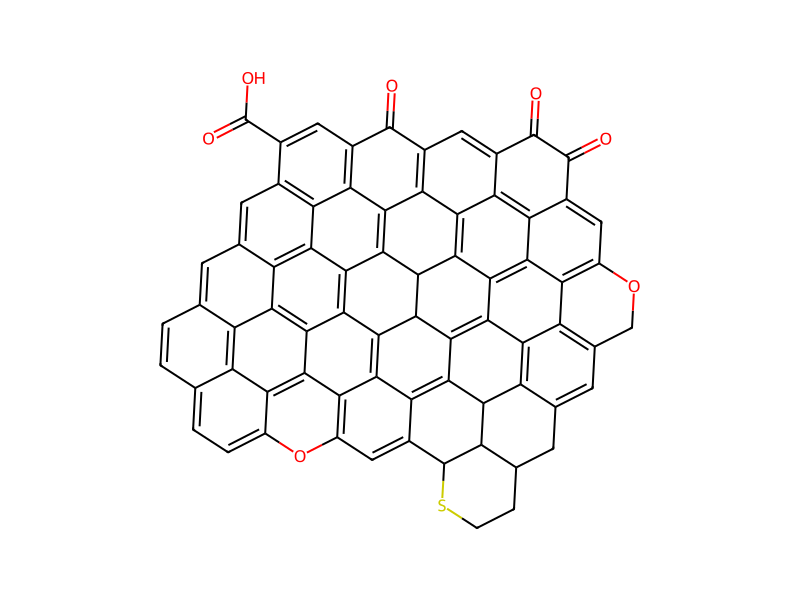
基本情報
- 標準SMILES
O=C(O)c1cc2c(=O)c3cc4c(=O)c(=O)c5cc6c7c8c(cc9c%10c8c8c%11c%12c(c3c3c%13c%14c%15c%16c%17c%18c(cc%19oc%20ccc%21ccc%22cc%23cc1c(c23)c%14c%23c1c%22c%21c%20c(c%19%17)c%151)C1SCCC(C9)C1C%10C=%18C=8C%16C%12%13)c4c5c%117)CO6- InChIKey
VNWKTOKETHGBQD-UHFFFAOYSA-N- 分子式
- C72H26O7S
- 平均分子量
- 1,035 g/mol
概要
Carbon black appears as odorless black pellets or extremely fine powder. Combustible solid that may contain flammable hydrocarbons. (NIOSH, 2024)
名称と識別子
- 優先名称
- Carbon Black
- 英語名
- Superba
- 分子量
- 0
名称と別名
名称をさらに表示
データベース識別子
- CAS
12768-98-8、1333-86-4、61512-59-2、97793-37-8- PubChem CID
- 172866199
- DTXSID
DTXSID7051216- UNII
- 4XYU5U00C4
- EC Number
- 215-609-9、603-226-3、612-159-9、619-291-6
物性
構造計算による物性
- XLogP
- 14.9
- 極性表面積
- 132 Ų
- 水素結合供与体数
- 1
- 水素結合受容体数
- 8
- 回転可能結合数
- 1
- 重原子数
- 80
- 形式電荷
- 0
- 複雑度
- 3,500
実験および物理化学的性質
Chemical Classes
Other Classes -> Elements, Nonmetallic
Carcinogens
Density
1.8 to 2.1 (NIOSH, 2024)
1.8-2.1
Relative density (water = 1): 1.8-2.1
1.8-2.1 @25 °C
1.8-2.1
Color/Form
Fine black powder
Black solid
Solubility
Insoluble (NIOSH, 2024)
INSOL IN ALL SOLVENTS
Insoluble in water
Solubility in water: none
Insoluble
Boiling Point
Sublimes (NIOSH, 2024)
4200 °C
sublimes
4200 °C @760 [mm Hg]
Sublimes
Melting Point
Sublimes (NIOSH, 2024)
Sublimes
≈3550 °C
sublimes
Sublimes
Vapor Pressure
0 mmHg (approx) (NIOSH, 2024)
Negligible at 20 °C
0 mmHg (approx)
0 mmHg (approx)
安全と法規制
GHS分類
GHS Classification
This chemical does not meet GHS hazard criteria for 70.9% (2922 of 4121) of all reports.
Warning
H351 (27.3%): Suspected of causing cancer [Warning Carcinogenicity]
P203, P280, P318, P405, and P501 (click each P-code to see the statement)
Aggregated GHS information provided per 4121 reports by companies from 50 notifications to the ECHA C&L Inventory.
Danger
危険有害性情報
Regulatory Information
Chemical: Carbon black
Regulation (EC) No 450/2009 (amended)
Carbon black is listed on the EPA's Chemical Data Reporting (CDR) system. Manufacturers and importers of Carbon black are required to report information about their production and use of this chemical to the EPA under the Toxic Substances Control Act (TSCA). (40 eCFR Part 711)
REACH registered substance: Carbon black (EC: 215-609-9)
Carbon black: HSNO Approval: HSR002801 Non hazardous
The New Jersey Worker and Community Right to Know Act requires public and private employers to provide information about hazardous substances at their workplaces. (N.J.S.A. 34:5A-1 et. seq.)
Fire Potential
SLIGHT, WHEN EXPOSED TO HEAT OR FLAME.
Carbon black can be ignited in the presence of open flames, and burns slowly with production of carbon monoxide.
Hazards Summary
The TLV Basis is bronchitis; Carbon black (CB) contains less than 0.3% extractable impurities; Workers who inhale CB have very low exposure to PAHs; Epidemiology studies have found an association with small opacities on chest x-ray, but there is doubt on their biological significance. Respiratory symptoms and chest x-ray abnormalities may be reversible after cessation of exposure; [ACGIH]
Special Reports
Boyland E; The Toxicology of Soot; NATO Conf Ser 6 7 (Soot Combust Syst Its Toxic Prop 13-24 (1983). A review and discussion with 19 references on the toxicology of soot, particularly with respect to carbon black.
Silva S et al; Carbon Black Pollution: Environmental Effects and Related Health Problems. Ann Fac Agrar (University Cattol Sacro Cuore) 22 (1): 131-41 (1982). Environmental effects and related health problems assoc with carbon black pollution are reviewed.
NIOSH; Criteria Document: Carbon Black (1978) DHEW Pub. NIOSH 78-204
European Commission, ESIS; IUCLID Dataset, Carbon Black (1333-86-4) (2000 CD-ROM edition).[Available from, as of March, 10 2009: http://esis.jrc.ec.europa.eu/]
FIFRA Requirements
Residues of carbon black are exempted from the requirement of a tolerance when used in accordance with good agricultural practice as inert (or occasionally active) ingredients in pesticide formulations applied to animals. Use: colorant/pigment in animal tags. Limit: none.
安全と保護具
First Aid Measures
Fresh air, rest.
Rinse and then wash skin with water and soap.
Rinse with plenty of water (remove contact lenses if easily possible).
Rinse mouth.
First Aid
Excerpt from NIOSH Pocket Guide for Carbon black:
(General first aid procedures)
Fire Fighting Procedures
If material on fire or involved in fire: Do not extinguish fire unless flow can be stopped Use water in flooding quantities as fog Solid streams of water may spread fire Cool all affected containers with flooding quantities of water Apply water from as far a distance as possible Use foam, dry chemical, or carbon dioxide
Storage Conditions
PRECAUTIONS FOR "CARCINOGENS": Storage site should be as close as practical to lab in which carcinogens are to be used, so that only small quantities required for ... expt need to be carried. Carcinogens should be kept in only one section of cupboard, an explosion-proof refrigerator or freezer (depending on chemicophysical properties ...) that bears appropriate label. An inventory ... should be kept, showing quantity of carcinogen & date it was acquired ... Facilities for dispensing ... should be contiguous to storage area. /Chemical Carcinogens/
Cleanup Methods
Electroflotation coagulation separation of carbon black from acetylene production wastewater was studied.
If carbon black is spilled or leaked, the following steps should be taken: Remove all ignition sources. Ventilate area of spill or leak. Carbon black dust may be collected by vacuuming with an appropriate high efficiency filtration system or by using wet methods; it should then be placed in an appropriate container. If a vaccum system is used, there should be no sources of ignition in the vicinity of the spill, and flashback prevention devices should be provided.
/SRP: If time permits, pits, ponds, lagoons, soak holes, or holding areas should be sealed with an impermeable flexible membrane liner./ Land spill - Dig a pit, pond, lagoon, holding area to contain liquid or solid material. Dike surface flow using soil, sand bags, foamed polyurethane, or foamed concrete. Absorb bulk liquid with fly ash, cement powder, or commercial sorbents.
Environmental considerations: Water spill Use natural barriers or oil spill control booms to limit spill travel. Remove trapped material with suction hoses.
For more Cleanup Methods (Complete) data for CARBON BLACK (6 total), please visit the HSDB record page.
Disposal Methods
SRP: The most favorable course of action is to use an alternative chemical product with less inherent propensity for occupational exposure or environmental contamination. Recycle any unused portion of the material for its approved use or return it to the manufacturer or supplier. Ultimate disposal of the chemical must consider: the material's impact on air quality; potential migration in soil or water; effects on animal, aquatic, and plant life; and conformance with environmental and public health regulations.
PRECAUTIONS FOR "CARCINOGENS": There is no universal method of disposal that has been proved satisfactory for all carcinogenic compounds & specific methods of chem destruction ... published have not been tested on all kinds of carcinogen-containing waste. ... summary of avail methods & recommendations ... /given/ must be treated as guide only. /Chemical Carcinogens/
PRECAUTIONS FOR "CARCINOGENS": ... Incineration may be only feasible method for disposal of contaminated laboratory waste from biological expt. However, not all incinerators are suitable for this purpose. The most efficient type ... is probably the gas-fired type, in which a first-stage combustion with a less than stoichiometric air:fuel ratio is followed by a second stage with excess air. Some ... are designed to accept ... aqueous & organic-solvent solutions, otherwise it is necessary ... to absorb soln onto suitable combustible material, such as sawdust. Alternatively, chem destruction may be used, esp when small quantities ... are to be destroyed in laboratory. /Chemical Carcinogens/
PRECAUTIONS FOR "CARCINOGENS": HEPA (high-efficiency particulate arrestor) filters ... can be disposed of by incineration. For spent charcoal filters, the adsorbed material can be stripped off at high temp & carcinogenic wastes generated by this treatment conducted to & burned in an incinerator. ... LIQUID WASTE: ... Disposal should be carried out by incineration at temp that ... ensure complete combustion. SOLID WASTE: Carcasses of lab animals, cage litter & misc solid wastes ... should be disposed of by incineration at temp high enough to ensure destruction of chem carcinogens or their metabolites. /Chemical Carcinogens/
For more Disposal Methods (Complete) data for CARBON BLACK (6 total), please visit the HSDB record page.
Spillage Disposal
Personal protection: complete protective clothing including self-contained breathing apparatus. Sweep spilled substance into covered containers. If appropriate, moisten first to prevent dusting. Carefully collect remainder. Then store and dispose of according to local regulations.
Preventive Measures
SRP: Local exhaust ventilation should be applied wherever there is an incidence of point source emissions or dispersion of regulated contaminants in the work area. Ventilation control of the contaminant as close to its point of generation is both the most economical and safest method to minimize personnel exposure to airborne contaminants.
SRP: The scientific literature for the use of contact lenses in industry is conflicting. The benefit or detrimental effects of wearing contact lenses depend not only upon the substance, but also on factors including the form of the substance, characteristics and duration of the exposure, the uses of other eye protection equipment, and the hygiene of the lenses. However, there may be individual substances whose irritating or corrosive properties are such that the wearing of contact lenses would be harmful to the eye. In those specific cases, contact lenses should not be worn. In any event, the usual eye protection equipment should be worn even when contact lenses are in place.
... SUBSTITUTION OF LESS IRRITATING SUBSTANCES ... REDESIGN OF OPERATIONS ... PREVENT CONTACT, PROVISION OF A PHYSICAL BARRIER AGAINST CONTACT, PROPER WASHING FACILITIES, WORK CLOTHING AND STORAGE FACILITIES, PROTECTIVE CLOTHING, AND BARRIER CREAMS. MEDICAL CONTROL ...
The employer shall ensure that respirators are adequately maintained, and stored in a dust free condition and that employees are instructed and drilled at least annually in the proper use, fit, and testing for leakage of respirators assigned to them. ... The employer shall ensure that, at the conclusion of the workshift, all clothing is removed only in change rooms. ... And that contaminated protective clothing that is to be cleaned, laundered, or disposed of is placed in a closed container in the change room.
For more Preventive Measures (Complete) data for CARBON BLACK (21 total), please visit the HSDB record page.
毒性情報
Interactions
It was concluded that carbon black distributed throughout the lung tissue provided a greater contact surface area for the adsorbed carcinogen benzopyrene and facilitated the increased desorption and resorption of the carcinogen. Justification for this conclusion was based on the observation that tumor production occurred only in the groups of rats that received benzopyrene adsorbed on carbon blacks. Although this may be a valid conclusion, carbon black also might have acted as an irritant promoter in the groups that received benzopyrene adsorbed on carbon black.
It was noted that some of the 3,4-benzopyrene in ... acetone solution acted as a free carcinogen /when 240 mice were painted with 3,4-benzopyrene adsorbed onto carbon black/, because this solvent eluted 10-23% of the adsorbed cmpd from carbon black. Dry powders of adsorbed and unadsorbed carcinogens were also tested, and it was found that, after 24 mo, none of the mice rubbed with either dry adsorbed carcinogen or dry carbon black developed any tumors. Twelve percent of the mice treated with dry unadsorbed carcinogen developed tumors. It was concluded that the carbon blacks tested did effectively block the carcinogenicity of 3,4-benzopyrene, although in differing degrees.
... The interaction effects of a single intratracheal instillation of ultrafine carbon black (CB) particles and staphylococcal lipoteichoic acid (LTA) on early pulmonary inflammation in male BALB/c mice /were studied/. ... The cellular profile, cytokine and chemokine levels in the bronchoalveolar lavage (BAL) fluid, and expression of chemokine and toll-like receptor (TLR) mRNAs in lungs /were measured/. LTA produced a dose-related increase in early pulmonary inflammation, which was characterized by (1) influx of polymorphonuclear neutrophils (PMNs) and (2) induction of interleukin (IL)-6, tumor necrosis factor (TNF)-alpha, macrophage inflammatory protein (MIP)-1alpha/CCL3, but no effect on monocyte chemoattractant protein (MCP)-1/CCL2 at 24 hr after instillation. Levels of some proinflammatory indicators and TLR2-mRNA expression were significantly increased by 14 nm or 95 nm CB (125 ug) and low-dose LTA (10 ug) treatment compared to CB or LTA alone at 4 hr after instillation. Notably, PMN levels and production of IL-6 and CCL2 in the 14 nm CB + LTA were significantly higher than that of 95 nm CB + LTA at 4 hr after instillation. However, at 24 hr after instillation, only PMN levels were significantly higher in the 14 nm CB + LTA than 95 nm CB + LTA but not the cytokines and chemokines. These data show additive as well as synergistic interaction effects of 14 nm or 95 nm ultrafine CB particles and LTA. /It was suggested/ that early pulmonary inflammatory responses in male BALB/c mice may be induced in a size-specific manner of the CB particles used...
... Respiratory syncytial virus (RSV) is the major cause of bronchiolitis and pneumonia in infants and may lead to the development of asthma in childhood. To determine whether particle exposure modulates the immune response to RSV, eight-week-old female BALB/c mice received an intratracheal (it) instillation of either 40 ug ultrafine carbon black (CB) particles or vehicle. The following day, mice were intratracheally instilled with either 106 pfu RSV or uninfected media. End points were examined 1, 2, 4, 7, and 10 days during RSV infection. Compared with RSV alone, tumor necrosis factor-alpha (TNF-alpha) protein was reduced in the bronchoalveolar lavage fluid (BALF) on days 1 and 2 of infection; there was also a reduction in BALF lymphocyte numbers on day 4, which correlated with reductions in both IFN-gamma-inducible protein (IP-10), lymphotactin, and IFN-gamma mRNAs in the lungs of RSV + CB mice. Multiprobe ribonuclease protection assays of RSV + CB lung tissue showed no changes in the RSV-associated chemokines regulated upon activation, normal T cell expressed and secreted (RANTES), eotaxin, monocyte chemoattractant protein (MCP-1), macrophage inflammatory protein (MIP)-1 alpha or MIP-1 beta. Viral titers in RSV + CB mice were lower than RSV on days 2-4 of infection. By day 7 of infection, however, neutrophil numbers, proinflammatory cytokine mRNA expression, and protein levels of TNF-alpha and the Th2 cytokine interleukin (IL)-13 were increased in the lungs of RSV + CB mice, indicating an exacerbation of infection. These data indicate that preexposure to ultrafine particles induces an inflammatory milieu promoting allergic immune responses rather than IFNgamma production necessary for microbial defense.
Male Wistar rats were treated by ozone or carbon black (CB) alone as well as in combination. Intratracheal instillation with various amounts of CB was followed either by an acute 7-day or subchronic 2-month ozone exposure (0.5 ppm). Two functional parameters were investigated in alveolar macrophages from bronchoalveolar lavagates, the phagocytotic capacity and the chemotactic migration capability. In the phagocytosis assay, the percentage of phagocytizing macrophages decreased significantly in the CB-exposed groups whereas the ozone groups remained close to or at the control level after 7 days and 2 months of exposure, respectively. The number of ingested particles per macrophage and the formation of superoxide anion radicals were not changed after a 7-day exposure to ozone compared to the control group but were increased after a 2-month ozone exposure. However, a reduction was found in the CB groups. A stimulating effect of ozone was observed in the combined groups. Chemotactic migration was generally retarded in the CB-treated groups. From the results it can be concluded that ozone is able to stimulate the phagocytotic and chemotactic activity of alveolar macrophages whereas CB impairs these functions.
Exposure Routes
The substance can be absorbed into the body by inhalation.
inhalation, skin and/or eye contact
Signs and Symptoms
Cough.
Redness.
Cough; irritation eyes; in presence of polycyclic aromatic hydrocarbons: [potential occupational carcinogen]
Medical Surveillance
Preplacement or initial examinations shall include at least: 1) Comprehensive medical histories with special emphasis directed towards identifying existing disorders of the respiratory system, heart, and skin; comprehensive work histories to determine previous occupational exposure to potential respiratory and skin irritants and pulmonary carcinogens; and smoking and tobacco histories. 2) Physical examination with special attention to the upper and lower respiratory tract, heart, skin, and mucous membranes of the oral cavity. Skin and oral examinations should be specially directed to any preneoplastic and neoplastic lesions. 3) Specific clinical tests, including at least a 35 x 42 cm posteroanterior and lateral chest roentgenogram and pulmonary function tests including forced vital capacity (FVC), forced expiratory volume in 1 sec (FEV 1), electrocardiograms (ECGs) and sputum cytology. 4) A judgement of the employee's ability to use positive and negative pressure respirators. Periodic examinations shall be made at least annually. Roentgenographic examinations shall be made available for workers occupationally exposed to carbon black containing > 0.1% polycyclic aromatic hydrocarbons annually and for workers occupationally exposed to carbon black containing less than 0.1% polycyclic aromatic hydrocarbons every 3 yr. These examinations shall include at least: 1) Interim medical and work histories; 2) Physical exam and clinical tests as described above.
Periodic examinations: Chest X-rays should be taken annually if the carbon black contains more than 0.1% cyclohexanone extractable material, or every 3 yr if the carbon black contains 0.1% cyclohexane extractable material or less, and pulmonary function tests, ECGs and examination of the skin and oral cavities of workers will help detect any occupationally related illness that might otherwise go undetected because of either delayed toxic effects or the subtlety of the changes. Special medical attention should be given to workers exposed to carbon black containing more than 0.1% cyclohexane extractable material, because of the possiblity of neoplasms of the skin, oral mucosa, or respiratory tract.
Carbon black production facility employees (1755) participated in the third round of the industry-wide medical surveillance testing. They were employed in 22 North American plants. Spirometry and a systematically administered questionnaire were included in the year 2000 round of the industry-wide medical surveillance program. Industrial hygiene data from an industry-wide survey in 2000-2001, as well as all available exposure assessment data collected since 1979, were integrated with process questionnaires and exposure rating questionnaires completed by plant personnel. Analyses included multiple linear regression and categorical data analyses. Multiple regression analyses showed statistically significant, consistent relationships between cumulative exposure and small reductions in forced expiratory volume in 1 second (FEV1) but not with other spirometry parameters. The estimated slopes were -2 mL FEV1 per mg-year/cu m of cumulative total dust exposure and -0.7 mL FEV1 per mg-year/cu m of cumulative exposure for the inhalable fraction. In addition, heavy cumulative exposures were associated with a small increase in chronic bronchitis in nonsmokers. Recent exposures, typically much lower than in the past, were not demonstrated to be associated with these effects. Consistent with good occupational hygiene practice for any contaminant, workplace exposures to carbon black should be controlled to lowest practical levels.
... Longitudinal analyses were carried out on data from workers in the European carbon black manufacturing industry who provided three full-size chest radiographs sequentially between 1987-1995. All chest radiographs were independently read by three experienced readers according to the International Labour Organisation (ILO) classification. After exclusion of participants with previous lung diseases or injuries, females, unreadable chest radiographs and from factories with a low participation rate, data from 675 workers were available for the longitudinal analyses. An association was observed between cumulative carbon black exposure and new cases of chest radiograph abnormalities (ILO category > or = 1/0) and progression in small opacities. These associations were mainly related to changes in chest radiographs from workers at one factory. A large percentage of workers with chest radiograph abnormalities reversed to normal chest films; however, after adjusting for other factors, this was not associated with levels of exposure to carbon black dust. In conclusion, the results show that exposure to carbon black is associated with increased risk of chest radiographic abnormalities, which may be reversible after reduction or cessation of exposure.
For more Medical Surveillance (Complete) data for CARBON BLACK (8 total), please visit the HSDB record page.
Human Toxicity Excerpts
/HUMAN EXPOSURE STUDIES/ Non-cancer respiratory effects in carbon black workers that have been reported include cough, sputum production, bronchitis, chest radiographic opacities (eg, pneumoconiosis) and decrements in lung function.
/SIGNS AND SYMPTOMS/ Carbon black used as pigment in ... liq eye liners & mascara, has produced black pigmentation of palpebral conjunctiva at the upper tarsal border after regular application ... /for @ least 2 yr./ ... Although there is lymphocytic infiltration & pigment is taken up by macrophages, deposits cause essentially no symptoms.
/SIGNS AND SYMPTOMS/ Long-term (chronic): Inhalation of carbon black can cause cough, phlegm, tiredness, chest pain, and headache. Dermal, mucosal, or inhalation exposure can cause irritation.
/SIGNS AND SYMPTOMS/ ... Most reports describe the effect of carbon black on the lung of human's certain changes which are typical for pneumoconiosis and changes that are suspected to become pneumoconiosis in the future. There were many studies describing carbon black pneumoconiosis from 1951 to 1994. This disease, therefore, has been considered as an occupational disease of workers exposed to carbon black in its production and usage.
For more Human Toxicity Excerpts (Complete) data for CARBON BLACK (49 total), please visit the HSDB record page.
Artificial Pollution Sources
Particulate emissions from portable space heaters ... .
In the thermal and furnace process plants, systems of electrostatic precipitators, cyclones, and bag filters will collect over 99% of the black. The general procedure is to burn the waste gases from the furnace process after the black has been removed; the major /air/ pollutants after this has been completed are carbon and, if a sulfur containing fuel had been used, sulfur dioxide. ... In the channel process, the carbon is collected by impingement on long channel irons. Much of the carbon does not impinge in this way, however, and can escape to the atmosphere.
Sources of carbon black to the atmosphere other than from production processes mainly arise throughout maintenance procedures, leaks in plant conveying systems, or loading and unloading operations.
Since the bulk of carbon black produced is utilized as a reinforcing agent for rubber tires, the ultimate /release/ of carbon black into the environment comes through tire wear.
As automobiles passed a measuring point, the concentrations of carbon dioxide and aerosol black carbon in their dispersing exhaust plumes wer recorded. After subtraction of background levels, the ratio of the increments of the species allows a calculation of the emission factor of aerosol black carbon per unit mass of fuel from each individual vehicle. These factors spanned a range of greater than two orders of magnitude, representing the emission of aerosol black carbon per gram of carbon consumed in the fuel. Their distribution showed that 20% of the vehicles accounted for 65% of the emissions. The real time measurement methodology allows for a determination of the distribution of emission factors across the actual population of sources. These results are similar to the wide range of carbon monoxide emission factors reported recently.
Carcinogen Classification
Carbon black
Group 2B: Possibly carcinogenic to humans
Volume Sup 7: Overall Evaluations of Carcinogenicity: An Updating of IARC Monographs Volumes 1 to 42, 1987; 440 pages; ISBN 92-832-1411-0 (out of print)
2010
2006
Non-Human Toxicity Excerpts
/LABORATORY ANIMALS: Acute Exposure/ Ultrafine carbon black (ufCB) 14 nm in diameter and fine carbon black (CB) 260 nm in diameter were instilled intratracheally in rats at mass of 125 ug, and the bronchoalveolar lavage (BAL) profile at 6 hr was assessed. UfCB generated a 50% neutrophil alveolitis 6 hr after intratracheal instillation compared to CB, which showed similar activity to the phosphate-buffered saline (PBS) vehicle control. UfCB instillation also produced a marked increase in lactate dehydrogenase (LDH) levels in BAL fluid, which was associated with increased epithelial permeability measured as total protein. In contrast, CB had much less of an effect in increasing BAL protein. Although both particle types caused a decrease in glutathione (GSH) in lung tissue compared to control, the greatest depletion was seen in ufCB-treated animals. To investigate time response, bronchoalveolar lavage was carried out at 6 hr, 24 hr, and 7 days after a single 125-ug instillation of ufCB. Neutrophil influx was relatively persistent and was still maintained 7 days later. Tumor necrosis factor (TNF) production by BAL leukocytes increased gradually postinstillation, whereas nitric oxide production became significantly higher at 24 h after instillation and remained at raised levels up to 7 days. Higher doses of CB caused more inflammation than the ufCB. Thus, in the instillation model, a localized dose of particle over a certain level causes the particle mass to dominate the response, rather than the surface area. In contrast to the effect of CB, which showed a dose-related increasing inflammatory response, ufCB at the highest dose caused less of a neutrophil influx than at the lower dose. Six hours after intratracheal instillation, the threshold dose for neutrophil influx occurred at 50 ug. Calculation of surface area of particles instilled suggested that this was likely to be an overload-inducing dose of particles, as gauged from recent experiments with inhaled particles. In summary, this study provides evidence in a rat instillation model that ufCB has greater ability than CB to produce lung inflammation and oxidant stress at a relatively low dose of 125 ug. At high doses, however, BAL is not a reliable indicator of pulmonary response, since the overall response seems to scale to mass or volume of instilled particulate without an influence of surface area.
/LABORATORY ANIMALS: Acute Exposure/ Daily exposure to particulate matter (PM) is known to adversely affect cardiac function and is also known to be exaggerated with senescence. This study tests the hypothesis that cardiac function is uniquely altered by PM exposure in senescent mice. A mechanism for PM-induced cardiac effects is also postulated by examining the activity of nitric oxide synthase (NOS) and the generation of reactive oxygen species (ROS) in heart tissue. Echocardiography is performed in awake 18- and 28-mo-old mice at baseline and immediately following 3-hr exposures to either filtered air or carbon black (CB; approximately 400 ug/cu m) on 4 days. At 28 mo, left ventricular diameter at end-systole and end-diastole is significantly (P < 0.05) elevated, and fractional shortening is significantly reduced (49 +/- 3% vs. 56 +/- 3%) with CB exposure. In vivo hemodynamic measurements at 28 mo also demonstrate significant (P < 0.05) reductions in ejection fraction and increases in right ventricular and pulmonary vascular pressures following CB exposure. Functional changes at 28 mo are associated with increased ROS production as suggested by enhanced luminol activity. This elevated ROS production with aging and CB exposure is attributable to NOS uncoupling. Measurements of natriuretic peptide (atrial and brain) transcription and matrix metalloproteinase (MMP2 and MMP9) activity in heart tissue are significantly (P < 0.05) amplified with senescence and exposure to CB, pointing to increased cardiac stress and remodeling. These results demonstrate that acute PM exposure reduces cardiac contractility in senescent mice, and this decline in function is associated with increased ROS production linked to NOS uncoupling.
/LABORATORY ANIMALS: Acute Exposure/ /It was/ hypothesized that heart-rate regulation during particulate matter (PM) exposure differs with senescence-dependent susceptibility owing to variation in autonomic nervous control. Heart rate (HR) and heart-rate variability (HRV) parameters were measured from 162 samples of 2-min electrocardiograph (ECG) recordings in age-matched healthy (n = 5) and terminally senescent (n = 3) AKR mice during 3-hr exposures to filtered-air (FA, day 1) and carbon black (CB, day 4; <200 microg/m(3)). On day 1, HR was significantly (p <.01) depressed during FA in terminally senescent mice. By day 4, HR was further slowed significantly (p <.01) due to the effects of CB exposure for 3 days. The combined effects of terminal senescence and CB exposure acted to depress HR to an average (+/-SEM) 445 +/- 40 bpm, or approximately 80 bpm lower compared to healthy HR responses. The change in rMSSD, an HRV parameter corresponding to relative influences of parasympathetic tone on HR, was significantly (p <.01) greater on day 1 and day 4 in terminally senescent mice compared to healthy mice. In contrast, the LF/HF ratio, an HRV parameter derived from spectral analysis indicating relative changes in cardiac sympathetic tone, was significantly (p <.01) depressed in terminally senescent mice on day 1. By day 4, significant increases in LF/HF were evident in healthy mice during CB exposure, suggesting that HR regulation was associated with an increase in sympathetic tone. Alternatively, terminally senescent mice appeared to modulate a lower HR without change in LF/HF ratio during CB exposure, suggesting an absence of sympathetic tone. In conclusion, older healthy mice increase cardiac sympathetic tone during PM exposure while terminally senescent mice show a greater PM-induced parasympathetic tone in regulating HR. The significance of the current results suggest that PM-induced HR regulatory changes may ultimately depend on the degree of physiological aging.
/LABORATORY ANIMALS: Acute Exposure/ Rats were instilled with fine and ultrafine carbon black and titanium dioxide. Inflammation was quantified by bronchoalveolar lavage; the ability of the macrophages to phagocytoses indictor fluorescent beads and to migrate towards aC5a were determined. ... Ultrafine particles induced more PMN recruitment, epithelial damage, and cytotoxicity than their fine counterparts, exposed at equal mass. Both ultrafine and fine particles significantly impaired the phagocytic ability of alveolar macrophages. Only ultrafine particle treatment significantly enhanced the sensitivity of alveolar macrophages to chemotact towards C5a. ...
For more Non-Human Toxicity Excerpts (Complete) data for CARBON BLACK (53 total), please visit the HSDB record page.
Populations at Special Risk
... Lung diseases or conditions may influence the deposition and retention of particles such as carbon black. For instance, asthmatics had a higher total deposition of ultrafine carbon particles in the respiratory tract compared with healthy individuals. ...
法規制情報
FIFRA Requirements
Residues of carbon black are exempted from the requirement of a tolerance when used in accordance with good agricultural practice as inert (or occasionally active) ingredients in pesticide formulations applied to animals. Use: colorant/pigment in animal tags. Limit: none.
化学と産業
薬理情報
Mechanism of Action
Macrophages were treated with carbon black and carbon black adsorbate complexes to determine whether the presence, identity and coverage of the adsorbate altered the phagocytic ingestion of the carbon black particles. This study was performed to determine the effect of such treatment on the capacity of the macrophages to phagocytize a secondary particle challenge via its Fc membrane receptor. Rat alveolar macrophages were incubated in vitro with two carbon blacks that had 15 fold differences in specific surface areas (ASTM-N339 less than Black-Pearls-2000) sorbed with 0.5 and 1.0 monolayer coverages of a polar and semi polar adsorbate; acrolein and benzofuran. One half monolayer coverages of N339 with either adsorbate significantly suppressed the phagocytosis of the carbon black, whereas one monolayer coverage did not. Neither adsorbate at either coverages affected the phagocytosis of Black-Pearls-2000. It was concluded that these results indicate that the surface properties of the particles, the chemical properties of chemical pollutants, and the interactions between particles and pollutants can play a major role in defining the biological effects of particles that are carried to the distal lung.
The desorption of adsorbed molecules from amorphous carbon black was investigated. Five oil furnace carbon blacks consisting of pelletized agglomerates of 0.20 to 0.24 nanometer aciniform particles and 13 adsorbates were used. The adsorbates consisted of organic compounds containing functional groups characteristic of organic molecules formed on particles generated by combustion of organic material. The carbon blacks were incorporated into liquid chromatographic columns. n-Hexane, dichloromethane, tetrahydrofuran, methanol, and water were used as mobile phases. Ten microliter sample aliquots were injected into the chromatographs. The data showed that the adsorbates displaced the mobile phase molecules from the surface. The extent of desorption increased with increasing solubility of the adsorbate in the mobile phase. Desorption also depended on the heat of desorption. With the exception of basic adsorbates adsorbed on the least polar carbon black, N765, most of the compounds were adsorbed irreversibly when the mobile phase was water. The adsorption isotherms showed that desorption depended on the extent of surface coverage and increased as the extent of coverage approached one monolayer. It was concluded that adsorbed molecules are desorbed from particulate surfaces to different extents, the amount desorbed depending on the polarity of the physiological fluid that interacts with the surface. Desorption also depends on the extent of adsorbent surface covered.
Exposure to ambient ultrafine particles induces airway inflammatory reactions and tissue remodeling. In this experiment, to determine whether ultrafine carbon black (ufCB) affects proliferation of airway epithelium and, if so, what the mechanism of action is, ... human primary bronchial epithelial cell cultures /were studied/. Incubation of cells in the serum-free medium with ufCB increased incorporations of [(3)H]thymidine and [(3)H]leucine into cells in a time- and dose-dependent manner. This effect was attenuated by Cu- and Zn-containing superoxide dismutase (Cu/Zn SOD) and apocynin, an inhibitor of NADPH oxidase, and completely inhibited by pretreatment with the epidermal growth factor receptor (EGF-R) tyrosine kinase inhibitors AG-1478 and BIBX-1382, and the mitogen-activated protein kinase kinase inhibitor PD-98059. Transfection of a dominant-negative mutant of H-Ras likewise abolished the effect ufCB. Stimulation with ufCB also induced processing of membrane-anchored proheparin-binding (HB)-EGF, release of soluble HB-EGF into the medium, association of phosphorylated EGF-R and Shc with glutathione-S-transferase-Grb2 fusion protein, and phosphorylation of extracellular signal-regulated kinase (ERK). Pretreatment with AG-1478, [Glu(52)]Diphtheria toxin, a specific inhibitor of HB-EGF, neutralizing HB-EGF antibody, Cu/Zn SOD, and apocynin each inhibited ufCB-induced ERK activation. These results suggest that ufCB causes oxidative stress-mediated proliferation of airway epithelium, involving processing of HB-EGF and the concomitant activation of EGF-R and ERK cascade.
... Ultrafine carbon black (ufCB) does not have its effects via transition metal-mediated mechanisms. However, ufCB and other ultrafines generate free radicals at their surface as measured by a number of chemical assays and are able to cause oxidative stress to cells and this is likely to be a factor in their ability to cause inflammation. Changes in calcium resulting from oxidative stress within cells may be an additional factor leading to transcription of pro-inflammatory genes...
Absorption, Distribution and Excretion
Uptake and retention of carbon black particles in lung macrophages have been observed following inhalation ... as well as following injection into the cerebral ventricles of rats ... or into the bladder wall of rats. ... Carbon black particles perfused into the abdominal aorta of rabbits were observed in the endothelial cells of the vessel.
Particles were found in phagocytic cells in the proximal convoluted tubules and glomeruli of the kidneys in mice, together with amyloidosis and renal fibrosis. It was later reported that carbon black particles also accumulated in the lungs of exposed monkeys (total duration of exposure, 5784 hr) ...
Mice (for their lifespan), guinea pigs, and monkeys (up to 13,000 total hr) were exposed to 1.6 mg/cu m of various types of furnace blacks for 7 hr/day, 5 days/wk. ... Carbon black was found scattered in lung tissue, both free-lying and inside macrophages (scavenger cells). In mice, the black was diffuse and finely distributed, while monkeys progressively developed diffusely distributed areas of nodularity where the black was concentrated. ... Carbon black was observed to infiltrate the pulmonary lymph nodes, and was also present in the liver, spleen, and kidneys of exposed animals.
The effect of continuous exposure to inert carbonaceous particles on the pulmonary clearance of inhaled diesel tracer particles was studied in male Fischer 344 rats. Submicron carbon black particles with a mass median aerodynamic diameter of 0.22 um and having a size distribution similar to those particles from a GM 5.7 liter diesel engine were successfully generated and admin to test animals at a nominal concn of 6 mg/cu m for 20 hr/day, 7 day/wk, for periods lasting 1 to 11 wk. Immediately after the carbon black exposure, test animals were admin (14)C tagged diesel particles for 45 min in a nose only chamber. The pulmonary retention of inhaled radioactive tracer particles was determined at preselected time intervals. Based upon the data collected up to six months post exposure, prolonged exposure to carbon black particles exhibits the same inhibitory effect on pulmonary clearance as prolonged exposure to diesel exhaust with a comparable particulate dose. This observation, coupled with the observation that continuous exposure to nitrogen oxide at 2 ppm produced no significant incr on the pulmonary retention of radioactive diesel test particles, indicates that the accumulation of inert carbonaceous material is the predominant cause of impaired lung clearance.
For more Absorption, Distribution and Excretion (Complete) data for CARBON BLACK (10 total), please visit the HSDB record page.
用途と製造
Uses
Used mainly in rubber (90%) and as a pigment (9%); [ACGIH] Carbon black is a manufactured material while soot is a waste product of combustion. Compared to soot, carbon black particles are more homogeneous and less biologically active. [AIHAJ 2001;62(2):218-28]
Painting (Pigments, Binders, and Biocides) [Category: Paint]
Lithography printing [Category: Hobbies]
USED AS A PIGMENT FOR RUBBER TIRES, FOR PRINTING, STENCILING & DRAWING INKS; FOR LEATHER, STOVE POLISH, PHONOGRAPH RECORDS, FOR ELECTRICAL INSULATING APPARATUS.
CHEMICAL REDUCING AGENT
Finely divided carbon black is a plastics stabilizer from uv radiation.
Impurities
Benzene extract, 0-1.7%; Ash, 0-1.0%; Sulfur, 0-1.5% volatile matter, 0.4-9.0%
Polyaromatic hydrocarbons (PAH) are reportedly present in carbon blacks ... . /Carbon blacks/
U.S. Exports
(1972) 5.05X10+10 G
(1975) 4.0X10+10 G
CHEMICAL PROFILE: Carbon black. US Exports: 2003: 393 million pounds; 2004: 391 million pounds
CHEMICAL PROFILE: Carbon black. US Exports: 2006: 326 million pounds; 2007: 351 million pounds
U.S. Imports
(1972) 5.22X10+8 G
(1975) 1.50X10+10 G
CHEMICAL PROFILE: Carbon black. US Imports: 2003: 631 million pounds; 2004: 439 million pounds
CHEMICAL PROFILE: Carbon black. US Imports: 2006: 343 million pounds; 2007: 363 million pounds
U.S. Production
2023: 4,000,000,000 - <5,500,000,000 lb
(1972) 1.45X10+12 G
(1975) 1.25X10+12 G (EXCLUDING CHANNEL PROCESS)
(1985) 1.17X10+12 g
(1991) 3.40x10+9 lbs
For more U.S. Production (Complete) data for CARBON BLACK (20 total), please visit the HSDB record page.
Consumption Patterns
94% IS USED IN ELASTOMERS (OF WHICH 12% IS USED IN MASTERBATCHED STYRENE-BUTADIENE RUBBER ELASTOMERS); 3% IS USED IN PAINT & PRINTING INKS; AND 3% IS USED IN OTHER APPLICATIONS, INCL PAPER (1973)
Tires, 65%; Other fabricated rubber products, 25%; Colorant and filler for plastics, inks, etc 10% (1985)
CHEMICAL PROFILE: Carbon black: Rubber, 88% (tires, 68%; industrial rubber products, 20%); miscellaneous non-rubber (inks, paints, plastics, etc), 9%; exports, 3%.
CHEMICAL PROFILE: Carbon black: End-use Pattern for carbon black in 1991
For more Consumption Patterns (Complete) data for CARBON BLACK (16 total), please visit the HSDB record page.
Methods of Manufacturing
QUASI-GRAPHITIC FORM OF CARBON OF SMALL PARTICLE SIZE. BY TERM CARBON BLACK SEVERAL FORMS OF ARTIFICIALLY PREPD CARBON OR CHARCOAL ARE DESIGNATED EG: 1. ANIMAL CHARCOAL OBTAINED BY CHARRING BONES, MEAT, BLOOD, ETC; 2. GAS BLACK: FURNACE BLACK; CHANNEL BLACK: OBTAINED BY INCOMPLETE COMBUSTION OF NATURAL GAS ... 3. LAMP BLACK, OBTAINED BY BURNING VARIOUS FATS, OILS, RESIN, ETC, UNDER SUITABLE CONDITIONS; 4. ACTIVATED CHARCOAL ... PREPD FROM WOOD AND VEGETABLES.
A finely divided form of carbon, practically all of which is made by burning vaporized heavy-oil fractions in a furnace with 50% of the air required for complete combustion (partial oxidation). This type is also called furnace black. Carbon black can also be made from methane or natural gas by cracking (thermal black) or direct combustion (channel black), but these methods are virtually obsolete. All types are characterized by extremely fine particle size, which accounts for their reinforcing and pigmenting effectiveness.
The Tosco II process pyrolysis research study was conceived to develop process equipment and to maximize carbon black production and quality. ... Chopped tires are fed into a rotary drum with hot ceramic balls at 480-549 °C in a reducing atmosphere. The rubber pyrolyzes and forms a solid residue, some oil vapor, and off-gases. ... A trommel screen separates the fine carbon black from the ceramic balls. The carbon is pelletized after steel, fiber glass, and other contaminants have been removed. ... The pilot plant process was designed to handle 15 tons of tires per day, and generally one ton of tires produced ... 1270-1540 kg of carbon black. The types of blacks and other related contents in the residue from tire pyrolysis ... are unpredictable. However, carbon blacks are carefully chosen to achieve specific properties in compounded rubbers. Thus, the diverse and unpredicatable residue mixture is useful only as a low grade filler for mechanical goods and is unsuitable as a carbon black source.
Carbon black can be produced by four basic manufacturing processes; three of which employ partial oxidation and one which utilizes a cracking type process. The partial oxidation processes are the channel, gas furnace, and oil furnace while the so called thermal process is a cracking type process
For more Methods of Manufacturing (Complete) data for CARBON BLACK (14 total), please visit the HSDB record page.
Formulations/Preparations
DEPENDING ON THE PROCESS OF MANUFACTURE THERE ARE VARIATIONS IN THE CHEM COMPOSITION OF CARBON BLACK. IT CONTAINS 88-99.5% OF CARBON; 0.3-11% OF OXYGEN; 0.1-1% OF HYDROGEN; UP TO 1% INORG MATERIALS; SMALL AMT OF TARRY MATTER AND TRACES OF SULFUR.
FORMS: POWDER; PELLETS; PASTES. GRADES: (ASTM) /AMERICAN SOCIETY FOR TESTING & MATERIALS/ N660, N550, N330, N110, N220, N761, N762, N601, 5300 (CHANNEL), 5301.
Grades: HAF (high abrasion furnace), FEF (fast extrusion furnace), SRF (semireinforcing furnace), HMF (high modules furnace), GPF (general purpose furnace), SAF (super abrasion furnace), ISAF (intermediate abrasion furnace), FF (fine furnace), XCF (electrically conductive furnace), APF (all-purpose furnace), FT (fine thermal), MT (medium thermal), MT-NS-FF (medium thermal, non-staining, free flowing)
Household Products
Cosmetics product ingredient: Carbon black
Information on 407 consumer products that contain Carbon black in the following categories is provided:
Use Classification
Food Additives -> COLOUR -> JECFA Functional Classes
Food Additives -> COLOUR -> JECFA Functional Classes
サプライヤー50 社
関連反応
現在のフィルター条件では反応記録がありません。
関連ノート
読み込み中…