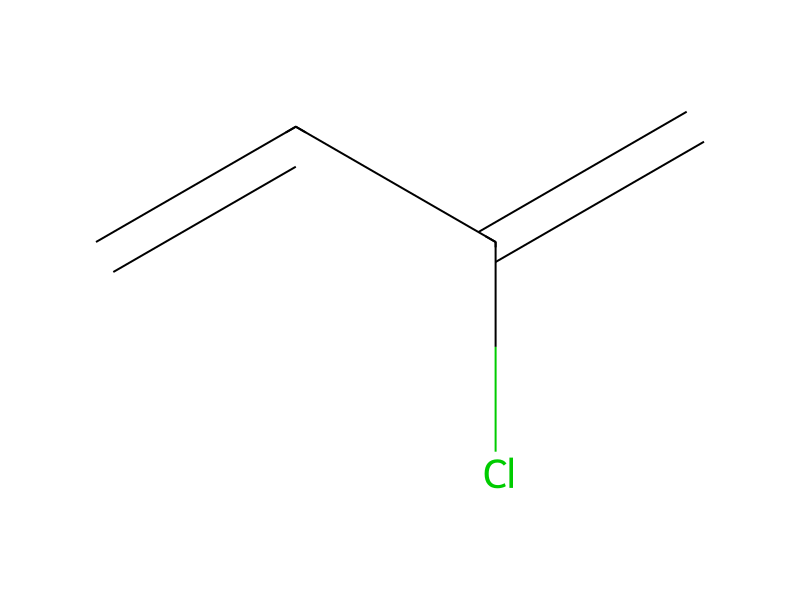
名称と識別子
- 優先名称
- Polychloroprene
- 現地名
- ポリクロロプレン
- 英語名
- Polychloroprene
- 分子式
- C4H5Cl
- 分子量
- 88.5355
名称と別名
名称をさらに表示
データベース識別子
- CAS
9010-98-4
物性
物理化学的性質
- 融点
- 260 °C · >260 °C
- 比重(密度)
- 1.23 g/mL · 1.23 g/mL at 25 °C(lit.)
- 貯蔵温度
- -196 °C · -196°C
- 外見
- チャンク
- 色
- 白からベージュ
- Dielectric constant
- 6 · 6.0(Ambient)
- InChI
- InChI=1S/C4H5Cl/c1-3-4(2)5/h3H,1-2H2
- InChIKey
- YACLQRRMGMJLJV-UHFFFAOYSA-N
- SMILES
- C=C(Cl)C=C
- CAS データベース
- 9010 · 9010-98-4(CAS DataBase Reference)
- EPAの化学物質情報
- Chloroprene polymer (9010-98-4)
化学的性質
化学的特性ポリクロロプレンは合成ゴムの一種でありその主な特徴は非常に高い耐候性と耐油性です商業名「ネオプレン」としてもよく知られており1930年代にデュポン社によって初めて開発されましたこれはクロロプレン2クロロブタ13ジエンの重合によって作られますポリクロロプレンは幅広い産業において多くの用途がありますウェットスーツから自動車部品まで多岐に渡る用途で利用されています
化学的特性The appearance of neoprene is milky white, beige or light brown flakes or lumps. Its density is 1.23–1.25 g.cm–3. The solubility parameter δ of neoprene is 9.2–9.41. Neoprene is soluble in toluene, xylene, chloroform, and dichloroethane, and slightly soluble in acetone, methyl ethyl ketone, ethyl acetate, cyclohexane but insoluble in n-hexane and solvent gasoline. Neoprene has good physical, chemical and mechanical properties. In comparison with natural rubber, it is much denser, more resistant to water and hydrocarbon solvents, less permeable to many gases, and was more resistant to degradation by oxygen, ozone, hydrogen chloride, hydrogen fluoride, and other chemicals. It has certain flame retardance. The decomposition temperature is 230–260°C, and it can be used for a long time at 80–100°C.
化学性质ポリクロロプレンの最も重要な特性の一つはその耐候性です紫外線酸素オゾンに対する耐性が非常に高く屋外での使用に適していますまた優れた耐油性を持つため自動車のゴム部品や化学物質を扱う環境でのガスケットとしても使用されます
安全と法規制
安全データ
- wgk
- 3
- tsca
- TSCA listed
- rtecs
- EI9640000
- 化審法
- 一般化学物質
- safety_code
- 24/25
- ストレージクラス
- 11 - Combustible Solids
- 有毒物質データの
- 9010-98-4(Hazardous Substances Data)
化学と産業
応用分野
解説クロロプレンCH2=CCl-CH=CH2の高重合体.ペルオキソ-硫酸カリウムを触媒として乳化重合によって得られる.普通,80% 以上がトランス-1,4構造を有する.trans-1,4-ポリクロロプレンは密度1.65 g cm-3(25 ℃,結晶),1.23 g cm-3(25 ℃,非晶).結晶の融点 Tm = 80 ℃,ガラス転移温度 Tg - 47 ℃,θ溶媒はメチルエチルケトンである.合成ゴムとして利用されている.森北出版「化学辞典(第2版)
用途クロロプレンCH2=CClCH=CH2の重合体(ポリマー)で、代表的な合成ゴムの一つ。1931年アメリカのデュポン社からデュプレンDupreneという商品名で市販され、ついでネオプレンNeopreneと改称された。ポリクロロプレンは,単独、あるいは共重合体とし、合成ゴムとして用いられる。耐候性、耐油性にすぐれ、天然ゴムよりも燃えにくい。油用ホース、ベルトなどに用いられる。商標名はネオプレン。
説明Neoprene, also known as polychloroprene and chloroprene rubber, is an elastomer produced by polymerization of chloroprene.
来歴Polychloroprene was discovered in 1930 at E. I. DuPont de Nemours & Co. inWilmington Delaware. The discovery grew out of a need to develop a synthetic substitute for natural rubber. DuPont first marketed this first commercially successful synthetic elastomer as DuPrene in 1933. In response to new technology development that significantly improved the product and manufacturing process, the name was changed to Neoprene in 1936. The current commercially acceptable generic name for this class of chlorinated elastomers is CR or chloroprene rubber. polychloroprene structure
使用Polychloroprene is a (Solid) Mechanical rubber products, lining oil-loading hose and reaction equipment, adhesive cement, binder for rocket fuels, coatings for electric wiring, gaskets and seals. (Liquid) Specialty items made by dipping or electrophoresis from the latex. (Foam) Adhesive tape to replace metal fasteners for automotive accessories, seat cushions, carpet backing, sealant
使用用途クロロプレンゴムは合成ゴムの一種で耐オゾン性、耐油性、耐熱性などに優れたゴムです。物性も含めた様々な観点でバランスの取れたゴムとも言え、数多くの業界で用いられています。 クロロプレンゴムの用途としては例えば自動車のベルトやホース、ワイヤーやケーブル、Oリングなどが挙げられます。また有機溶剤に溶解させて接着剤として用いることもあります。クロロプレンゴムを用いた接着剤はゴムや金属、硬質プラスチックなど幅広い材料に用いることが可能です。
調製方法
Commercial polychloroprene rubber is manufactured by aqueous free-radical emulsion polymerization followed by isolation of the solid polymer by one of several processes: freeze roll isolation, drum drying , extruder isolation, precipitation and drying or spray drying. Isolation of powdered polychloroprene has been reviewed. Of the methods cited, freeze roll and drum drying isolation are commercially important. The large-scale commercial manufacture of polychloroprene consists of eight or nine unit operations: (1) Monomer solution makeup Water solution makeup (2) Emulsification (3) Polymerization (4) Stripping of residual monomer (5) Peptization for chloroprene–sulfur copolymers (6) Freeze roll isolation Drum drying (7) Drying of freeze-rolled film (8) Roping (9) Cutting and packaging (25kg)
製造方法Polychloroprene is made from one of two starting materials, acetylene or butadiene. Acetylene can be dimerized and then chloronated to form chloroprene. Alternatively, when adequate butadiene is available, this can be directly halogenated (eqs. 7 and 8). In either case, the chloroprene product can then be polymerized to polychloroprene. Essentially a butadiene elastomer with chlorine present in the backbone,the polymer exhibits excellent tensile strength and low hysteresis, much like natural rubber. Tensile strength properties up to 28 MPa are possible with the proper reinforcing system (see FILLERS). The polarity imparted by the chlorine atom improves the oil and solvent resistance approaching those of nitrile polymers. The polymer can be protected with para-phenylenediamine antiozonants to give ozone resistance, and heat aging is also good. As a result, chloroprene elastomers are used in a wide variety of applications needing a balance of such properties.
上流・下流製品情報
上流原料
下流製品
サプライヤー50 社
補足説明
定義ChEBI: A macromolecule composed of repeating (2Z)-2-chlorobut-2-ene-1,4-diyl units.
関連反応
現在のフィルター条件では反応記録がありません。
関連ノート
読み込み中…