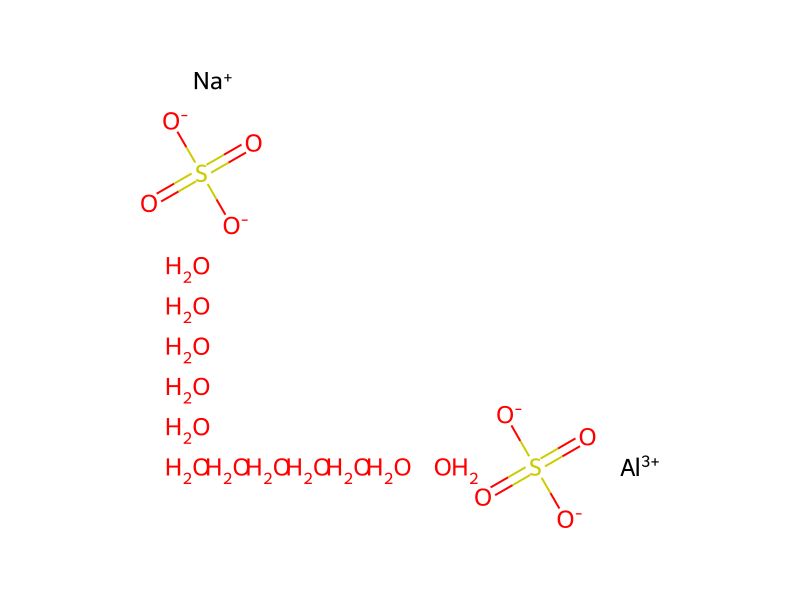
基本情報
- 標準SMILES
O.O.O.O.O.O.O.O.O.O.O.O.O=S(=O)([O-])[O-].O=S(=O)([O-])[O-].[Al+3].[Na+]- InChIKey
ZEMWIYASLJTEHQ-UHFFFAOYSA-J- 分子式
- AlH24NaO20S2
- 平均分子量
- 458.3 g/mol
- 単同位体質量
- 458.00154308
名称と識別子
- 優先名称
- Aluminum sodium sulfate dodecahydrate
- IUPAC
- aluminum;sodium;disulfate;dodecahydrate
- 現地名
- 硫酸ナトリウムアルミニウム?12水(ナトリウムみょうばん)
- 英語名
- Aluminium sodium sulfate 12-water
- 分子式
- AlH24NaO20S2
- 分子量
- 458.28
名称と別名
名称をさらに表示
データベース識別子
- CAS
7784-28-3- PubChem CID
- 24568
- DTXSID
DTXSID7044263- UNII
- 1224CG79TA
物性
構造計算による物性
- 極性表面積
- 189 Ų
- 水素結合供与体数
- 12
- 水素結合受容体数
- 20
- 回転可能結合数
- 0
- 重原子数
- 24
- 形式電荷
- 0
- 複雑度
- 62.2
実験および物理化学的性質
Color/Form
COLORLESS, CUBIC OCTAHEDRAL CRYSTALS
WHITE GRANULES OR POWDER
Solubility
110 G SOL IN 100 CC WATER @ 15 °C; 146 G SOL IN 100 CC WATER @ 20 °C /ANHYDROUS FORM/
PRACTICALLY INSOL IN ALCOHOL
110 g anhydrous salt/100 cc of water at 15 °C
物理化学的性質
- LogP
- -1.031 · -1.031 (est)
安全と法規制
危険有害性情報
FDA Requirements
Bottled water shall, when a composite of analytical units of equal volume from a sample is examined by the methods described in paragraph (d)(1)(ii) of this section, meet the standards of chemical quality and shall not contain sulfate in excess of 250.0 mg/l. /Sulfate/
Sodium aluminum sulfate is an indirect food additive for use only as a component of adhesives.
Aluminum sodium sulfate used for multiple purposes in food for human consumption is generally recognized as safe when used in accordance with good manufacturing practice.
Aluminum sodium sulfate used as a general purpose food additive in animal drugs, feeds, and related products is generally recognized as safe when used in accordance with good manufacturing or feeding practice.
OSHA Standards
Permissible Exposure Limit: Table Z-1 8-hr Time Weighted Avg: 15 mg/cu m. /Aluminum, metal, as Al, total dust/
Permissible Exposure Limit: Table Z-1 8-hr Time Weighted Avg: 5 mg/cu m. /Aluminum, metal, As Al, respirable fraction/
Vacated 1989 OSHA PEL TWA 2 mg/cu m is still enforced in some states. /Aluminum soluble salts & alkyls, as Al/
State Drinking Water Guidelines
(AZ) ARIZONA 73 ug/l /Aluminum/
(CA) CALIFORNIA 200 ug/l /Aluminum/
(ME) MAINE 1430 ug/l /Aluminum/
安全と保護具
Cleanup Methods
ALUMINUM WAS RECOVERED FROM ALUMINUM SLUDGE AT A WATER TREATMENT PLANT BY ADDN OF SULFURIC ACID. OPTIMUM PH WAS 2.0 FOR ALUMINUM RECOVERY. UNDER OPTIMAL CONDITIONS, THE RECOVERED ALUMINUM IS AS EFFICIENT AS VIRGIN ALUMINUM IN TREATMENT OF SEWAGE FOR PHOSPHORUS REMOVAL. /ALUMINUM/
Preventive Measures
SRP: The scientific literature for the use of contact lenses in industry is conflicting. The benefit or detrimental effects of wearing contact lenses depend not only upon the substance, but also on factors including the form of the substance, characteristics and duration of the exposure, the uses of other eye protection equipment, and the hygiene of the lenses. However, there may be individual substances whose irritating or corrosive properties are such that the wearing of contact lenses would be harmful to the eye. In those specific cases, contact lenses should not be worn. In any event, the usual eye protection equipment should be worn even when contact lenses are in place.
Threshold Limit Values (TLV)
8 hr Time Weighted Avg (TWA): 1 mg/cu m (respirable fraction). /Aluminum metal and insoluble compounds/
Excursion Limit Recommendation: Excursions in worker exposure levels may exceed three times the TLV-TWA for no more than a total of 30 min during a work day, and under no circumstances should they exceed five times the TLV-TWA, provided that the TLV-TWA is not exceeded. /Aluminum metal and insoluble compounds/
毒性情報
Body Burden
A body burden of 100 mg/70 kg man with a daily dietary intake of approximately 36 mg. ... The total body burden of aluminum in humans can be estimated to range from 60-100 mg. /Aluminum/
THE NORMAL BLOOD LEVEL OF ALUMINUM IS 17 UG ALUMINUM/100 ML AND MOST SOFT TISSUES CONTAIN BETWEEN 0.2 AND 0.6 PPM. HUMAN BODY BURDEN OF ALUMINUM IS 50 TO 150 MG & IS APPARENTLY UNAFFECTED BY EITHER NORMAL DAILY INTAKE LEVELS ESTIMATED TO BE APPROXIMATELY 10 TO 100 MG OR CONSIDERABLY HIGHER DOSES. /ALUMINUM/
Aluminum content of normal human brain ranged from 0.1-3.9 ug/g dry weight. In a study of 208 samples taken from 7 patients, ... a mean aluminum content of 1.9 + or - 0.07 ug/g dry weight of gray matter /was found/ to be abnormal. In a study of 585 areas sampled from the brain tissue of 10 patients with Alzheimer's disease they found 28% had an aluminum concn > 4 ug/g. The range of the 585 samples was 0.4-107 ug/g. /Aluminum/
Interactions
In a case study of patients on long-term dialysis, systemic aluminum absorption with concurrent oral citrate (as an alkalinizing agent) and aluminum containing phosphate binder (eg, aluminum hydroxide or carbonate) was significantly increased. Based on the proposed mechanism and pharmacologic similarity, an interaction may be expected to occur between citric acid and other aluminum salts (eg, aluminum phosphate, aluminum glycinate, attapulgite, dihydroxyaluminum, kaolin, magaldrate). It has been shown that following concurrent administration of citric acid (from lemon juice) and aluminum hydroxide there is an increase in serum levels of a nonionized aluminum citrate complex, which is postulated to easily pass the gastrointestinal barrier. Simultaneous administration of citric acid and aluminum hydroxide should be avoided since significant systemic absorption of aluminum may occur. This may be of additional concern in patients on long-term dialysis or with impaired renal function. /Aluminum hydroxide/
... 25 Dialysis patients that experienced accidental exposure to aluminum and parathyroid hormone /were examined/. At the same time as parathyroid hormone decreased, serum calcium increased. Based on this observation it has been suggested that aluminum is incorporated, instead of calcium, into the bone and that this leads to the osteomalacia characteristic of aluminum induced bone disease. Instead of being incorporated into osteoid bone tissue, calcium returns to the circulation which in turn inhibits the parathyroid hormone release from the parathyroid. In support of this hypothesis, ... a strong correlation /was found/ between bone aluminum content and the amount of bone occupied by unmineralized osteoid in humans. Experimental support for the hypothesis of calcium aluminum interactions has also been provided in studies on chicks. /Aluminum/
Environmental Fate
AQUATIC FATE: The adsorption of aluminum by fine particulates was studied in Whitray Beck, a hill stream in England. ... Uptake of aluminum by the particles increased with total aluminum, with pH, and with particle concentration, although the fraction of aluminum bound at a given pH and particle concentration decreased with total aluminum ... . /Aluminum/
TERRESTRIAL FATE: Air dried, <2 mm fractions of 3 soil samples from The Netherlands and 1 from New Hampshire, were taken from the surface and subsurface horizons of two podzols (Haplorthods) and of a recent driftsand (Udipsamment). Duplicate samples of each emulsion soil horizon were leached ... with aqueous hydrogen chloride (pH 3.0). ... Charge balances of the leachates indicate that dissolved aluminum is present mainly as aquo-aluminum +3. Only in leachates of podzol Bhs horizons is a significant fraction (20-30%) of dissolved aluminum organically complexed. Dissolved aluminum concn are significantly correlated with the organic (tetrasodium pyrophosphate extractable) aluminum content of the soil sample. Mobility of aluminum in the Hubbard Brook soils is significantly lower than in the Dutch soils, because of higher soil-solution pH values. /Aluminum cmpd/
TERRESTRIAL FATE: Albic and spodic soil horizons were sampled from old growth eastern white pine/mixed northern hardwoods. Adirondacks, and an ochric soil horizon was sampled from the Appalachian plateau of NY State. 21 Three horizon forest floor and 21 forest floor/mineral soil (field moist equivalent of 12.0 oven dry albic, spodic, or ochric mineral soil) columns were leached in triplicate with either 10 uM nitric acid (pH 5), 5 uM sulfuric acid (pH 5), 100 uM nitric acid (pH 4), 50 uM sulfuric acid (pH 4), 1000 uM nitric acid (pH 3), 500 uM sulfuric acid (pH 3), or distilled, deionized water (pH 5.7) control treatment). Nitric acid leached more aluminum than did sulfuric acid from forest floor/spodic soil columns. Increasing the nitric acid concn from pH 3-5 increased total aluminum concn in leachates from 0.70 to 0.85 mM, while increasing sulfuric acid had no effect. Addition of pH 3 sulfuric acid to forest floor/spodic columns raised leachate pH relative to pH 3 nitric acid and controls, and resulted in the lowest aluminum concn of all treatments in the first 3 of 4 sequential leachings. /Aluminum/
TERRESTRIAL FATE: Albic and spodic soil horizons were sampled from old growth eastern white pine/mixed northern hardwoods sites in the Adirondacks, and an ochric soil horizon was sampled from the Appalachian Plateau of NY State. 9 Three-horizon forest floor, 9 mineral soil (field moist equivalent of 12.0 oven-dry albic, spodic, or ochric mineral soil) and 9 forest floor/mineral soil columns were leached with 60 ml of (a) 10 mM ammonium nitrate (control), (b) 1.0 mM nitric acid in 10 mM ammonium nitrate (pH 3), and (c) 1.0 mM ammonium nitrate (pH 3) at the rate of 10 ml/h. The above procedure was repeated on each mineral soil without a forest floor, except leaching soln were 0.5 mM calcium nitrate or calcium sulfate, each in 10 mM ammonium nitrate Adding 2 and 0.5 cmol sub c (H+)/kg to forest floor and mineral soils, respectively, simulated snowmelt additions. Total aluminum concn in leachates from forest floor/albic or forest floor/ochric columns were greater than the sum of concn in leachates from the forest floor and mineral horizon when leached separately. This positive synergistic behavior of the forest floor-mineral horizon sequences was also observed in the forest floor-spodic horizon sequence when leached with control soln, but the synergism was negative for both labile and non-labile aluminum when leached with the acids. Sulfuric acid leached less aluminum from the spodic horizon than did nitric acid, regardless of the presence of a forest floor, but nitric acid, sulfuric acid, and control soln leached similar concn of aluminum from the albic and ochric horizons. The forest floor effects on the mineral soil leachates were attributed to effects of calcium, sulfate, nitrate, and dissolved organic carbon leached from the forest floor to the mineral horizon since forest floor removed nearly all added H+. /Aluminum/
Natural Pollution Sources
Occurs naturally as the mineral mendozite
THE CRUDE LUMP ALUM AS IT OCCURS WITH EARTH ATTACHED HAS BEEN KNOWN AS ROCK ALUM (ALUMEN RUPEUM) AND AS ROMAN ALUM. /ALUM/
Human Toxicity Excerpts
Patients who had died with dialysis encephalopathy syndrome had brain gray matter aluminum levels that were 3 times higher (approximately 12 mg/kg dry weight) than those seen in patients who had been comparably dialyzed but did not have dialysis encephalopathy syndrome (approximately 4 mg/kg dry weight). Both of these groups were markedly higher than the 1 mg/kg dry weight level seen in controls. These data clearly indicate elevated brain levels of aluminum in dialyzed patients and emphasize the fact that only the highest levels of brain aluminum are associated with dialysis encephalopathy syndrome. /Aluminum/
X ray spectrometric evidence of aluminum accumulation in neurofibrillary tangle bearing neurons of human brains was reported. Quite in contrast to the extensive literature on aluminum in dialysis encephalopathy syndrome, there appears to be only a small amount of additional corroborating evidence for elevated brain levels of aluminum in Alzheimer's disease patients. ... Much of the argument for a role of aluminum in Alzheimer's disease has been built on the fact that in experimental animals, such as cat and rabbit, intracerebral injections of small amounts of aluminum result in neural degeneration which is characterized by the development of neurofibrillary tangles. ... Aluminum induced tangles in experimental animals are composed of single 10 nm filaments while those from Alzheimer's disease are paired, helically wound filaments. ... In spite of the apparent similarities in the two types of tangles, there are sufficient differences to warrant caution in interpreting that the tangles in humans are caused by aluminum as they are in experimental animals. /Aluminum/
Genetic predisposition to Alzheimer's disease and other similar neuroencephalopathies has become more widely appreciated. For example, paired helical filaments containing neurons have been found to be common in patients on the island of Guam who have been diagnosed with a particular type of encephalopathy, referred to as amyotrophic lateral sclerosis with Parkinsonism dementia complex (ALS-PD complex of Guam). Elevation of aluminum levels of drinking water in Guam have been associated with the high incidence of this complex, but it appears that only the indigenous population of Guam is affected suggesting a genetic predisposition. /Aluminum/
THERE IS SOME EVIDENCE THAT @ INTAKE LEVELS CONSIDERABLY HIGHER THAN NORMAL THERE IS TENDENCY FOR BODY TO BECOME DEPLETED OF /PHOSPHORUS/, OWING TO BINDING OF DIETARY PHOSPHATE BY ALUMINUM IN DIGESTIVE TRACT. /ALUMINUM/
For more Human Toxicity Excerpts (Complete) data for SODIUM ALUM (17 total), please visit the HSDB record page.
Non-Human Toxicity Excerpts
LARGE DOSES /OF ALUM/ CHRONICALLY ADMIN ORALLY TO ANIMALS CAUSED INCR LOSS OF PHOSPHATE IN FECES & DECR IN PHOSPHATIDES OF BLOOD & TISSUES; THERE WAS ALSO AN INCREASED DEPOSIT OF ALUMINUM IN BONE. /ALUMINUM CMPD/
CONCN SOLUTIONS /OF ALUM/ (EG, 20%) HAVE PRODUCED GINGIVAL NECROSIS & FATAL HEMORRHAGIC GASTROENTERITIS ... INCOORDINATION, CLONIC CONTRACTIONS, & EVIDENCE OF NEPHRITIS. /ALUMINUM/
... The acute oral toxicity of the complex sulfates, the alums, for example, anhydrous sodium aluminum sulfate, appears to be somewhat less than that of the simple sulfate, the lethal dose for the rabbit being of the order of 225 mg aluminum/kg. ...
In one study, concentrations of aluminum ranging from 500 to 1,000 ug/g body weight were added to the diets of pregnant rats from day 6 to day 19 of gestation, when the fetuses were removed by cesarean section. Aluminum in the diet did not affect embryo or fetal mortality rate, litter size, fetal body weight, or length. However, in a similarly designed experiment in which the pregnant mothers received subcutaneous injections of parathyroid hormone (68 U/kg) on days 6, 9, 12, 15, or 18 of gestation, there was an increase only in the resorption rate in those animals receiving aluminum at 1,000 ug/g body weight. /Aluminum/
For more Non-Human Toxicity Excerpts (Complete) data for SODIUM ALUM (11 total), please visit the HSDB record page.
Probable Routes of Human Exposure
INTAKE OF ALUMINUM IS CHIEFLY BY MOUTH, FROM FOODS AND BEVERAGES, ALSO BY LUNGS, FROM THE ATMOSPHERIC DUST CONTENT. IT IS PRESENT IN NATURAL DIET, IN AMT VARYING FROM VERY LOW IN ANIMAL PRODUCTS TO RELATIVELY HIGH IN PLANTS. /ALUMINUM/
... The direct transfer of aluminum ... /in/ dialysis treatment ... Aluminum administered ... by subcutaneous injection of alum-precipitated allergenic preparations. /Aluminum/
WORKMEN ... CONTAMINATED WITH ALUM /THROUGH EYES/ ... . /ALUM/
Production of aluminum sulfate and aluminum fluoride is associated with exposure to several irritant substances. Such production has been connected with reversible bronchial obstruction or asthma. In an aluminum plant in Sweden, 6 cases of asthma occurred in 1975, and 7 in 1976. The number of exposed workers was 35-40. The levels of aluminum fluoride (personal sampling) were measured during these two years, and the mean concentrations were 3-6 mg/cu m. In 1977, improvements were made at this plant thereby reducing the mean levels of aluminum fluoride to 0.4-1.0 mg/cu m. During the years 1978-1980, only two cases of asthma occurred. /Aluminum sulfate/
Electrolytic production of aluminum can lead to a substantial exposure to fluorides and carcinogenic tar oils, including polyaromatic hydrocarbons. /Aluminum/
Environmental Water Concentrations
DRINKING WATER: A survey of aluminum concn in drinking water of 12 West European countries showed that concn were less than the European Economic Community maximum acceptable concn of 0.2 mg/l. In the United Kingdom, the Northumbrian Water Authority produced water with 0.12 mg/l aluminum in alum using plants and 0.07 mg/l in non-alum using plants. The North West Water Authority's levels were 0.09 and 0.07 mg/l, not statistically different among alum users and non-alum users. The Yorkshire Water Authority product was higher than the European Economic Community limit in 5 of 6 annual means (highest, 0.73 mg/l); some of the high values were attributed to raw water quality fluctuations and inadequate alum dosing control. Thames Water Authority water was well within European Economic Community limits. In the Federal Republic of Germany mean aluminum concn reported were <0.001 to 0.062 mg/l. Mean aluminum concn in water from four regional Italian works were below the European Economic Community maximum acceptable concn in all cases. Sweden's results were among the lowest for all European alum treated potable water plants. In Switzerland Aluminum values were generally below the European Economic Community maximum acceptable concn; however, this country uses a guideline of 0.05 mg/l. Waters treated with polyaluminum chloride had lower aluminum concentrations than those treated with alum. Results from France, Denmark, the Netherlands, and Norway indicated low aluminum levels. Results from Belgium indicate decreasing levels of aluminum since the implementation of a limit of 0.1 mg/l in 1984. /Aluminum/
DRINKING WATER: Thirty seven brands of domestic and imported mineral waters were analyzed for aluminum content by inductively coupled atomic plasma spectrophotometry. Only five of the waters tested had aluminum concentrations greater than the detection limit of 5.1 ug/l, ie, Aqui, Health Valley, Knjazmilos, Vichy Celestins, and Vichy St Yorre Royal. Only the Vichy St Yorre Royal, for which one sample contained 305 ug aluminum/l, exceeded the 200 ug/l European Economic Community maximum and WHO guideline for aluminum in drinking water. For 2 others, the European Economic Community guideline of 50 ug/l was exceeded for one of the two samples tested. /Aluminum/
The solute and particulate aluminum chemistry of a relatively unpolluted snowfall associated with a maritime airmass was measured by neutron activation analysis and inductively-coupled plasma analysis (soluble fraction) and neutron activation analysis (particulate material), to characterize background conditions for the Scottish Highlands. Aluminum concentrations were compared to those found in a polluted black snowfall with a trajectory that originated over eastern Europe and to those levels found in seasonal snowpack. The variability of the concentration of solute and the chemical composition of particulate material is reported on an intra-and inter-site basis. The solute aluminum content of Scottish snowfall in the inter-site survey was 19.2 ug/l, and in the intra-site survey 52.2 ug/l. The aluminum composition of particulate matter found within Scottish snow was 20,600 ppm in the inter-site survey, and 21,100 ppm in the intra-site survey. For the black snow, the solute aluminum content was 84 + or - 3 ug/l, and the aluminum composition of particulate matter was 52,300 ppm. The mean concentration of aluminum in seasonal snowpack was 27,200 ppm. /Aluminum solute & particulate/
Antidote and Emergency Treatment
TREATMENT: TO RELIEVE THE GI DISTRESS /CAUSED BY SWALLOWING ALUMINUM SALTS/... THE DEGREE OF DEHYDRATION & ELECTROLYTE LOSS CAUSED BY VOMITING & DIARRHEA MUST BE DETERMINED, & CORRECTED BY IV INFUSIONS OF APPROPRIATE SOLUTIONS. /ALUMINUM SALTS/
DIAGNOSIS: WHEN HISTORY IS UNATTAINABLE, DIAGNOSIS DEPENDS ON THE DEMONSTRATION OF LARGE AMT OF ALUMINUM IN VOMITUS, STOMACH CONTENTS OR FECES. /ALUMINUM CMPD/
Poisoning with alum should be treated with copious drinks of water and gastric lavage if vomiting has not occurred. Demulcent drinks should be given and shock alleviated if the patient shows signs of collapse.
Deferoxamine has been used to treat dialysis encephalopathy and osteomalacia with symptomatic relief reported. The use of deferoxamine for aluminum toxic dialysis patients has been suggested for serum levels of aluminum between 100 and 200 ug/ml. Deferoxamine also has been used to diagnose aluminum related osteodystrophy. After a deferoxamine infusion of 40 mg/kg over 2 hours, an increment in plasma aluminum concentration of 200 ug/l identified 35 of 37 patients with biopsy-proven aluminum related osteodystrophy (sensitivity, 94%; specificity, 50%). Calcium disodium ethylenediaminetetraacetic acid does not appear as effective as deferoxamine in chelating aluminum. Especially in dialysis patients, aluminum containing medications should be reduced. /Aluminum/
法規制情報
FDA Requirements
Bottled water shall, when a composite of analytical units of equal volume from a sample is examined by the methods described in paragraph (d)(1)(ii) of this section, meet the standards of chemical quality and shall not contain sulfate in excess of 250.0 mg/l. /Sulfate/
Sodium aluminum sulfate is an indirect food additive for use only as a component of adhesives.
Aluminum sodium sulfate used for multiple purposes in food for human consumption is generally recognized as safe when used in accordance with good manufacturing practice.
Aluminum sodium sulfate used as a general purpose food additive in animal drugs, feeds, and related products is generally recognized as safe when used in accordance with good manufacturing or feeding practice.
State Drinking Water Guidelines
(AZ) ARIZONA 73 ug/l /Aluminum/
(CA) CALIFORNIA 200 ug/l /Aluminum/
(ME) MAINE 1430 ug/l /Aluminum/
安全データ
- 安衛法
- 57,57-2
- 有毒物質データの
- 7784-28-3(Hazardous Substances Data)
化学と産業
薬理情報
Biological Half-Life
The mean plasma half-life of aluminum after iv admin in dogs is approx 4.5 hr. /Aluminum/
The shorter half-life for the urinary elimination of aluminum was about 8 hr. /Aluminum/
Absorption, Distribution and Excretion
It was calculated that a dialysate aluminum concn of 0.2-1.0 mg/l (a concn readily found in many water supplies) would result in the direct transfer of aluminum into the blood of 3-16 mg for each dialysis treatment or 42-211 mg/mo. /Aluminum/
A given oral dose of aluminum results in significantly higher serum and tissue levels of the metal in nephrectomized rats than in intact controls in spite of the fact that only minimal amounts of aluminum are normally excreted in the urine. /Aluminum/
It was found that 70-90% of total aluminum bound to plasma proteins (60-70% to a high molecular weight protein and 10-20% to albumin while only 10-30% was unbound). This high affinity of aluminum for plasma proteins strongly suggests high levels of binding of aluminum to a variety of tissue proteins. /Aluminum/
It was shown that the uptake of aluminum into the blood during renal dialysis was due to the extensive binding of aluminum to plasma proteins leaving very little aluminum in the non-bound state in plasma. Thus, the plasma proteins served as a trap for accumulating the metal. It was shown that the component of plasma protein that binds aluminum is saturable. Consistent with this ... is the fact that, during dialysis with aluminum-containing dialysate, plasma aluminum levels reach a plateau. /Aluminum/
For more Absorption, Distribution and Excretion (Complete) data for SODIUM ALUM (17 total), please visit the HSDB record page.
用途と製造
Uses
Found as the mineral mendozite; Used to bleach flour, engrave metal, waterproof textiles, tan leather, size paper, refine sugar, and purify water; Also used as a dye mordant, food additive, precipitant, and in ceramics, matches, inks, and baking powders; [HSDB]
Pulp and Paper Processing [Category: Industry]
Ceramics making [Category: Hobbies]
MEDICATION (VET)
MEDICATION
BLEACHING AGENT IN FLOUR; FOOD ADDITIVE.
Use Classification
Food Additives -> ACIDITY_REGULATOR; FIRMING_AGENT -> JECFA Functional Classes
Cosmetics -> Antiperspirant; Astringent
General Manufacturing Information
THE CRUDE LUMP ALUM AS IT OCCURS WITH EARTH ATTACHED HAS BEEN KNOWN AS ROCK ALUM (ALUMEN REPEUM) AND AS ROMAN ALUM. /FORM NOT STATED/
INCOMPATIBILITIES: WHEN ALUM IS DISPENSED IN POWDERS WITH PHENOL, SALICYLATES, OR TANNIC ACID, GRAY OR GREEN COLORS MAY BE DEVELOPED DUE TO TRACES OF IRON IN ALUM.
THE SUPPLY IN SOILS IS ABUNDANT. SOME ACID SOILS CONTAIN SUFFICIENT ALUMINUM IN SOLUTION FORM TO KILL CERTAIN PLANTS. /ALUMINUM/
応用分野
解説NaAl(SO4)2・12H2OまたNaMIII(SO4)2・12H2O(MIIl=Al,Cr,Mn,Fe,Gaなど)の総称.
サプライヤー2 社
関連反応
現在のフィルター条件では反応記録がありません。
関連ノート
読み込み中…