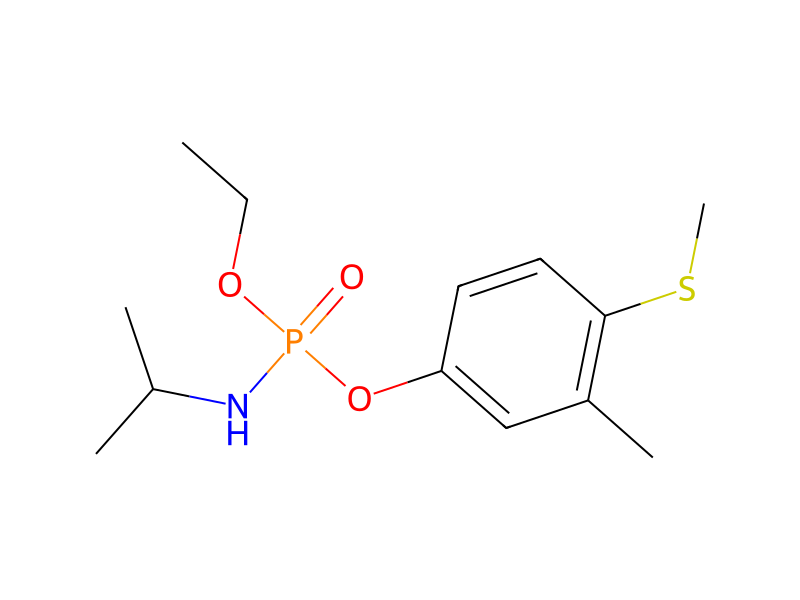
基本情報
- 標準SMILES
CCOP(=O)(NC(C)C)Oc1ccc(SC)c(C)c1- InChIKey
ZCJPOPBZHLUFHF-UHFFFAOYSA-N- 分子式
- C13H22NO3PS
- 平均分子量
- 303.36 g/mol
- 単同位体質量
- 303.10580119
概要
Fenamiphos appears as brown waxy solid or colorless solid. Used as a nematocide. (EPA, 1998)
名称と識別子
- 優先名称
- Fenamiphos
- IUPAC
- N-[ethoxy-(3-methyl-4-methylsulfanylphenoxy)phosphoryl]propan-2-amine
- 現地名
- フェナミホス
- 英語名
- Fenamiphos
- 分子式
- C13H22NO3PS
- 分子量
- 303.36
名称と別名
名称をさらに表示
データベース識別子
- CAS
22224-92-6- PubChem CID
- 31070
- DTXSID
DTXSID3024102- ChEMBL
CHEMBL1313005、CHEMBL450410- ChEBI
CHEBI:38680- UNII
- H4NO3L2HBE
- EC Number
- 244-848-1
- Nikkaji
- J11.420K
物性
構造計算による物性
- XLogP
- 3.2
- 極性表面積
- 72.9 Ų
- 水素結合供与体数
- 1
- 水素結合受容体数
- 5
- 回転可能結合数
- 7
- 重原子数
- 19
- 形式電荷
- 0
- 複雑度
- 314
実験および物理化学的性質
Pesticides
Pesticide -> EPA IRIS
Nematicides
Active substance -> EU Pesticides database: Not approved
Pesticides -> Organophosphate Insecticides
Pesticide
Pesticide (Fenamiphos) -> USDA PDB
LogP
log Kow = 3.23
3.23
3.3
3.18
Density
1.14 at 39-120 °F (NTP, 1992) - Denser than water; will sink
1.15 g/cu cm at 15 °C
1.15 g/cm³
1.14 at 39-120 °F
1.15 @ 20°C
1.14
Color/Form
Colorless crystals
Off-white to tan, waxy solid
Solubility
less than 1 mg/mL at 69 °F (NTP, 1992)
In water, 400 mg/L at 20 °C
In water, 329 mg/L at 20 °C
In dichloromethane, isopropanol, toluene > 200; hexane 10-20 (all in g/L, 20 °C)
Soluble in organic solvents
0.329 mg/mL at 20 °C
Boiling Point
Decomposes (NTP, 1992)
decomposes
450 °C @760 [mm Hg]
Decomposition
When heated to decomposition it emits very toxic fumes of /phosphorous, nitric and sulfur oxides/.
40% degradation in propanol-water mixture after 14 days at pH 2. No degradation after 50 days at pH 7. 50% degradation after 31.5 hr at pH 11.3.
Melting Point
121 °F (EPA, 1998)
49 °C
Off-white to tan waxy solid with a melting point of 49 °C and a vapor pressure of 4.7X10⁻⁵ mm Hg at 20 °C /Technical grade/
49 °C
49.2 °C
121 °F
Vapor Pressure
9.8e-09 mmHg at 86 °F (EPA, 1998)
0.00005 [mmHg]
9.0X10⁻⁶ mm Hg at 20 °C
Vapor pressure, Pa at 30 °C:
0.00005 mmHg
0.000001 [mm Hg] @25 °C
Physical Description
Fenamiphos appears as brown waxy solid or colorless solid. Used as a nematocide. (EPA, 1998)
Off-white to tan, waxy solid. [insecticide] [Note: Found commercially as a granular ingredient (5-15%) or in an emulsifiable concentrate (400 g/l).]; [NIOSH]
Solid
COLOURLESS CRYSTALS WITH CHARACTERISTIC ODOUR.
Off-white to tan, waxy solid.
Off-white to tan, waxy solid. [insecticide] [Note: Found commercially as a granular ingredient (5-15%) or in an emulsifiable concentrate (400 g/l).]
物理化学的性質
- 融点
- 49 °C · 49°C
- 沸点
- 375.6 · 375.6±52.0 °C(Predicted)
- 比重(密度)
- 1.14 · 1.14
- 蒸気圧
- 1.2 x · 1.2 x 10-4 Pa (20 °C)
- 闪点
- 100 °C · 100 °C
- 貯蔵温度
- 0 · 0-6°C
- 溶解性
- Chloroform (Slightly), Methanol (Slightly)
- 酸解離定数(Pka)
- -0.09 · -0.09±0.70(Predicted)
- 外見
- 液体
- 色
- 茶色
- 水溶解度
- 0.07 g/100mL · 0.07g/100mL
- Merck
- 13 · 13,3984
- BRN
- 4752893 · 4752893
- Henry's Law Constant
- 1.1 · 1.1×103 mol/(m3Pa) at 25℃, HSDB (2015)
- 主な用途
- 農業環境
- InChI
- 1S/C13H22NO3PS/c1-6-16-18(15,14-10(2)3)17-12-7-8-13(19-5)11(4)9-12/h7-10H,6H2,1-5H3,(H,14,15)
- InChIKey
- ZCJPOPBZHLUFHF-UHFFFAOYSA-N
- SMILES
- CCOP(=O)(NC(C)C)Oc1ccc(SC)c(C)c1
- LogP
- 4.01 at · 4.01 at 30℃
- CAS データベース
- 22224 · 22224-92-6(CAS DataBase Reference)
- NISTの化学物質情報
- Fenamiphos(22224-92-6)
- EPAの化学物質情報
- Fenamiphos (22224-92-6)
化学的性質
化学的特性Fenamiphos is a colorless crystal or a tan, waxy solid. It is non-corrosive to metals and breaks down readily in strong acids and bases. Fenamiphos is used as a nematicide and an insecticide. It is sparingly soluble in water, but readily soluble in dichloromethane, isopropanol, and toluene. It is used primarily for the control of nematodes and thrips on citrus, grapes, peanuts, pineapples, tobacco, turf, and ornamentals. There are no residential uses for fenamiphos. The US EPA has grouped fenamiphos as an RUP owing to its high acute toxicity and toxicity to wildlife. Reports have indicated that the manufacture and sale of fenamiphos is to be phased out by 2007–2008.
安全と法規制
GHS分類
GHS Classification
Danger
H300: Fatal if swallowed [Danger Acute toxicity, oral]
P260, P262, P264, P264+P265, P270, P271, P273, P280, P284, P301+P316, P302+P352, P304+P340, P305+P351+P338, P316, P320, P321, P330, P337+P317, P361+P364, P391, P403+P233, P405, and P501 (click each P-code to see the statement)
Danger
H300+H310+H330 (27.2%): Fatal if swallowed, in contact with skin or if inhaled [Danger Acute toxicity, oral; acute toxicity, dermal; acute toxicity, inhalation]
P260, P262, P264, P264+P265, P270, P271, P273, P280, P284, P301+P316, P302+P352, P304+P340, P305+P351+P338, P316, P320, P321, P330, P337+P317, P361+P364, P391, P403+P233, P405, and P501 (click each P-code to see the statement)
危険有害性情報
Regulatory Information
Commission Regulation No 844/2012
06/85/EC, Reg. (EU) 2015/415, Reg. (EU) 2018/917, Reg. (EU) 2019/707, Reg. (EU) 2020/1246, Reg. (EU) 2020/869, Reg. (EU) No 540/2011
REACH registered substance: Fenamiphos (EC: 244-848-1)
The New Jersey Worker and Community Right to Know Act requires public and private employers to provide information about hazardous substances at their workplaces. (N.J.S.A. 34:5A-1 et. seq.)
Fire Hazards
(Non-Specific -- Organophosphorus Pesticide, n.o.s.) Container may explode in heat of fire. Fire and runoff from fire control water may produce irritating or poisonous gases. Emits toxic fumes of nitrogen oxides, phosphorus oxides, and sulfur oxides when heated to decomposition. (EPA, 1998)
Combustible. Liquid formulations containing organic solvents may be flammable.
Hazards Summary
Classified as highly toxic and may be used only by a certified applicator; [EXTOXNET] The average of two baseline respective cholinesterase activity determinations three days apart, with no exposures to enzyme inhibiting pesticides for at least 30 days, is recommended for each worker prior to exposure to cholinesterase inhibitors because of large inter-individual differences in published baseline values. To be established at least once a year. Removal from workplace exposures is recommended until the cholinesterase activity returns to within 20% of baseline. [TLVs and BEIs]
Special Reports
USEPA/Office of Pesticide Programs; Interim Reregistration Eligibility Decision (IRED) for Fenamiphos. EPA issues an IRED for a pesticide that is undergoing reregistration, requires a reregistration eligibility decision, and also needs a cumulative assessment under FQPA. The IRED, issued after EPA completes the individual pesticide's aggregate risk assessment, may include taking risk reduction measures -- for example, reducing risks to workers or eliminating uses that the registrant no longer wishes to maintain -- to gain the benefits of these changes before the final RED can be issued following the Agency's consideration of cumulative risks.[Available from, as of July 24,2003: http://www.epa.gov/pesticides/reregistration/status.htm]
FIFRA Requirements
Tolerances are established for residues of the nematicide/insecticide fenamiphos, ethyl 3-methyl-4-(methylthio)phenyl 1-(methylethyl)phosphoramidate, including its metabolites and degradates, in or on the commodities in the following table. Compliance with the tolerance levels specified in this paragraph is to be determined by measuring only the sum of fenamiphos, ethyl 3-methyl-4-(methylthio)phenyl 1-(methylethyl)phosphoramidate, and its cholinesterase inhibiting metabolites ethyl 3-methyl-4-(methylsulfinyl)phenyl 1-(methylethyl)phosphoramidate and ethyl 3-methyl-4-(methylsulfonyl)phenyl 1-(methylethyl)phosphoramidate, calculated as the stoichiometric equivalent of fenamiphos, in or on the commodity.[Table#5977]
Pesticides classified for restricted use. The following uses of pesticide products containing the active ingredients specified below have been classified for restricted use and are limited to use by or under the direct supervision of a certified applicator. Active Ingredient: fenamiphos; Formulation: emulsifiable concentrates 35% and greater; Use Pattern: all uses; Classification: restricted; Criteria influencing restriction: acute dermal toxicity.
This notice announces EPA's order for the cancellations, voluntarily requested by the registrants and accepted by the Agency, of the products listed in Tables 1 and 2 of Unit II., pursuant to section 6(f)(1) of the Federal Insecticide, Fungicide, and Rodenticide Act (FIFRA), as amended. ... Accordingly, EPA hereby issues in this notice a cancellation order granting the requested cancellations. Any distribution, sale, or use of the products subject to this cancellation order is permitted only in accordance with the terms of this order, including any existing stocks provisions. ... /The cancellation of Nemacur 3 (fenamiphos) is/ effective October 25, 2011. ... The registrants may sell and distribute existing stocks ... until January 15, 2012, 1 year after the date on which the maintenance fee was due. Thereafter, the registrants are prohibited from selling or distributing the pesticides ... except for export consistent with FIFRA section 17 or for proper disposal. Persons other than registrants are allowed to sell, distribute, or use existing stocks until such stocks are exhausted, provided that such sale, distribution, or use is consistent with the terms of the previously approved labeling on, or that accompanied, the cancelled products.
Based on its review, EPA has identified risk mitigation measures that the Agency believes are necessary to address the human health and environmental risks associated with the current use of fenamiphos. The EPA is now publishing its interim decision on the reregistration eligibility of and risk management decision for the current uses of fenamiphos and its associated human health and environmental risks. The reregistration eligibility and tolerance reassessment decisions for fenamiphos will be finalized once the cumulative risks for all of the organophosphate pesticides are considered. The ... Interim Reregistration Eligibility Decision for Fenamiphos, which was approved on March 31, 2002, contains the Agency's decision on the individual chemical fenamiphos.
As the federal pesticide law FIFRA directs, EPA is conducting a comprehensive review of older pesticides to consider their health and environmental effects and make decisions about their continued use. Under this pesticide reregistration program, EPA examines newer health and safety data for pesticide active ingredients initially registered before November 1, 1984, and determines whether the use of the pesticide does not pose unreasonable risk in accordance to newer saftey standards, such as those described in the Food Quality Protection Act of 1996. Fenamiphos is found on List A, which contains most pesticides that are used on foods and, hence, have a high potential for human exposure. List A consists of the 194 chemical cases (or 350 individual active ingredients) for which EPA issued registration standards prior to FIFRA '88. Case No: 0333; Pesticide type: insecticide, fungicide; Registration Standard Date: 06/87; Case Status: OPP is reviewing data from the pesticide's producers regarding its human health and/or environmental effects, or OPP is determining the pesticide's eligibility for reregistration and developing the RED document.; Active ingredient (AI): fenamiphos; AI Status: The producers of the pesticide have made commitments to conduct the studies and pay the fees required for reregistration, and are meeting those commitments in a timely manner.
安全と保護具
Fire Fighting
(Non-Specific -- Organophosphorus Pesticide, n.o.s.) Stay upwind; keep out of low areas. Move container from fire area if you can do it without risk. Fight fire from maximum distance. Dike fire control water for later disposal; do not scatter the material. Wear positive pressure breathing apparatus and special protective clothing.
Use powder, foam, carbon dioxide.
First Aid Measures
Fresh air, rest. Artificial respiration may be needed. Refer for medical attention.
Remove contaminated clothes. Rinse and then wash skin with water and soap. Refer for medical attention .
First rinse with plenty of water for several minutes (remove contact lenses if easily possible), then refer for medical attention.
Rinse mouth. Give a slurry of activated charcoal in water to drink. Refer for medical attention .
First Aid
Note: Fenamiphos is a cholinesterase inhibitor.
(General first aid procedures)
Exposure Control and Personal Protection
Biological Exposure Indices (BEI) [ACGIH] - Acetylcholinesterase activity in red blood cells = 70% of individual's baseline; Butylcholinesterase activity in serum or plasma = 60% of individual's baseline; Sample at end of shift; [TLVs and BEIs]
Fire Fighting Procedures
If material on fire or involved in fire: Do not extinguish fire unless flow can be stopped. Use water in flooding quantities as fog. Solid streams of water may be ineffective. Cool all affected containers with flooding quantities of water. Apply water from as far a distance as possible. Use "alcohol" foam, dry chemical or carbon dioxide. /Organophosphorus pesticides, liquid, flammable, toxic; Organophosphorus pesticides, liquid, toxic/
If material on fire or involved in fire: Use water in flooding quantities as fog. Extinguish fire using agent suitable for type of surrounding fire. (Material itself does not burn or burns with difficulty.) /Organophosphorus pesticides, solid, toxic/
Use powder, foam, carbon dioxide.
Storage Conditions
Provision to contain effluent from fire extinguishing. Separated from food and feedstuffs. Well closed.
You should store this chemical under refrigerated temperatures and away from mineral acids and bases.
Cleanup Methods
Environmental considerations: Air spill: Apply water spray or mist to knock down vapors. /Organophosphorus pesticides, liquid, flammable, toxic; Organophosphorus pesticides, liquid, toxic; Organophosphorus pesticides, solid, toxic/
Environmental considerations: Water spill: Use natural barriers or oil spill control booms to limit spill travel. Remove trapped material with suction hoses. /Organophosphorus pesticides, liquid, flammable, toxic; Organophosphorus pesticides, liquid, toxic; Organophosphorus pesticides, solid, toxic/
Environmental considerations: Land spill: Dig a pit, pond, lagoon, holding area to contain liquid or solid material. /SRP: If time permits, pits, ponds, lagoons, soak holes, or holding areas should be sealed with an impermeable flexible membrane liner./ Dike surface flow using soil, sand bags, foamed polyurethane, or foamed concrete. Absorb bulk liquid with fly ash, cement powder, or commercial sorbents. /Organophosphorus pesticides, liquid, flammable, toxic; Organophosphorus pesticides, liquid, toxic; Organophosphorus pesticides, solid, toxic/
Personal protection: chemical protection suit including self-contained breathing apparatus. Do NOT wash away into sewer. Sweep spilled substance into covered containers. If appropriate, moisten first to prevent dusting. Carefully collect remainder. Then store and dispose of according to local regulations.
Disposal Methods
SRP: The most favorable course of action is to use an alternative chemical product with less inherent propensity for occupational exposure or environmental contamination. Recycle any unused portion of the material for its approved use or return it to the manufacturer or supplier. Ultimate disposal of the chemical must consider: the material's impact on air quality; potential migration in soil or water; effects on animal, aquatic, and plant life; and conformance with environmental and public health regulations.
Spillage Disposal
Personal protection: chemical protection suit including self-contained breathing apparatus. Do NOT wash away into sewer. Sweep spilled substance into covered containers. If appropriate, moisten first to prevent dusting. Carefully collect remainder. Then store and dispose of according to local regulations.
Preventive Measures
Containers ... should be cleaned with a suspension of bleaching powder in water or with other alkaline soln after soaking for 24 hr and then be rinsed with hot water. /Organophosphorus pesticides/
The worker should immediately wash the skin when it becomes contaminated.
The worker should wash daily at the end of each work shift, and prior to eating, drinking, smoking, etc.
Work clothing that becomes wet and significantly contaminated should be removed or replaced.
For more Preventive Measures (Complete) data for FENAMIPHOS (14 total), please visit the HSDB record page.
毒性情報
Treatment
If the compound has been ingested, rapid gastric lavage should be performed using 5% sodium bicarbonate. For skin contact, the skin should be washed with soap and water. If the compound has entered the eyes, they should be washed with large quantities of isotonic saline or water. In serious cases, atropine and/or pralidoxime should be administered. Anti-cholinergic drugs work to counteract the effects of excess acetylcholine and reactivate AChE. Atropine can be used as an antidote in conjunction with pralidoxime or other pyridinium oximes (such as trimedoxime or obidoxime), though the use of '-oximes' has been found to be of no benefit, or possibly harmful, in at least two meta-analyses. Atropine is a muscarinic antagonist, and thus blocks the action of acetylcholine peripherally.
Interactions
Male mice were treated orally with the organophosphorus insecticides fenamiphos and dichlorvos at 10 and 150 mg/kg respectively. The insecticides produced signs of toxicosis characteristic of cholinesterase inhibition and induced death in all treated mice. Pretreatment of mice with diphenhydramine HCl (20 and 30 mg/kg subcutaneously 15 min. before either insecticide significantly (P < 0.05) reduced the incidence of toxic manifestations (excessive salivation, Straub tail, and whole body tremor), delayed the onset of death and increased the percentage of survivors. Doses of diphenhydramine less than 20 mg/kg were not so effective. The data indicated a protective property of diphenhydramine against organophosphorus insecticide-induced toxicosis.
Target Organs
Nervous
respiratory system, central nervous system, cardiovascular system, blood cholinesterase
Health Effects
Acute exposure to cholinesterase inhibitors can cause a cholinergic crisis characterized by severe nausea/vomiting, salivation, sweating, bradycardia, hypotension, collapse, and convulsions. Increasing muscle weakness is a possibility and may result in death if respiratory muscles are involved. Accumulation of ACh at motor nerves causes overstimulation of nicotinic expression at the neuromuscular junction. When this occurs symptoms such as muscle weakness, fatigue, muscle cramps, fasciculation, and paralysis can be seen. When there is an accumulation of ACh at autonomic ganglia this causes overstimulation of nicotinic expression in the sympathetic system. Symptoms associated with this are hypertension, and hypoglycemia. Overstimulation of nicotinic acetylcholine receptors in the central nervous system, due to accumulation of ACh, results in anxiety, headache, convulsions, ataxia, depression of respiration and circulation, tremor, general weakness, and potentially coma. When there is expression of muscarinic overstimulation due to excess acetylcholine at muscarinic acetylcholine receptors symptoms of visual disturbances, tightness in chest, wheezing due to bronchoconstriction, increased bronchial secretions, increased salivation, lacrimation, sweating, peristalsis, and urination can occur. Certain reproductive effects in fertility, growth, and development for males and females have been linked specifically to organophosphate pesticide exposure. Most of the research on reproductive effects has been conducted on farmers working with pesticides and insecticdes in rural areas. In females menstrual cycle disturbances, longer pregnancies, spontaneous abortions, stillbirths, and some developmental effects in offspring have been linked to organophosphate pesticide exposure. Prenatal exposure has been linked to impaired fetal growth and development. Neurotoxic effects have also been linked to poisoning with OP pesticides causing four neurotoxic effects in humans: cholinergic syndrome, intermediate syndrome, organophosphate-induced delayed polyneuropathy (OPIDP), and chronic organophosphate-induced neuropsychiatric disorder (COPIND). These syndromes result after acute and chronic exposure to OP pesticides.
Ecotoxicity Values
LC50; Species: Coturnix japonica (Japanese Quail) age 14 days, captive breeding colony; diet (ad libitum; without limit or restraint) 59 ppm for 8 days (95% confidence interval: 49-71 ppm)
LD50; Species: Columba livia (Rock Dove) oral via capsule 0.510 mg/kg for 7 days
LC50; Species: Anas platyrhynchos (Mallard Duck) age 14 days; diet (chemical incorporated into food) 316 ppm for 8 days (95% confidence interval: 221-457 ppm)
LD50; Species: Duck oral 1.68 mg/kg
For more Ecotoxicity Values (Complete) data for FENAMIPHOS (26 total), please visit the HSDB record page.
Environmental Fate
TERRESTRIAL FATE: Based on a classification scheme(1), Koc values of 73 to 1,686(2-6) indicate that fenamiphos is expected to have high to low mobility in soil, depending on the soil characteristics(SRC). Volatilization of fenamiphos from moist soil surfaces is not expected to be an important fate process(SRC) given an estimated Henry's Law constant of 9.0X10⁻⁹ atm-cu m/mole(SRC), based upon its vapor pressure, 9.0X10⁻⁶ mm Hg(7), and water solubility, 400 mg/L(7). Fenamiphos is not expected to volatilize from dry soil surfaces(SRC) based upon its vapor pressure(7). When exposed to natural sunlight, fenamiphos photodegrades on soil with a half-life of 3.23 hrs, forming the main product fenamiphos sulfoxide(8). In laboratory studies, biodegradation half-lives were 24 to 72 days(9-10). Field application studies of fenamiphos had reported half-lives of 2.1 to 43 days(11-12). An anaerobic half-life of 87.9 days was reported following six days of aerobic incubation(8).
AQUATIC FATE: Based on a classification scheme(1), Koc values of 73 to 1686(2-6) indicate that fenamiphos is not expected to adsorb to suspended solids and sediment under most conditions(SRC), but will absorb strongly to suspended soils and sediments that contain higher levels of clay or organic matter(6). Volatilization from water surfaces is not expected(7) based upon an estimated Henry's Law constant of 9.0X10⁻⁹ atm-cu m/mole(SRC), derived from its vapor pressure, 9.0X10⁻⁶ mm Hg(8), and water solubility, 400 mg/L(8). According to a classification scheme(9), average BCFs of 21 and 61 for fillet and whole fish, respectively(10), suggest bioconcentration in aquatic organisms is moderate(SRC). However, residues taken up by fish are quickly depurated when fish are no longer exposed to fenamiphos, resulting in no bioaccumulation(10). Fenamiphos was found to be stable in acidic and neutral buffer solutions at 5 and 22 °C while dissipation was rapid at 50 °C(11). The hydrolysis half-lives for fenamiphos at pHs 4.1, 7.1, and 9.1 and at a temperature of 32 °C were 228, 5310, and 37 hrs, respectively(11). Photolysis of fenamiphos in an aqueous solution irradiated with a xenon lamp produced fenamiphos sulfoxide(12). Based on field studies in soil, where reported half-lives of fenamiphos, fenamiphos-sulfoxide, and fenamiphos-sulfone were 16, 75, and 55 days, respectively(10), fenamiphos is expected to biodegrade in aqueous environments. In a field study, fenamiphos (50 ug/L) added to filtered estuarine water had a half-life of 1.8 days forming the main product fenamiphos sulfoxide(13).
ATMOSPHERIC FATE: According to a model of gas/particle partitioning of semivolatile organic compounds in the atmosphere(1), fenamiphos, which has a vapor pressure of 9.0X10⁻⁶ mm Hg at 20 °C(2), will exist in both the vapor and particulate phases in the ambient atmosphere. Vapor-phase fenamiphos is degraded in the atmosphere by reaction with photochemically-produced hydroxyl radicals(SRC); the half-life for this reaction in air is estimated to be 5 hours(SRC), calculated from its rate constant of 7.8X10⁻¹¹ cu cm/molecule-sec at 25 °C(SRC) that was derived using a structure estimation method(3). Particulate-phase fenamiphos may be removed from the air by wet or dry deposition(SRC). When exposed to natural sunlight on soil, fenamiphos photodegrades with a half-life of 3.23 hrs(4), indicating fenamiphos may be susceptible to direct photolysis by sunlight(SRC).
Exposure Routes
The substance can be absorbed into the body by inhalation, through the skin and by ingestion.
inhalation, skin absorption, ingestion, skin and/or eye contact
Toxicity Summary
Fenamiphos is a cholinesterase or acetylcholinesterase (AChE) inhibitor. A cholinesterase inhibitor (or 'anticholinesterase') suppresses the action of acetylcholinesterase. Because of its essential function, chemicals that interfere with the action of acetylcholinesterase are potent neurotoxins, causing excessive salivation and eye-watering in low doses, followed by muscle spasms and ultimately death. Nerve gases and many substances used in insecticides have been shown to act by binding a serine in the active site of acetylcholine esterase, inhibiting the enzyme completely. Acetylcholine esterase breaks down the neurotransmitter acetylcholine, which is released at nerve and muscle junctions, in order to allow the muscle or organ to relax. The result of acetylcholine esterase inhibition is that acetylcholine builds up and continues to act so that any nerve impulses are continually transmitted and muscle contractions do not stop. Among the most common acetylcholinesterase inhibitors are phosphorus-based compounds, which are designed to bind to the active site of the enzyme. The structural requirements are a phosphorus atom bearing two lipophilic groups, a leaving group (such as a halide or thiocyanate), and a terminal oxygen.
Ecotoxicity Excerpts
/BIRDS and MAMMALS/ A statistically significant decrease in normal hatchlings and survivors /at 14 days/ was observed when Bobwhite quail mated pairs were fed diets containing 8 ppm or more of fenamiphos. The NOAEL /was/ 2 ppm... /for this study/. /90% ai/
/BIRDS and MAMMALS/ Fenamiphos is classified as very highly toxic to birds and mammals. Due to the potency of fenamiphos and its degradates (fenamiphos sulfoxide and sulfone), exposure to extremely small quantities can result in the impairment of reproductive capability or the death of wildlife. Terrestrial wildlife can be exposed to fenamiphos applied to the ground by deliberate or incidental ingestion of soil and/or granules while feeding or preening, ingestion of residues on soil invertebrates and plants, dermal contact, and inhalation.
/BIRDS and MAMMALS/ Dietary exposure to 16 ppm of technical fenamiphos reduced feed consumption and egg production in the mallard duck. The highest (NOEL) was determined to be 8 ppm.
/BIRDS and MAMMALS/ Fenamiphos was included in the formal Section 7 consultation with the US Fish and Wildlife Service (USFWS) for the corn cluster review in 1984. The Biological Opinion stated that this use of fenamiphos would jeopardize the continued existence of the Attwaters greater prairie chicken /(endangered)/ and the Aleutian Canada goose /(threatened)/.
For more Ecotoxicity Excerpts (Complete) data for FENAMIPHOS (10 total), please visit the HSDB record page.
法規制情報
FIFRA Requirements
Tolerances are established for residues of the nematicide/insecticide fenamiphos, ethyl 3-methyl-4-(methylthio)phenyl 1-(methylethyl)phosphoramidate, including its metabolites and degradates, in or on the commodities in the following table. Compliance with the tolerance levels specified in this paragraph is to be determined by measuring only the sum of fenamiphos, ethyl 3-methyl-4-(methylthio)phenyl 1-(methylethyl)phosphoramidate, and its cholinesterase inhibiting metabolites ethyl 3-methyl-4-(methylsulfinyl)phenyl 1-(methylethyl)phosphoramidate and ethyl 3-methyl-4-(methylsulfonyl)phenyl 1-(methylethyl)phosphoramidate, calculated as the stoichiometric equivalent of fenamiphos, in or on the commodity.[Table#5977]
Pesticides classified for restricted use. The following uses of pesticide products containing the active ingredients specified below have been classified for restricted use and are limited to use by or under the direct supervision of a certified applicator. Active Ingredient: fenamiphos; Formulation: emulsifiable concentrates 35% and greater; Use Pattern: all uses; Classification: restricted; Criteria influencing restriction: acute dermal toxicity.
This notice announces EPA's order for the cancellations, voluntarily requested by the registrants and accepted by the Agency, of the products listed in Tables 1 and 2 of Unit II., pursuant to section 6(f)(1) of the Federal Insecticide, Fungicide, and Rodenticide Act (FIFRA), as amended. ... Accordingly, EPA hereby issues in this notice a cancellation order granting the requested cancellations. Any distribution, sale, or use of the products subject to this cancellation order is permitted only in accordance with the terms of this order, including any existing stocks provisions. ... /The cancellation of Nemacur 3 (fenamiphos) is/ effective October 25, 2011. ... The registrants may sell and distribute existing stocks ... until January 15, 2012, 1 year after the date on which the maintenance fee was due. Thereafter, the registrants are prohibited from selling or distributing the pesticides ... except for export consistent with FIFRA section 17 or for proper disposal. Persons other than registrants are allowed to sell, distribute, or use existing stocks until such stocks are exhausted, provided that such sale, distribution, or use is consistent with the terms of the previously approved labeling on, or that accompanied, the cancelled products.
Based on its review, EPA has identified risk mitigation measures that the Agency believes are necessary to address the human health and environmental risks associated with the current use of fenamiphos. The EPA is now publishing its interim decision on the reregistration eligibility of and risk management decision for the current uses of fenamiphos and its associated human health and environmental risks. The reregistration eligibility and tolerance reassessment decisions for fenamiphos will be finalized once the cumulative risks for all of the organophosphate pesticides are considered. The ... Interim Reregistration Eligibility Decision for Fenamiphos, which was approved on March 31, 2002, contains the Agency's decision on the individual chemical fenamiphos.
As the federal pesticide law FIFRA directs, EPA is conducting a comprehensive review of older pesticides to consider their health and environmental effects and make decisions about their continued use. Under this pesticide reregistration program, EPA examines newer health and safety data for pesticide active ingredients initially registered before November 1, 1984, and determines whether the use of the pesticide does not pose unreasonable risk in accordance to newer saftey standards, such as those described in the Food Quality Protection Act of 1996. Fenamiphos is found on List A, which contains most pesticides that are used on foods and, hence, have a high potential for human exposure. List A consists of the 194 chemical cases (or 350 individual active ingredients) for which EPA issued registration standards prior to FIFRA '88. Case No: 0333; Pesticide type: insecticide, fungicide; Registration Standard Date: 06/87; Case Status: OPP is reviewing data from the pesticide's producers regarding its human health and/or environmental effects, or OPP is determining the pesticide's eligibility for reregistration and developing the RED document.; Active ingredient (AI): fenamiphos; AI Status: The producers of the pesticide have made commitments to conduct the studies and pay the fees required for reregistration, and are meeting those commitments in a timely manner.
CERCLA Reportable Quantities
Releases of CERCLA hazardous substances are subject to the release reporting requirement of CERCLA section 103, codified at 40 CFR part 302, in addition to the requirements of 40 CFR part 355. Fenamiphos is an extremely hazardous substance (EHS) subject to reporting requirements when stored in amounts in excess of its threshold planning quantity (TPQ) of 10 or 10,000 lbs. Extremely hazardous substances that are solids are subject to either of two threshold planning quantities ... The lower quantity applies only if the solid exists in powdered form and has a particle size less than 100 microns; or is handled in solution or in molten form; or meets the criteria for a National Fire Protection Association (NFPA) rating of 2, 3 or 4 for reactivity. If the solid does not meet any of these criteria, it is subject to the upper ... threshold planning quantity ... . PEER REVIEWED**
State Drinking Water Guidelines
(Az) Arizona 1.8 ug/L
(FL) Florida 1.75 ug/L
(ME) Maine 1.8 ug/L
安全データ
- OEB
- D
- OEL
- TWA: 0.1 mg/m3 [skin]
- wgk
- 3
- rtecs
- TB3675000
- ridadr
- UN 2811/3017
- 毒性
- LD50 orally in rats (mg/kg): 10-25 (Waggoner, Khasawinah); LD50 orally in birds (mg/kg): 2.4 (Hill, Camardese)
- PRTR法
- 第1種指定化学物質
- risk_code
- 24-28-50/53-36-26/28
- 化審法
- 一般化学物質
- 安衛法
- 57,57-2
- 消防法
- 危-4-1-II
- hazard_code
- T+;N,N,T+
- safety_code
- 23-28-36/37-45-60-61-35-26
- hazard_class
- 6.1(a)
- packing_group
- I
- Hazard Classifications
- Acute Tox. 2 DermalAcute Tox. 2 InhalationAcute Tox. 2 OralAquatic Acute 1Aquatic Chronic 1Eye Irrit. 2
- ストレージクラス
- 6.1A - Combustible acute toxic Cat. 1 and 2very toxic hazardous materials
- 有毒物質データの
- 22224-92-6(Hazardous Substances Data)
化学と産業
薬理情報
Biological Half-Life
In male white rats ... following a single oral administration of 6 mg/kg in corn-oil ... phenamiphos was more highly concentrated in the brain than in the plasma tissue. The half life in these tissues was 100 and 212 hours, respectively...
/After oral administration of fenamiphos to rats,/ alpha and beta half-lives in the brain were 2 and 100 hours, respectively, and alpha and beta half-lives in plasma were 17.5 and 212 hours, respectively.
The pharmacokinetics of phenamiphos in male white rats ... following a single oral administration of 6 mg/kg in corn-oil were investigated. ... Phenamiphos was more highly concentrated in the brain than in the plasma tissue. The half life in these tissues was 100 and 212 hours, respectively...
Metabolism/Metabolites
The major metabolic pathway for fenamiphos is oxidation and formation of the sulfoxide and sulfone analogs. Loss of the isopropyl and probably the isopropyl amine moieties are also likely. Subsequent hydrolysis, conjugation, and excretion in urine gives nonorganosoluble compounds whose molecular weights are 400-800.
In pigs given fenamiphos sulfoxide orally, excreted metabolites were primarily conjugated phenols of the sulfoxide and sulfone. The metabolic pathway was hydrolysis and/or oxidation followed by conjugation. /Fenamiphos sulfoxide/
Rats treated iv or orally with fenamiphos excreted fenamiphos phenols in different stages of oxidation at the sulfur atom and their respective sulfuric acid conjugates.
The metabolic fate of labelled fenamiphos was studied in rats in vivo and in rat liver microsomes in vitro. The compounds were labelled with (14)C in the ethyl or isopropyl position or with (3)H in the thiomethyl position. Fenamiphos was excreted within 12-15 hr after a single oral dose of 2 mg/kg bw. In vitro a small quantity of an unknown metabolite, possibly resulting from the N-dealkylation of fenamiphos, was observed. Apart from this minor component, metabolism in animals and plants followed the same pattern: oxidation of the thioether to the sulfoxide and sulfone, dearylation to yield the methyl thioether phenol (or its sulfoxide and sulfide), and potential dealkylation of the ethyl, isopropyl, or isopropylamino moiety of the phosphate ester. Treatment of rats with fenamiphos sulfoxide or sulfone produced the same excretion pattern and almost identical urinary metabolites.
For more Metabolism/Metabolites (Complete) data for FENAMIPHOS (6 total), please visit the HSDB record page.
Metabolism of organophosphates occurs principally by oxidation, by hydrolysis via esterases and by reaction with glutathione. Demethylation and glucuronidation may also occur. Oxidation of organophosphorus pesticides may result in moderately toxic products. In general, phosphorothioates are not directly toxic but require oxidative metabolism to the proximal toxin. The glutathione transferase reactions produce products that are, in most cases, of low toxicity. Paraoxonase (PON1) is a key enzyme in the metabolism of organophosphates. PON1 can inactivate some organophosphates through hydrolysis. PON1 hydrolyzes the active metabolites in several organophosphates insecticides as well as, nerve agents such as soman, sarin, and VX. The presence of PON1 polymorphisms causes there to be different enzyme levels and catalytic efficiency of this esterase, which in turn suggests that different individuals may be more susceptible to the toxic effect of organophosphate exposure.
Absorption, Distribution and Excretion
The pharmacokinetics of phenamiphos in male white rats ... following a single oral administration of 6 mg/kg in corn-oil were investigated. Rats were sacrificed at 0.5, 1.0, 1.5, 3, 6, 12, 24, 48, or 72 hours following exposure, and blood /and brain samples ... collected for analysis. The total recovered phenamiphos from brain and plasma tissues peaked at the first time interval and disappeared bi-exponentially to the end of the study. The rapid distribution resulted from the quick absorption of the compound in the intestine of the rat. Phenamiphos was more highly concentrated in the brain than in the plasma tissue. The half life in these tissues was 100 and 212 hours, respectively...
About 93-95% of an oral dose of fenamiphos was absorbed by rats and excreted by 12-15 hr after treatment. 48 hr later, residues in tissues were greatest in liver and kidney; less in fat, GI tract, and heart; and minimal in brain and muscle. Similar results were obtained in a whole body autoradiographic study of rats treated orally with fenamiphos which showed that oral absorption was virtually complete, distribution volumes were low, and excretion was rapid and nearly complete by 8 hr after dosing. Pretreatment of rats for 14 days before treatment with fenamiphos did not alter absorption, distribution, or elimination patterns. Distribution following oral doses was rapid in brain, and plasma and concentrations in brain exceeded concentrations in plasma by about 1.3-fold to twofold. Concentrations in brain and plasma were highest 0.5 hr after dosing and declined... .
Oral absorption of fenamiphos sulfoxide was equally rapid in pigs and reached max blood concentrations 2 hours after a 0.9 mg/kg dose. 57% of the administered dose was excreted within 5 hours and 90% was recovered after 48 hours. Tissue residues were minimal; only liver and kidney contained residues >0.1ppm. /Fenamiphos sulfoxide/
In vitro dermal absorption of fenamiphos by human and rat skin accounted for 0.42-9.95% of the applied dose and was 2.07 + or - 0.33 ug/sq cm/hr (human) and 3.15 + or - 0.40 ug/sq cm/hr (rat. Dermal absorption of a granular formulation was considerably less (0.01-0.03 ug/sq cm/hr) and dermal absorption of a liquid formulation was considerably more (13.0 + or - 1.87 ug/sq cm/hr (human) and 49.0 + or - 2.69 ug/sq cm/hr (rat)) during 24 hours.
For more Absorption, Distribution and Excretion (Complete) data for FENAMIPHOS (9 total), please visit the HSDB record page.
用途と製造
Uses
Fenamiphos is a systemic, organophosphate nematicide used on tobacco, turf, bananas, pineapples, citrus crops, vegetables, and grains. [EXTOXNET]
Farming (Pesticides) [Category: Industry]
For fenamiphos (USEPA/OPP Pesticide Code: 100601) there are 0 labels match. /SRP: Not registered for current use in the U.S., but approved pesticide uses may change periodically and so federal, state and local authorities must be consulted for currently approved uses./
Classified for restricted use and limited to use by or under the direct supervision of a certified applicator. Formulation: Emulsifiable concentrate 35% and greater; Use Pattern: All uses; Classification: Restricted; Criteria Influencing Restriction: Acute dermal toxicity.
Nematicide for use on a wide variety of field, vegetable and fruit crops. Nematicidal activity against endoparasitic, ectoparasitic, cyst forming and root knotting species ...
Controls nematodes in field, vegetable, fruit, turf, and ornamental crops.
Methods of Manufacturing
React 4-methylthio-m-cresol with ethylisopropylamidophosphorochloride.
Fenamiphos is prepared by condensing 4-methylthio-m-cresol with O-ethyl N-isopropyl phosphoramidochloride, or with ethyl dichlorophosphate followed by reaction with isopropylamine.
3-Methyl-4-(methylmercapto)phenol + phosphorus oxychloride + ethanol + isopropylamine (dehydrochlorination/dehydrochlorination/dehydrochlorination)
Formulations/Preparations
Emulsifiable concentrate, granule, oil-in-water emulsion.
Emulsifiable concentrates: 400 g active ingredient/L, 3 lb/US gal
Granular 15%, 10% and 5% active ingredient
Mixtures: (fenamiphos +) isofenphos; carbofuran; disulfoton
For more Formulations/Preparations (Complete) data for FENAMIPHOS (8 total), please visit the HSDB record page.
General Manufacturing Information
The WHO Recommended Classification of Pesticides by Hazard identifies fenamiphos (technical grade) as Class IB: highly hazardous; Main Use: nematocide.
Preparation: H. Kayser, G. Schrader, United States of America patent 2978479 (1961 to Bayer)
応用分野
用途殺虫剤、農薬
説明Fenamiphos is a colorless crystalline substance. Solubility in water is 400 mg/L (20 C). It is soluble in polar organic solvents. Log Kow = 3.3(20 C). It is stable in aqueous media; DT50 (22 C) at pH 4, 7, and 9 are 1, 8, and 3 yr.
使用Fenamiphos is primarily used to control nematodes in a wide range of crops and in turf. It will also control mites and sucking insects in crops.
一般的な説明Brown waxy solid or colorless solid. Used as a nematocide.
上流・下流製品情報
上流原料
関連反応
現在のフィルター条件では反応記録がありません。
関連ノート
読み込み中…