基本情報
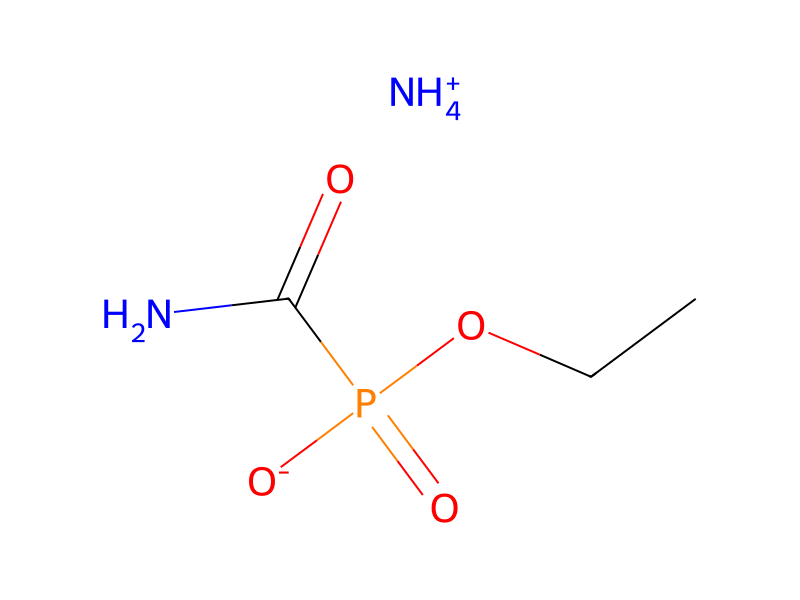
- 標準SMILES
CCOP(=O)([O-])C(N)=O.[NH4+]- InChIKey
OTSAMNSACVKIOJ-UHFFFAOYSA-N- 分子式
- C3H11N2O4P
- 平均分子量
- 170.1 g/mol
- 単同位体質量
- 170.04564346
名称と識別子
- 優先名称
- Fosamine ammonium
- IUPAC
- azanium carbamoyl(ethoxy)phosphinate
名称と別名
Fosamine ammoniumFosamine-ammonium25954-13-6Fosamine ammonium saltKrenite brush control agentAmmonium ethyl carbamoyl phosphonateDTXSID9032406Ammonium ethyl (aminocarbonyl)phosphonateDPX 1108DTXCID7012406RefChem:1085550Ammonium ethyl carbamoylphosphonate
名称をさらに表示
Phosphonic acid, carbamoyl-, monoethyl ester, ammonium salt2350MJR49JPhosphonic acid, (aminocarbonyl)-, monoethyl ester, monoammonium saltFosamine [ANSI]Caswell No. 465GFosamineammoniumHSDB 3435Ammonium, ethyl carbamoylphosphonate
データベース識別子
- CAS
25954-13-6- PubChem CID
- 33256
- DTXSID
DTXSID9032406- UNII
- 2350MJR49J
- EC Number
- 247-363-3
物性
構造計算による物性
- 極性表面積
- 93.5 Ų
- 水素結合供与体数
- 2
- 水素結合受容体数
- 4
- 回転可能結合数
- 3
- 重原子数
- 10
- 形式電荷
- 0
- 複雑度
- 148
実験および物理化学的性質
PesticidesPesticides -> Herbicides, Other
Density1.33
Color/Form
COLORLESS CRYSTALLINE SOLID
WHITE CRYSTALLINE SOLID
Solubility
@ 25 °C: 1.79 KG/KG WATER, 300 MG/KG ACETONE, 400 MG/KG BENZENE, 12 G/KG ETHANOL, 1.4 G/KG DIMETHYLFORMAMIDE, 158 G/KG METHANOL, 200 MG/KG HEXANE
SLIGHTLY SOL IN MOST COMMON ORGANIC SOLVENTS
0.04 g/kg chloroform at 25 °C
CorrosivityCorrosive to copper and brass.
DecompositionDecomposes in dilute solutions of acids.
Melting Point175 °C
Vapor Pressure
0.00000398 [mmHg]
0.53 mPa @ 25 °C
Physical DescriptionColorless or white solid; [HSDB]
Stability/Shelf Life
AQUEOUS FORMULATIONS AND DILUTED SPRAYS ARE STABLE, BUT IT DECOMP IN ACID MEDIA IN DILUTE SOLN (5 MG/L) ... .
Stable in neutral and alkaline media.
Other Experimental PropertiesVap: 4x10⁻⁶ mm Hg at 25 °C
安全と法規制
GHS分類
GHS Classification
This chemical does not meet GHS hazard criteria for 5.5% (3 of 55) of reports.
Warning
H312 (70.9%): Harmful in contact with skin [Warning Acute toxicity, dermal]
P261, P264+P265, P271, P280, P302+P352, P304+P340, P305+P351+P338, P317, P319, P321, P337+P317, P362+P364, P403+P233, P405, and P501 (click each P-code to see the statement)
Aggregated GHS information provided per 55 reports by companies from 3 notifications to the ECHA C&L Inventory. Each notification may be associated with multiple companies.
危険有害性情報
Other Safety InformationIMAP assessments - Phosphonic acid, (aminocarbonyl)-, monoethyl ester, monoammonium salt: Human health tier I assessment
Hazards SummaryAn eye irritant; [MSDSonline]
FIFRA Requirements
As the federal pesticide law FIFRA directs, EPA is conducting a comprehensive review of older pesticides to consider their health and environmental effects and make decisions about their future use. Under this pesticide reregistration program, EPA examines health and safety data for pesticide active ingredients initially registered before November 1, 1984, and determines whether they are eligible for reregistration. In addition, all pesticides must meet the new safety standard of the Food Quality Protection Act of 1996. Pesticides for which EPA had not issued Registration Standards prior to the effective date of FIFRA, as amended in 1988, were divided into three lists based upon their potential for human exposure and other factors, with List B containing pesticides of greater concern and List D pesticides of less concern. Ammonium ethyl carbamolyphosphonate is found on List B. Case No: 2355; Pesticide type: Herbicide; Case Status: RED Approved 12/94; OPP has made a decision that some/all uses of the pesticide are eligible for reregistration, as reflected in a Reregistration Eligibility Decision (RED) document.; Active ingredient (AI): Ammonium ethyl carbamolyphosphonate; Data Call-in (DCI) Date(s): 06/11/91, 03/14/95; AI Status: OPP has completed a Reregistration Eligibility Decision (RED) document for the case/AI.
Hazard Classes and CategoriesAcute Tox. 4 (70.9%)
安全と保護具
Preventive Measures
Avoid contact with skin, syes, and clothing. Do not contaminate water by cleaning of equipment or disposal of wastes.
Irritating to eyes. May irritate nose, throat, skin. Avoid breathing spray or mist.
SRP: The scientific literature for the use of contact lenses in industry is conflicting. The benefit or detrimental effects of wearing contact lenses depend not only upon the substance, but also on factors including the form of the substance, characteristics and duration of the exposure, the uses of other eye protection equipment, and the hygiene of the lenses. However, there may be individual substances whose irritating or corrosive properties are such that the wearing of contact lenses would be harmful to the eye. In those specific cases, contact lenses should not be worn. In any event, the usual eye protection equipment should be worn even when contact lenses are in place.
毒性情報
Ecotoxicity Values
LD50 Mallard duck oral more than 4150 mg (as emulsifiable concentrate)/kg
LD50 Bobwhite quail oral more than 4150 mg (as emulsifiable concentrate)/kg
LC50 Bluegill 278 mg active ingredient (as emulsifiable concentrate)/l/96 hr /Conditions of bioassay not specified/
LC50 Rainbow trout more than 415 mg active ingredient (as emulsifiable concentrate)/l/96 hr /Conditions of bioassay not specified/
For more Ecotoxicity Values (Complete) data for FOSAMINE (6 total), please visit the HSDB record page.
Environmental Fate
AQUATIC FATE: STUDIES SHOWED THAT IT IS STABLE FOR EXTENDED PERIODS IN NEUTRAL OR ALKALINE WATER.
TERRESTRIAL FATE: UNDER FIELD CONDITIONS T/2 IN SOIL WAS APPROX 1 WK FOLLOWING TREATMENT OF PRACTICAL USE LEVELS.
Terrestrial Fate: Rapidly decomposed by soil microorganisms. Half-life in soil is about 10 days.
TERRESTRIAL FATE: AT 10 PPM IT DID NOT AFFECT THE SOIL POPULATION COUNT OF FUNGI & BACTERIA OVER AN 8 WK PERIOD. IT HAD NO EFFECT ON THE SOIL NITRIFICATION PROCESS.
For more Environmental Fate (Complete) data for FOSAMINE (7 total), please visit the HSDB record page.
Acute Toxicity LinkChemical: FOSAMINE AMMONIUM
Soil Adsorption/Mobility
In field studies (conducted in DE, FL, and IL), greenhouse studies, and soil column studies, fosamine-ammonium was found to leach very little, either downward or laterally(1); most undegraded fosamine-ammonium remained in the upper 4 inches of soil(1).
Artificial Pollution SourcesFosamine-ammonium's use as a contact herbicide(1-3) releases the compound directly to the environment through applications in sprays and other routes of application(SRC).
Environmental Biodegradation
Laboratory studies in biometer flasks on two soil types (pHs of 6.4 and 6.5) treated with C-14 fosamine-ammonium demonstrated rapid degradation by microbial action(1); 14-CO2 evolution in nonsterile soils reached 45-75% after 90 days(1); in soil sterilized by a single autoclaving at steam pressure for 15 min, 14-CO2 evolution was only 8-18%(2).
Environmental Bioconcentration
Based upon a water solubility of 1.79 kg/L at 25 °C(1), the BCF of fosamine-ammonium can be estimated to be 0.2 from a recommended regression derived equation(2,SRC). The BCF value indicates that bioconcentration in aquatic organisms is not an important fate process(SRC). In bioaccumulation studies using channel catfish and (14)C fosamine-ammonium, fosamine-ammonium BCFs of less than 1 were measured(2).
Volatilization from Water/Soil
Based upon a vapor pressure of 4X10⁻⁶ mm Hg(1) and a water solubility of 1.79 kg/l at 25 °C(1), the Henry's Law constant for fosamine-ammonium can be estimated to be 5X10-13 atm-cu m/mole (SRC). This value of Henry's Law constant indicates that fosamine-ammonium is essentially nonvolatile from water(2).
Non-Human Toxicity Excerpts
... The emulsifiable concentrate with or without surfactant is not an irritant of eyes and skin of rabbits. In 90 day feeding trials in rats no adverse effects were detected at 1000 mg active ingredient/kg diet.
STATIC 96 HR MEDIAN LETHAL CONCN FOR 12 WATER SOLUBLE HERBICIDES WITH YEARLING COHO SALMON IN FRESHWATER INCL KRENITE WAS MORE THAN 200 MG/L.
RESIDUES IN CHANNEL CATFISH EXPOSED TO 1.1 PPM FOR 4 WK WERE FOUND TO PLATEAU IN 2-3 WK WITH AN ACCUMULATION FACTOR OF LESS THAN 1. NO ADVERSE EFFECTS ON THE FISH OBSERVED DURING THESE EXPERIMENTS.
No pathological changes upon feeding to rats at 10000 mg/kg body wt for 90 days.
Fosamine ammonium has been reported to be teratogenic to avian embryos following spray application of the eggs. The embryotoxic and teratogenic potential of fosamine ammonium was examined in mallards (Anas platyrhynchos) and bobwhite (Colinus virginianus). At 96 hr of development, eggs were briefly immersed in distilled water or in fosamine ammonium formulation in distilled water at concentrations of 1.5, 6.5, or 30% fosamine ammonium. At 6.5% ai, fosamine ammonium reduced hatching success in bobwhite and mallards to 85 and 33% of that in the distilled water controls. At 30% ai, fosamine ammonium caused 95 to 100% mortality in both species by the time of hatching. Early embryonic growth was impaired by 30% fosamine ammonium in both species. There was no evidence of teratogenesis of the axial skeleton, as reported previously in chickens and Japanese quail (Coturnix japonica). Most abnormal embryos had severe edema and some stunting. Mallard hatchlings from the 1.5 and 6.5% fosamine ammonium groups weighed significantly less than controls and had lower plasma alanine aminotransferase and aspartate aminotransferase activities, with elevated plasma glucose and cholesterol concentrations. Brain acetylcholinesterase activity was unaffected by fosamine ammonium in embryos and hatchlings. /Fosamine ammonium/
Environmental Abiotic Degradation
The rate constant for the vapor phase reaction of fosamine-ammonium with photochemically produced hydroxyl radicals has been estimated to be 4.9X10⁻¹¹ cu cm/molecule-sec at 25 °C which corresponds to an atmospheric half-life of about 7.9 hours at an atmospheric concn of 5X10+5 hydroxyl radicals per cu cm(1,SRC). In aqueous hydrolysis studies using buffered water at 20 °C, less than 3% of initial fosamine-ammonium degraded over a 4 week period at pHs of 7 and 9(2); however, at pH 5, a degradation half-life of about 10 days was observed(2). Fosamine-ammonium was found to be stable (less than 2% degradation over 4 weeks) to direct photolysis and photosensitized photolysis (using riboflavin and anthraquinone sensitizers) in photolysis studies using sunlight and water at pH 7.9 and a Brandywine River water at pH 6.5(2); when sediments were added to the river water, degradation reached 45% after 4 weeks, but the degradation process was considered to be biological(2).
Probable Routes of Human ExposureOccupational exposure to fosamine-ammonium occurs through dermal contact and inhalation of dust and sprays, especially to workers applying the compound as a herbicide(1).
Environmental Fate/Exposure Summary
Fosamine-ammonium's use as a contact herbicide releases the compound directly tothe environment through applications in sprays and other routes of application. If released to the atmosphere, fosamine-ammonium will degrade rapidly in the vapor phase by reaction with photochemically produced hydroxyl radicals (half-life of about 7.9 hr). Particulate phase fosamine-ammonium will be removed physically from air by wet and dry deposition. If released to soil or water, fosamine-ammonium can degrade through biodegradation and aqueous hydrolysis; however, hydrolysis will be important only in very acidic soils and water. Results of field, greenhouse and soil column studies have demonstrated that fosamine-ammonium is unlikely to leach under environmental conditions. Field and greenhouse persistence studies have found soil half-lives of about one week to 10 days; carbamoyl phosphonic acid has been identified as a fosamine-ammonium metabolite. Occupational exposure to fosamine-ammonium occurs through dermal contact and inhalation of dust and sprays, especially to workers applying the compound as a herbicide. (SRC)
法規制情報
FIFRA Requirements
As the federal pesticide law FIFRA directs, EPA is conducting a comprehensive review of older pesticides to consider their health and environmental effects and make decisions about their future use. Under this pesticide reregistration program, EPA examines health and safety data for pesticide active ingredients initially registered before November 1, 1984, and determines whether they are eligible for reregistration. In addition, all pesticides must meet the new safety standard of the Food Quality Protection Act of 1996. Pesticides for which EPA had not issued Registration Standards prior to the effective date of FIFRA, as amended in 1988, were divided into three lists based upon their potential for human exposure and other factors, with List B containing pesticides of greater concern and List D pesticides of less concern. Ammonium ethyl carbamolyphosphonate is found on List B. Case No: 2355; Pesticide type: Herbicide; Case Status: RED Approved 12/94; OPP has made a decision that some/all uses of the pesticide are eligible for reregistration, as reflected in a Reregistration Eligibility Decision (RED) document.; Active ingredient (AI): Ammonium ethyl carbamolyphosphonate; Data Call-in (DCI) Date(s): 06/11/91, 03/14/95; AI Status: OPP has completed a Reregistration Eligibility Decision (RED) document for the case/AI.
化学と産業
薬理情報
Metabolism/MetabolitesTHE ELIMINATED (14)C IN URINE & FECES WAS 87% INTACT FOSAMINE AND ABOUT 13% CARBAMOYLPHOSPHONIC ACID.
Absorption, Distribution and Excretion
WHEN ADMIN AS A SINGLE ORAL DOSE TO PRECONDITIONED RATS BY INTRAGASTRIC INTUBATION, RADIOACTIVITY WAS RAPIDLY ELIMINATED IN FECES (87%) & URINE (13%). TRACE AMT FOUND IN THE GI TRACT, HIDE & EXHALED AIR RADIOACTIVITY FOUND IN BODY TISSUES AFTER 72 HR.
Uptake via leaves, (not via roots). No downward transport in the plant.
用途と製造
Uses
Used as herbicide to control woody brush in public easements, forestry, and other non-cropland; [HSDB] No registered food uses; [Reference #1]
Farming (Pesticides) [Category: Industry]
BRUSH CONTROL AGENT & GROWTH REGULANT
CONTACT HERBICIDE
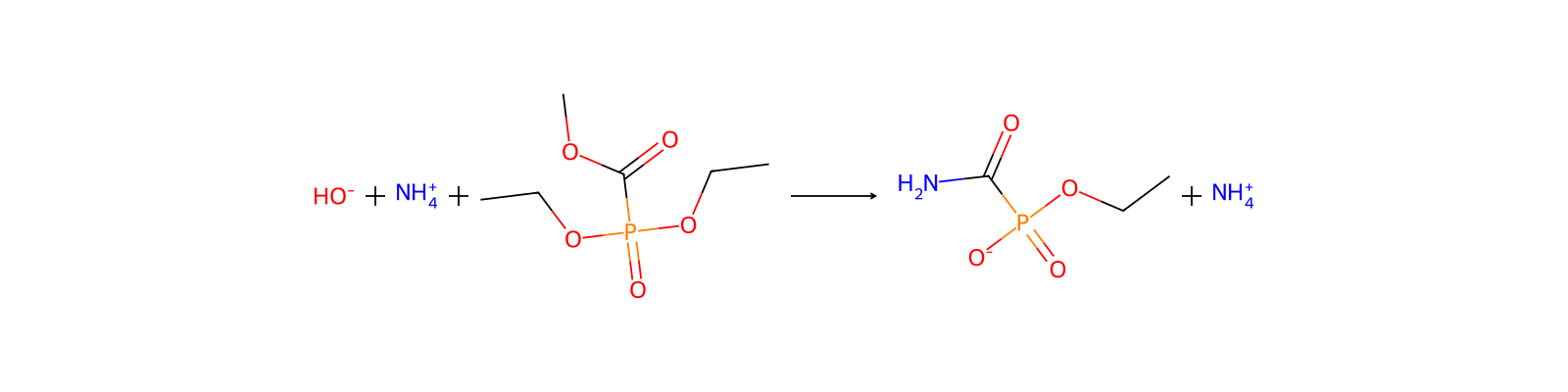
Methods of Manufacturing/PRODUCED/ BY REACTION OF TRIETHYL PHOSPHITE WITH METHYL CHLOROFORMATE & AMMONIA.
Formulations/PreparationsKRENITE BRUSH CONTROL AGENT IS A LIQUID FORMULATION FOR FIELD BINDWEED AND LEAFYSPURGE CONTROL IN NONCROPLAND AREAS. GROWTH REGULANT.
Use ClassificationHERBICIDES
General Manufacturing Information
... FOSAMINE-AMMONIUM ... WAS INTRODUCED /IN 1974/ BY EI DU PONT DE NEMOURS & CO(INC) (US PATENT 3627507; 3846512) AS CODE NUMBER 'DXP 1108', TRADE MARK 'KRENITE'.
USED AS A FOLIAR SPRAY @ RATES OF 1 1/2 TO 3 GALLONS PRODUCT (6 TO 12 POUNDS AI)/ACRE APPLIED IN LATE SUMMER OR EARLY FALL FOR CONTROL &/OR GROWTH SUPPRESSION OF MANY WOODY SPECIES. SUSCEPTIBLE TREATED PLANTS NORMALLY FAIL TO REFOLIATE DURING GROWING SEASON FOLLOWING TREATMENT & SUBSEQUENTLY DIE. KRENITE MAY BE USED ON NONCROPLAND AREAS SUCH AS RAILROAD, PIPELINE, UTILITY & HIGHWAY RIGHTS-OF-WAY, DRAINAGE DITCHBANKS, STORAGE AREAS, INDUSTRIAL PLANT SITES & OTHER SIMILAR AREAS INCLUDING LAND ADJACENT TO & SURROUNDING DOMESTIC WATER SUPPLY RESERVOIRS, SUPPLY STATIONS, LAKES & PONDS. ... FOR SELECTIVE USE IN FORESTRY (CONTROL OF HARDWOODS IN CONIFERS) & FOR FIELD BINDWEED CONTROL IN NONCROPLAND AREAS.
Not to be used on food or feed crops.
Compatible with dalapon-sodium. In other cases, a preliminary test is recommended. ... Do not spray before rain in order to ensure drying of the spray deposits.
関連反応
1 件
関連ノート
読み込み中…