基本情報
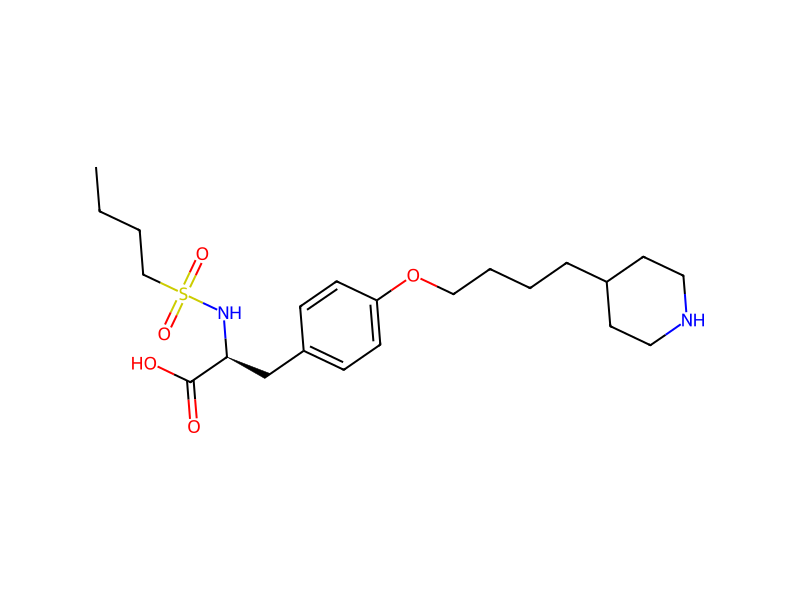
- 標準SMILES
CCCCS(=O)(=O)N[C@@H](Cc1ccc(OCCCCC2CCNCC2)cc1)C(=O)O- InChIKey
COKMIXFXJJXBQG-NRFANRHFSA-N- 分子式
- C22H36N2O5S
- 平均分子量
- 440.6 g/mol
- 単同位体質量
- 440.23449325
概要
Tirofiban is a member of the class of piperidines that is L-tyrosine in which a hydrogen attached to the amino group is replaced by a butylsulfonyl group and in which the hydrogen attached to the phenolic hydroxy group is replaced by a 4-(piperidin-4-yl)butyl group. It has a role as a fibrin modulating drug, an anticoagulant and a platelet glycoprotein-IIb/IIIa receptor antagonist. It is a member of piperidines, a L-tyrosine derivative and a sulfonamide.
名称と識別子
- 優先名称
- Tirofiban
- IUPAC
- (2S)-2-(butylsulfonylamino)-3-[4-(4-piperidin-4-ylbutoxy)phenyl]propanoic acid
名称と別名
名称をさらに表示
データベース識別子
- CAS
144494-65-5- PubChem CID
- 60947
- DTXSID
DTXSID20162730- ChEMBL
CHEMBL916- ChEBI
CHEBI:9605- UNII
- GGX234SI5H
- EC Number
- 635-682-4
- Nikkaji
- J523.557J
物性
構造計算による物性
- XLogP
- 1.4
- 極性表面積
- 113 Ų
- 水素結合供与体数
- 3
- 水素結合受容体数
- 7
- 回転可能結合数
- 14
- 重原子数
- 30
- 形式電荷
- 0
- 複雑度
- 579
実験および物理化学的性質
LogP
log Kow = 1.4 /Estimated/
1.4
Solubility
Very slightly soluble
3.17e-03 g/L
Other Experimental Properties
White to off-white, non-hygroscopic, free-flowing powder; MW: 495.08; very slightly soluble in water. /Tirofiban hydrochloride salt mono hydrate/
Hydroxyl radical reaction rate constant = 1.6X10⁻¹⁰ cu cm/molec-sec at 25 °C /Estimated/
安全と法規制
GHS分類
GHS Classification
Warning
H315 (100%): Causes skin irritation [Warning Skin corrosion/irritation]
P261, P264, P264+P265, P271, P280, P302+P352, P304+P340, P305+P351+P338, P319, P321, P332+P317, P337+P317, P362+P364, P403+P233, P405, and P501 (click each P-code to see the statement)
Aggregated GHS information provided per 39 reports by companies from 2 notifications to the ECHA C&L Inventory. Each notification may be associated with multiple companies.
危険有害性情報
FDA Requirements
The Approved Drug Products with Therapeutic Equivalence Evaluations List identifies currently marketed prescription drug products, incl tirofiban hydrochloride, approved on the basis of safety and effectiveness by FDA under sections 505 of the Federal Food, Drug, and Cosmetic Act. /Tirofiban Hydrochloride/
安全と保護具
Disposal Methods
SRP: The most favorable course of action is to use an alternative chemical product with less inherent propensity for occupational exposure or environmental contamination. Recycle any unused portion of the material for its approved use or return it to the manufacturer or supplier. Ultimate disposal of the chemical must consider: the material's impact on air quality; potential migration in soil or water; effects on animal, aquatic, and plant life; and conformance with environmental and public health regulations.
毒性情報
Interactions
Concurrent use /with other platelet aggregation inhibitors (especially inhibitors of platelet receptor GP IIb/IIIa) is not recommended.
Data from a large clinical study indicate that concomitant administration of tirofiban and levothyroxine or omeprazole was associated with a higher clearance of tirofiban; the clinical importance of this effect is not known.
Environmental Fate
TERRESTRIAL FATE: Based on a classification scheme(1), an estimated Koc value of 40,000(SRC), determined from a structure estimation method(2), indicates that tirofiban is expected to be immobile in soil(SRC). Volatilization of tirofiban from moist soil surfaces is not expected to be an important fate process(SRC) given an estimated Henry's Law constant of 7.4X10⁻¹⁵ atm-cu m/mole(SRC), using a fragment constant estimation method(3). Estimated pKa values of 3.3 (carboxylic acid group) and 10.5 (amino group)(4) indicate that tirofiban will exist as a zwitterion at pH values of 5 to 9 and therefore volatilization from moist soil is not expected to be an important fate process. Tirofiban is not expected to volatilize from dry soil surfaces(SRC) based upon an estimated vapor pressure of 5.2X10⁻¹⁶ mm Hg(SRC), determined from a fragment constant method(5). Biodegradation data were not available(SRC, 2005).
AQUATIC FATE: Based on a classification scheme(1), an estimated Koc value of 40,000(SRC), determined from a structure estimation method(2), indicates that tirofiban is expected to adsorb to suspended solids and sediment(SRC). Volatilization from water surfaces is not expected(3) based upon an estimated Henry's Law constant of 7.4X10⁻¹⁵ atm-cu m/mole(SRC), developed using a fragment constant estimation method(4). Estimated pKa values of 3.3 (carboxylic acid group) and 10.5 (amino group)(5) indicate that tirofiban will exist as a zwitterion at pH values of 5 to 9 and therefore volatilization from water surfaces is not expected to be an important fate process. According to a classification scheme(6), an estimated BCF of 3.2(SRC), from an estimated log Kow of 1.4(7) and a regression derived equation(8), suggests the potential for bioconcentration in aquatic organisms is low. Biodegradation data were not available(SRC, 2005).
ATMOSPHERIC FATE: According to a model of gas/particle partitioning of semivolatile organic compounds in the atmosphere(1), tirofiban, which has an estimated vapor pressure of 5.2X10⁻¹⁶ mm Hg at 25 °C(SRC), determined from a fragment constant method(2), is expected to exist solely in the particulate phase in the ambient atmosphere. Particulate-phase tirofiban may be removed from the air by wet and dry deposition(SRC). Tirofiban does not contain chromophores that absorb light at wavelengths >290 nm and therefore is not be expected to be susceptible to direct photolysis by sunlight(SRC).
Soil Adsorption/Mobility
Using a structure estimation method based on molecular connectivity indices(1), the Koc for tirofiban can be estimated to be 40,000(SRC). According to a classification scheme(2), this estimated Koc value suggests that tirofiban is expected to be immobile in soil.
Human Toxicity Excerpts
/SIGNS AND SYMPTOMS/ Limited information is available on the acute toxicity of tirofiban. In general, overdosage of tirofiban in humans may be expected to produce effects that are extensions of the pharmacologic and adverse effects of the drug, predominantly bleeding. The most frequently reported manifestation of overdosage was bleeding, principally minor bleeding at mucocutaneous and cardiac catheterization sites. Inadvertent overdosage with tirofiban has occurred in doses of up to twice those recommended for an IV loading infusion and up to 9.8 times higher than the recommended maintenance infusion dosage of 0.15 ug/kg per minute
Drug Induced Liver Injury
Drug-Induced Liver Injury Severity and Toxicity (DILIst)
tirofiban
DILI Negative
Intravenous
DOI:10.1016/j.drudis.2019.09.022
Environmental Bioconcentration
An estimated BCF of 3.2 was calculated for tirofiban(SRC), using an estimated log Kow of 1.4(1) and a regression-derived equation(2). According to a classification scheme(3), this BCF suggests the potential for bioconcentration in aquatic organisms is low(SRC).
Volatilization from Water/Soil
The Henry's Law constant for tirofiban is estimated as 7.4X10⁻¹⁵ atm-cu m/mole(SRC) using a fragment constant estimation method(1). This Henry's Law constant indicates that tirofiban is expected to be essentially nonvolatile from water surfaces(2). Estimated pKa values of 3.3 (carboxylic acid group) and 10.5 (amino group)(3) indicate that tirofiban will exist as a zwitterion at pH values of 5 to 9 and therefore volatilization from moist soil surfaces and water surfaces is not expected to be an important fate process. Tirofiban is not expected to volatilize from dry soil surfaces(SRC) based upon an estimated vapor pressure of 5.2X10⁻¹⁶ mm Hg(SRC), determined from a fragment constant method(4).
Non-Human Toxicity Excerpts
/LABORATORY ANIMALS: Developmental or Reproductive Toxicity/ Studies with tirofiban HCl at intravenous doses up to 5 mg/kg/day ... for rats and rabbits ... have revealed no harm to the fetus. /Tirofiban hydrochloride/
/LABORATORY ANIMALS: Developmental or Reproductive Toxicity/ Fertility and reproductive performance were not affected in studies with male and female rats given intravenous doses of tirofiban hydrochloride up to 5 mg/kg/day.
/GENOTOXICITY/ Tirofiban HCl was negative in the in vitro microbial mutagenesis and V-79 mammalian cell mutagenesis assays. In addition, there was no evidence of direct genotoxicity in the in vitro alkaline elution and in vitro chromosomal aberration assays. There was no induction of chromosomal aberrations in bone marrow cells of male mice after the administration of intravenous doses up to 5 mg tirofiban/kg. /Tirofiban hydrochloride/
Environmental Abiotic Degradation
Tirofiban is not expected to undergo hydrolysis in the environment due to the lack of hydrolyzable functional groups(1). Tirofiban does not contain chromophores that absorb light at wavelengths >290 nm and therefore is not be expected to be susceptible to direct photolysis by sunlight(SRC).
Probable Routes of Human Exposure
Occupational exposure to tirofiban may occur through inhalation and dermal contact with this compound at workplaces where tirofiban is produced or used. Exposure to the drug among the general population exposure may be limited to those individuals being administered tirofiban (an antithrombotic). (SRC)
Environmental Fate/Exposure Summary
Tirofiban's production and use as an antithrombotic may result in its release to the environment through various waste streams. If released to air, an estimated vapor pressure of 5.2X10⁻¹⁶ mm Hg at 25 °C indicates tirofiban will exist solely in the particulate phase in the ambient atmosphere. Particulate-phase tirofiban will be removed from the atmosphere by wet and dry deposition. Tirofiban does not contain chromophores that absorb light at wavelengths >290 nm and therefore is not be expected to be susceptible to direct photolysis by sunlight. If released to soil, tirofiban is expected to have no mobility based upon an estimated Koc of 40,000. Volatilization from moist soil surfaces is not expected to be an important fate process based upon the estimated Henry's Law constant of 7.4X10⁻¹⁵ atm-cu m/mol and estimated pKa values. A pKa of 3.3 (carboxylic acid group) and a pKa of 10.5 (amine group) indicate that tirofiban will exist as a zwitterion at environmental pH and therefore volatilization from moist soil is not expected to be an important fate process. Tirofiban is not expected to volatilize from dry soil surfaces based upon its vapor pressure. If released into water, tirofiban is expected to adsorb to suspended solids and sediment based upon the estimated Koc. Volatilization from water surfaces is not expected to be an important fate process based upon this compound's estimated Henry's Law constant and estimated pKas. Tirofiban will exist as a zwitterion at pH values of 5 to 9 and therefore volatilization from water surfaces is not expected to be an important fate process. An estimated BCF of 3.2 suggests the potential for bioconcentration in aquatic organisms is low. Hydrolysis is not expected to be an important environmental fate process since this compound lacks functional groups that hydrolyze under environmental conditions. Occupational exposure to tirofiban may occur through inhalation and dermal contact with this compound at workplaces where tirofiban is produced or used. Exposure to the drug among the general population exposure may be limited to those individuals being administered tirofiban (an antithrombotic). (SRC)
法規制情報
FDA Requirements
The Approved Drug Products with Therapeutic Equivalence Evaluations List identifies currently marketed prescription drug products, incl tirofiban hydrochloride, approved on the basis of safety and effectiveness by FDA under sections 505 of the Federal Food, Drug, and Cosmetic Act. /Tirofiban Hydrochloride/
化学と産業
薬理情報
ATC Code
B01AC17
B - Blood and blood forming organs
QB - Blood and blood forming organs
Pharmacodynamics
Tirofiban prevents the blood from clotting during episodes of chest pain or a heart attack, or while the patient is undergoing a procedure to treat a blocked coronary artery. It is a non-peptide antagonist of the platelet glycoprotein (GP) IIb/IIIa receptor, and inhibits platelet aggregation. When administered intravenously, tirofiban inhibits ex vivo platelet aggregation in a dose- and concentration-dependent manner. When given according to the recommended regimen, >90% inhibition is attained by the end of the 30-minute infusion. Tirofiban has been recently shown in patients with unstable angina to reduce ischemic events at 48 hours following infusion when compared to standard heparin therapy.
Mechanism of Action
Tirofiban is a reversible antagonist of fibrinogen binding to the GP IIb/IIIa receptor, the major platelet surface receptor involved in platelet aggregation. Platelet aggregation inhibition is reversible following cessation of the infusion of tirofiban.
Tirofiban inhibits platelet aggregation by reversibly binding to the platelet receptor glycoprotein (GP) IIb/IIIa of human platelets, thus preventing the binding of fibrinogen. Inhibition of platelet aggregation occurs in a dose- and concentration-dependent manner.
Biological Half-Life
2 hours
Elimination: Approximately 2 hours.
Metabolism/Metabolites
Metabolism appears to be limited.
Metabolism appears to be limited.
FDA Pharmacological Classification
GGX234SI5H
TIROFIBAN
Physiologic Effects [PE] - Decreased Platelet Aggregation
Established Pharmacologic Class [EPC] - Platelet Aggregation Inhibitor
Tirofiban is a Platelet Aggregation Inhibitor. The physiologic effect of tirofiban is by means of Decreased Platelet Aggregation.
TIROFIBAN
MeSH Pharmacological Classification
Fibrinolysin or agents that convert plasminogen to FIBRINOLYSIN.
Drugs or agents which antagonize or impair any mechanism leading to blood platelet aggregation, whether during the phases of activation and shape change or following the dense-granule release reaction and stimulation of the prostaglandin-thromboxane system.
Absorption, Distribution and Excretion
It is cleared from the plasma largely by renal excretion, with about 65% of an administered dose appearing in urine and about 25% in feces, both largely as unchanged tirofiban.
22 to 42 L
213 - 314 mL/min [Healthy subjects]
Not highly bound to plasma proteins; protein binding is concentration-independent over the range of 0.01 to 25 ug/mL. Unbound fraction in human plasma is 35%.
Tirofiban is approximately 65% bound to plasma proteins ... The steady-state volume of distribution of tirofiban ranges from 22-42 L. It is not known whether tirofiban is distributed into milk or crosses the placenta in humans; however, the drug is distributed into milk in rats and crosses the placenta in pregnant rats and rabbits.
About 65 and 25% of a single dose of tirofiban is excreted in urine and feces, respectively, principally as unchanged parent drug. Plasma clearance of tirofiban in healthy individuals ranges from 213-314 mL/minute, with renal clearance accounting for 39-69% of plasma clearance. In patients with coronary artery disease, the plasma clearance of tirofiban ranges from 152-267 mL/minute and does not appear to be influenced by gender or race; renal clearance in these patients accounts for 39% of plasma clearance. Plasma clearance is about 19-26% lower in geriatric patients (those exceeding 65 years of age) with coronary artery disease than in younger patients. Plasma clearance appears to be independent of dose in healthy individuals and is not appreciably affected by mild to moderate hepatic insufficiency. In patients with renal impairment (creatinine clearance less than 30 mL per minute), including those requiring hemodialysis, plasma clearance of tirofiban is decreased by greater than 50% compared with that in individuals with normal renal function. Tirofiban is removed by hemodialysis.
用途と製造
Formulations/Preparations
Parenteral: For injection, concentrate, for IV infusion 250 ug (of tirofiban) per mL (6.25 and 12.5 mg) Aggrastat, (Merck). /Tirofiban hydrochloride/
Parenteral: Injection, for IV infusion 50 ug (of tirofiban) per mL (12.5 mg) in 0.9% sodium chloride Aggrastat Premixed in Iso-osmotic Sodium Chloride Injection (in IntraVia flexible container), (Merck). /Tirofiban hydrochloride in sodium chloride/
General Manufacturing Information
Specific nonpeptide platelet fibrinogen receptor (GPIIb/IIIa) antagonist.
Information available in 2005 indicated that Tirofiban was used in the manufacture of pharmaceutical preparations in the following countries: Spain (1)
Information available in 2005 indicated that Tirofiban hydrochloride monohydrate was used in the manufacture of pharmaceutical preparations in the following countries: Argentina, Australia, Austria, Belgium, Brazil, Canada, Chile, Colombia, Costa Rica, Croatia, Czech Republic, Denmark, Ecuador, El Salvador, Finland, France, Germany, Greece, Guatemala, Honduras, Hong Kong, Hungary, Ireland, Israel, Italy, Malaysia, Mexico, Netherlands, New Zealand, Nicaragua, Norway, Panama, Poland, Romania, Singapore, South Africa, Spain, Sweden, Switzerland, Thailand, Turkey, United Kingdom, United States (1,2)
関連反応
現在のフィルター条件では反応記録がありません。
関連ノート
読み込み中…