
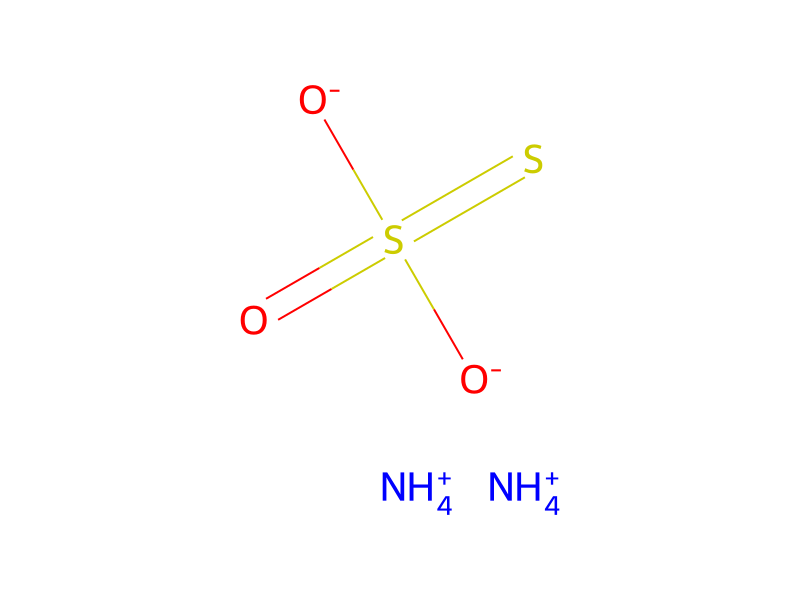
基本情報
- 標準SMILES
O=S([O-])([O-])=S.[NH4+].[NH4+]- InChIKey
XYXNTHIYBIDHGM-UHFFFAOYSA-N- 分子式
- H8N2O3S2
- 平均分子量
- 148.21 g/mol
- 単同位体質量
- 147.99763412
概要
Ammonium thiosulfate is a white crystalline solid. It is very soluble in water. The primary hazard is the threat posed to the environment. Immediate steps should be taken to limit its spread to the environment. It is used in photography, in chemical analysis, and for many other uses.
名称と識別子
- 優先名称
- Ammonium thiosulfate
- IUPAC
- diazanium;dioxido-oxo-sulfanylidene-λ6-sulfane
名称と別名
AMMONIUM THIOSULFATE7783-18-8Ammonium thiosulphateThio-SulAmmonium hyposulfiteAmmo hypoDiammonium thiosulfateThiosulfuric acid, diammonium saltAmmonium thiosulfate ((NH4)2S2O3)DTXSID6029703Thiosulfuric acid (H2S2O3), diammonium saltBKH1729645
名称をさらに表示
DTXCID509703CHEBI:147402RefChem:112212231-982-0AMMONIUMTHIOSULFATEdiammonium sulfurothioatediazanium;dioxido-oxo-sulfanylidene-lambda6-sulfaneDIAMMONIUM THIOSULPHATE
データベース識別子
- CAS
7783-18-8- PubChem CID
- 6096946
- DTXSID
DTXSID6029703- ChEBI
CHEBI:147402- UNII
- BKH1729645
- EC Number
- 231-982-0
物性
構造計算による物性
- 極性表面積
- 106 Ų
- 水素結合供与体数
- 2
- 水素結合受容体数
- 4
- 回転可能結合数
- 0
- 重原子数
- 7
- 形式電荷
- 0
- 複雑度
- 82.6
実験および物理化学的性質
Chemical ClassesNitrogen Compounds -> Ammonium Compounds
pH6.5-7.0 (60% soln)
OdorAMMONIA ODOR
Density
2 at 68 °F (USCG, 1999) - Denser than water; will sink
1.33 at 60.8 °F (USCG, 1999) - Denser than water; will sink
1.679
1.679 @25 °C
Color/Form
COLORLESS, MONOCLINIC CRYSTALS
WHITE CRYSTALS
Solubility
64 % at 68 °F (NTP, 1992)
VERY SOL IN COLD WATER; IN 100 CC OF WATER: 103.3 G @ 100 °C; SLIGHTLY SOL IN ACETONE
INSOL IN ALCOHOL, ETHER
Corrosivity
Copper-base alloys are seriously corroded by ... ammonium thiosulfate with corrosion rates exceeding 10 kg/(square meter year) at 100 °C.
High silicon cast iron has reasonable corrosion resistance /to ammonium thiosulfate/ with a corrosion rate < 4.4 kg/(square meter year) at 100 °C.
The corrosion rate for stainless steels /to ammonium thiosulfate/ is < 440 g/(square meter year) at 100 °C.
Boiling Point
Decomposes (NTP, 1992)
122 °F at 760 mmHg (USCG, 1999)
DecompositionDecomposed by heat
Melting Point
Decomposes at 302 °F (NTP, 1992)
50 °F (USCG, 1999)
150 °C (DECOMP)
Vapor Pressure0 mmHg (NTP, 1992)
Food Contact SubstancesFCS -> FDA Inventory of Food Contact Substances Listed in 21 CFR
安全と法規制
GHS分類
GHS Classification
This chemical does not meet GHS hazard criteria for 97.1% (168 of 173) of all reports.
Not Classified
Aggregated GHS information provided per 173 reports by companies from 5 notifications to the ECHA C&L Inventory.
危険有害性情報
Regulatory Information
Chemical: Thiosulfuric acid (H2S2O3), diammonium salt
Thiosulfuric acid (H2S2O3), ammonium salt (1:2) is listed on the EPA's Chemical Data Reporting (CDR) system. Manufacturers and importers of Thiosulfuric acid (H2S2O3), ammonium salt (1:2) are required to report information about their production and use of this chemical to the EPA under the Toxic Substances Control Act (TSCA). (40 eCFR Part 711)
REACH registered substance: Ammonium thiosulphate (EC: 231-982-0)
Ammonium thiosulphate: Does not have an individual approval but may be used under an appropriate group standard
Other Safety InformationIMAP assessments - Thiosulfuric acid (H2S2O3), diammonium salt: Human health tier I assessment
Fire Hazards
Special Hazards of Combustion Products: Toxic ammonia, hydrogen sulfide, and oxides of nitrogen and sulfur may form in fires. (USCG, 1999)
Special Hazards of Combustion Products: Toxic ammonia, hydrogen sulfide, and oxides of nitrogen and sulfur may form in fires. (USCG, 1999)
Health Hazards
Inhalation of dust may irritate respiratory system. Ingestion could be harmful. Contact with eyes or skin may cause irritation. (USCG, 1999)
Contact with eyes may cause eye irritation with discomfort, tearing, or blurring of vision. Contact with skin may cause irritation with discomfort or rash. (USCG, 1999)
Hazards Summary
A skin, eye, and respiratory tract irritant; Emergency treatment: Sodium thiosulfate; Ingestion of 12 grams of sodium thiosulfate is nontoxic except for violent laxative effect; [HSDB] Lethal dose effects include convulsions and acute tubular necrosis; [RTECS] An irritant; [MSDSonline] See Sodium thiosulfate.
FDA RequirementsAmmonium thiosulfate is an indirect food additive for use only as a component of adhesives.
Reactive Group
Salts, Acidic
Salts, Acidic
FIFRA Requirements
Residues of ammonium thiosulfate are exempted from the requirement of a tolerance when used as an intensifier when used with ammonium nitrate as a desiccant or defoliant in accordance with good agricultural practices as inert (or occasionally active) ingredients in pesticide formulations applied to growing crops or to raw agricultural commodities after harvest.
Reactivity Alerts
Strong Reducing Agent
Strong Reducing Agent
Reactivity Profile
AMMONIUM THIOSULFATE is sensitive to heat. This chemical is incompatible with magnesium and aluminum powder. Mixtures with sodium chlorate can cause an exothermic reaction which can then decompose explosively. (NTP, 1992). Reacts with strong oxidizers such as chlorates, nitrates, and nitrites to release toxic ammonia, hydrogen sulfide, and sulfur trioxide gases. Will not polymerize. Ammonia, hydrogen sulfide, and oxides of nitrogen and oxides of sulfur may form in fires (USCG, 1999).
AMMONIUM THIOSULFATE SOLUTION is sensitive to heat. This chemical is incompatible with magnesium and aluminum powder. Mixtures with sodium chlorate can cause an exothermic reaction which can then decompose explosively. (NTP, 1992). Reacts with strong oxidizers such as chlorates, nitrates, and nitrites to release toxic ammonia, hydrogen sulfide, and sulfur trioxide gases. Will not polymerize. Ammonia, hydrogen sulfide, and oxides of nitrogen and oxides of sulfur may form in fires (USCG, 1999).
Air and Water Reactions
Hygroscopic. Very soluble in water.
No rapid reaction with air. No rapid reaction with water.
Toxic Combustion ProductsTOXIC AMMONIA, HYDROGEN SULFIDE, AND OXIDES OF NITROGEN SULFUR MAY FORM IN FIRES.
安全と保護具
Fire FightingFire Extinguishing Agents: Use extinguishing agents appropriate for the surrounding fire. (USCG, 1999)
First Aid
EYES: First check the victim for contact lenses and remove if present. Flush victim's eyes with water or normal saline solution for 20 to 30 minutes while simultaneously calling a hospital or poison control center. Do not put any ointments, oils, or medication in the victim's eyes without specific instructions from a physician. IMMEDIATELY transport the victim after flushing eyes to a hospital even if no symptoms (such as redness or irritation) develop.
Get medical attention.
Preventive Measures
SRP: The scientific literature for the use of contact lenses in industry is conflicting. The benefit or detrimental effects of wearing contact lenses depend not only upon the substance, but also on factors including the form of the substance, characteristics and duration of the exposure, the uses of other eye protection equipment, and the hygiene of the lenses. However, there may be individual substances whose irritating or corrosive properties are such that the wearing of contact lenses would be harmful to the eye. In those specific cases, contact lenses should not be worn. In any event, the usual eye protection equipment should be worn even when contact lenses are in place.
SRP: Contaminated protective clothing should be segregated in such a manner so that there is no direct personal contact by personnel who handle, dispose, or clean the clothing. Quality assurance to ascertain the completeness of the cleaning procedures should be implemented before the decontaminated protective clothing is returned for reuse by the workers. Contaminated clothing should not be taken home at end of shift, but should remain at employee's place of work for cleaning.
Allowable Tolerances
Residues of ammonium thiosulfate are exempted from the requirement of a tolerance when used as an intensifier when used with ammonium nitrate as a desiccant or defoliant in accordance with good agricultural practices as inert (or occasionally active) ingredients in pesticide formulations applied to growing crops or to raw agricultural commodities after harvest.
Protective Action Criteria (PAC)
1.5 [ppm]
16 [ppm]
94 [ppm]
Personal Protective Equipment (PPE)
Respirator; rubber gloves; safety glasses; face shield; rubber apron, shield, or suit as necessary to prevent skin contact (USCG, 1999)
Wear chemical protective gloves to prevent contact with solution. Use splash-proof chemical goggles or face shield to prevent splashes from contacting the eyes. (USCG, 1999)
RESPIRATOR; RUBBER GLOVES; SAFETY GLASSES; FACE SHIELD; RUBBER APRON, SHIELD, OR SUIT AS NECESSARY TO PREVENT SKIN CONTACT.
毒性情報
Toxicity Summary
IDENTIFICATION AND USE:Ammonium thiosulfate exists as colorless, monoclinic or white crystals with ammonia like odor. It is very soluble in cold water; slightly soluble in acetone and insoluble in alcohol and ether. It is used to clean white metal; in lubricants for metal cold working, as an analytical reagent; fungicide, reducing agent; brightener in silver plating bath, and in hair waving preparations; fog screens, and cleaning compounds for zinc base die cast metals and it is used as a desiccant and defoliant in crop bearing plants. HUMAN EXPOSURE AND TOXICITY: Inhalation of dust may irritate respiratory system. Contact with eyes or skin may cause irritation. Ingestion may be harmful. ANIMAL STUDIES: No animal studies found.
Human Toxicity ExcerptsINHALATION OF DUST MAY IRRITATE RESPIRATORY SYSTEM. INGESTION COULD BE HARMFUL. CONTACT WITH EYES OR SKIN MAY CAUSE IRRITATION.
Environmental BioconcentrationBOD: 0.62 LB/LB, 5 DAYS
Toxicity DataLC (rat) > 2,260 mg/m3/4h
法規制情報
FDA RequirementsAmmonium thiosulfate is an indirect food additive for use only as a component of adhesives.
FIFRA Requirements
Residues of ammonium thiosulfate are exempted from the requirement of a tolerance when used as an intensifier when used with ammonium nitrate as a desiccant or defoliant in accordance with good agricultural practices as inert (or occasionally active) ingredients in pesticide formulations applied to growing crops or to raw agricultural commodities after harvest.
化学と産業
薬理情報
Absorption, Distribution and ExcretionPOORLY ABSORBED FROM ALIMENTARY TRACT AND SO ACTS AS AN OSMOTIC CATHARTIC. /THIOSULFATE SALTS/
用途と製造
Uses
Used to clean white metal and zinc-base die-cast metals and as a reducing agent and brightener in silver plating baths; Also used in photography, lubricants (for metal cold-working), fungicides, hair-waving preparations, fog screens, and in desiccants and defoliants (crop-bearing plants such as cotton, soybean, alfalfa, rice, and peppers); [HSDB]
Metal Machining [Category: Heat or Machine]
TO CLEAN "WHITE" METAL; IN PHOTOGRAPHY; IN LUBRICANTS FOR METAL COLD-WORKING.
ANALYTICAL REAGENT; FUNGICIDE; REDUCING AGENT; BRIGHTENER IN SILVER PLATING BATH; HAIR-WAVING PREPN; FOG SCREENS; CLEANING COMPOUNDS FOR ZINC-BASE DIE-CAST METALS.
Used as desiccants and defoliants in crop-bearing plants such as cotton, soybean, alfalfa, rice and peppers; Minor and potential new uses for ammonium thiosulfate include flue-gas desulfurization, removal of nitrogen oxides and sulfur dioxide from flue gases, converting sulfur in hydrocarbons to a water-soluble form, and converting cellulose to hydrocarbons.
ImpuritiesPhotographic grade /potential/ impurities: Sulfur; sulfur trioxide; lead; iron; & insoluble matter.
U.S. Production
2023: 1,000,000,000 - <2,500,000,000 lb
(1981) 8.54X10+10 G.
Consumption PatternsPhotography, 48%; Agricultural applications, 50%; Others including dechlorination, 2% (1981).
Consumer UsesPhotosensitive agent
Industry UsesDusting agent
Methods of Manufacturing
Direct reaction of ammonium sulfite with sulfur.
In the ATS process, sulfur dioxide is absorbed from incinerated Claus tail gas in aqueous ammonia to produce ammonium sulfite and ammonium bisulfite in solution. The solution passes to a converter where it flows countercurrent to hydrogen sulfide ... ammonium thiosulfate forms /in solution and/ is concentrated to 60 wt%.
Formulations/Preparations
Grades or purity: Technical; analytical; technical, 60% soln in water.
GRADES: PURE CRYSTALS (97%); 60% PHOTOGRAPHIC SOLN.
/Available as/ 58% solution, technical grade.
Agricultural grades
For more Formulations/Preparations (Complete) data for AMMONIUM THIOSULFATE (6 total), please visit the HSDB record page.
General Manufacturing Information
Oil and Gas Drilling, Extraction, and Support activities
Thiosulfuric acid (H2S2O3), ammonium salt (1:2): ACTIVE
It is compatible in any proportion with neutral or alkaline phosphate containing liquid fertilizers as well as with aqueous ammonia and nitrogen solutions.
関連反応
3 件


関連ノート
読み込み中…