| GHS 分類 | This chemical does not meet GHS hazard criteria for 98.3% (338 of 344) of all reports.Not ClassifiedAggregated GHS information provided per 344 reports by companies from 5 notifications to the ECHA C&L Inventory. |
|---|
| 規制情報 | Chemical: L-PhenylalanineRegulation (EC) No 1831/2003 (amended)Status: Active Update: 01-06-2022 https://echa.europa.eu/registration-dossier/-/registered-dossier/16991Phenylalanine: Does not have an individual approval but may be used under an appropriate group standardL-Phenylalanine: Does not have an individual approval but may be used under an appropriate group standard |
|---|
| その他の安全情報 | IMAP assessments - L-Phenylalanine: Environment tier I assessment |
|---|
| 火災危険 | Flash point data for this chemical are not availablehowever, it is probably combustible. (NTP, 1992) |
|---|
| 健康有害性 | ACUTE/CHRONIC HAZARDS: When heated to decomposition this compound emits toxic fumes of nitrogen oxides. (NTP, 1992) |
|---|
| 有害性の概要 | Safe when used as a flavoring agent in food[JECFA] May cause irritation[Sigma-Aldrich MSDS] |
|---|
| FDA 要件 | L-Phenylalanine is a food additive permitted for direct addition to food for human consumption, as long as 1) the quantity of the substance added to food does not exceed the amount reasonably required to accomplish its intended physical, nutritive, or other technical effect in food, and 2) any substance intended for use in or on food is of appropriate food grade and is prepared and handled as a food ingredient.Drug products containing certain active ingredients offered over-the-counter (OTC) for certain uses. A number of active ingredients have been present in OTC drug products for various uses, as described below. However, based on evidence currently available, there are inadequate data to establish general recognition of the safety and effectiveness of these ingredients for the specified uses: phenylalanine is included in weight control drug products.Phenylalanine used as a nutrient and/or dietary supplement in animal drugs, feeds, and related products is generally recognized as safe when used in accordance with good manufacturing or feeding practice. |
|---|
| 反応性グループ | Salts, Acidic |
|---|
| Special Reports | NAS, Food and Nutrition Board, Institute of MedicineDietary Reference Intakes for Energy, Carbohydrate, Fiber, Fat, Fatty Acids, Cholesterol, Protein, and Amino Acids (Macronutrients). National Academy Press, Washington, D.C. (2009).[Available from, as of March 10, 2010: http://www.nap.edu/catalog/10490.html] |
|---|
| Reactivity Profile | L-PHENYLALANINE may be light sensitive. Acts as a weak acid in solution. |
|---|
| Air and Water Reactions | Water soluble. Aqueous solutions are weak acids. |
|---|
| Hazard Classes and Categories | Not Classified |
|---|
| 消火 | Fires involving this material can be controlled with a dry chemical, carbon dioxide or Halon extinguisher. (NTP, 1992) |
|---|
| 応急処置 | EYES: First check the victim for contact lenses and remove if present. Flush victim's eyes with water or normal saline solution for 20 to 30 minutes while simultaneously calling a hospital or poison control center. Do not put any ointments, oils, or medication in the victim's eyes without specific instructions from a physician. IMMEDIATELY transport the victim after flushing eyes to a hospital even if no symptoms (such as redness or irritation) develop. |
|---|
| 非火災時の漏出対応 | SMALL SPILLS AND LEAKAGE: If you spill this chemical, you should dampen the solid spill material with water, then transfer the dampened material to a suitable container. Use absorbent paper dampened with water to pick up any remaining material. Seal your contaminated clothing and the absorbent paper in a vapor-tight plastic bag for eventual disposal. Wash all contaminated surfaces with a soap and water solution. Do not reenter the contaminated area until the Safety Officer (or other responsible person) has verified that the area has been properly cleaned. |
|---|
| 処分方法 | SRP: Criteria for land treatment or burial (sanitary landfill) disposal practices are subject to significant revision. Prior to implementing land disposal of waste residue (including waste sludge), consult with environmental regulatory agencies for guidance on acceptable disposal practices.SRP: At the time of review, regulatory criteria for small quantity disposal are subject to significant revision, however, household quantities of waste pharmaceuticals may be managed as follows: Mix with wet cat litter or coffee grounds, double bag in plastic, discard in trash.SRP: Expired or waste pharmaceuticals shall carefully take into consideration applicable DEA, EPA, and FDA regulations. It is not appropriate to dispose by flushing the pharmaceutical down the toilet or discarding to trash. If possible return the pharmaceutical to the manufacturer for proper disposal being careful to properly label and securely package the material. Alternatively, the waste pharmaceutical shall be labeled, securely packaged and transported by a state licensed medical waste contractor to dispose by burial in a licensed hazardous or toxic waste landfill or incinerator. |
|---|
| Personal Protective Equipment (PPE) | RECOMMENDED RESPIRATOR: Where the neat test chemical is weighed and diluted, wear a NIOSH-approved half face respirator equipped with an organic vapor/acid gas cartridge (specific for organic vapors, HCl, acid gas and SO2) with a dust/mist filter. (NTP, 1992) |
|---|
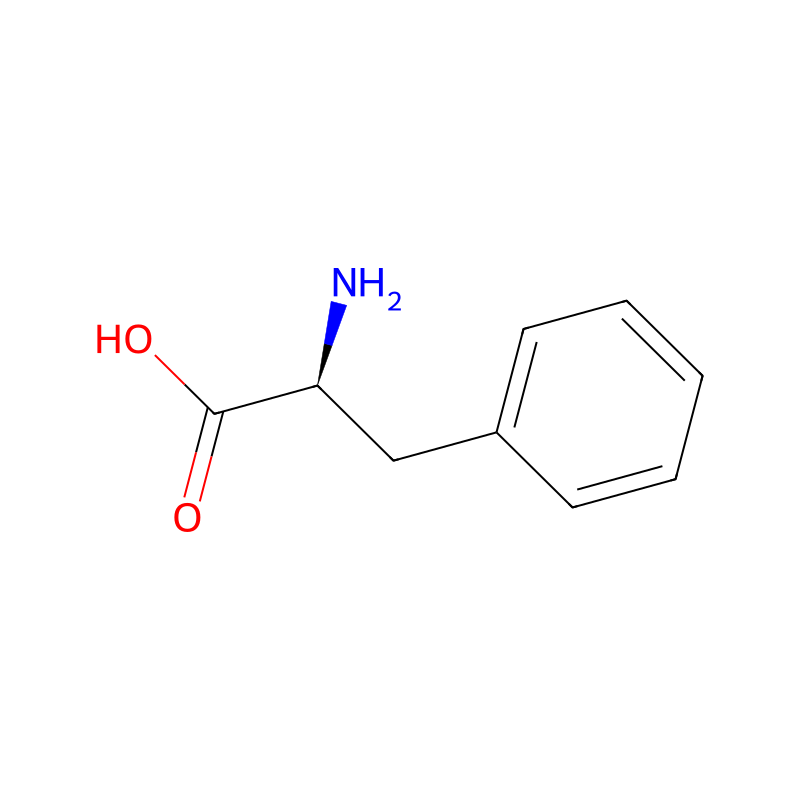
| 体内負荷 | Phenylalanine is an essential aromatic amino acid and is a precursor of melanin, dopamine, noradrenalin, and thyroxine(1). |
|---|
| Treatment | If PKU is diagnosed early, an affected newborn can grow up with normal brain development, but only by managing and controlling phenylalanine levels through diet, or a combination of diet and medication. The diet requires severely restricting or eliminating foods high in phenylalanine, such as meat, chicken, fish, eggs, nuts, cheese, legumes, milk and other dairy products. Starchy foods, such as potatoes, bread, pasta, and corn, must be monitored. Optimal health ranges (or "target ranges") of serum phenylalanine are between 120 and 360 µmol/L, and aimed to be achieved during at least the first 10 years of life. Recently it has been found that a chiral isomer of L-phenylalanine (called D-phenylalanine) actually arrests the fibril formation by L-phenylalanine and gives rise to flakes. These flakes do not propagate further and prevent amyloid formation by L-phenylalanine. D-phenylalanine may qualify as a therapeutic molecule in phenylketonuria (A8161). |
|---|
| 相互作用 | Ochratoxin A (0.8 mg) injected ip together with 0.8 mg of phenylalanine, 97% of animals survived, and 100% survived when 1 mg of phenylalanine was injected. |
|---|
| 健康影響 | Phenylalanine is neurotoxic. Chronic exposure to very high levels of phenylalanine in the blood (as found in phenylketonuria, or PKU) can lead to a build up in the cerebrospinal fluid and brain, leading to seizures, organ damage and unusual posture. High phenylalnine levels are particularly dangerous for children, because it retards brain development and can cause serious learning difficulties. Complications of PKU include severe intellectual disability, brain function abnormalities, microcephaly, mood disorders, irregular motor functioning, and behavioral problems such as attention deficit hyperactivity disorder. Chronically high levels of phenylalanine are associated with at least four other inborn errors of metabolism including: Hartnup Disorder, Hyperphenylalaniemia due to guanosine triphosphate cyclohydrolase deficiency, Tyrosinemia Type 2 (or Richner-Hanhart syndrome) and Tyrosinemia Type 3 (TYRO3). |
|---|
| 環境中動態 | TERRESTRIAL FATE: Based on a classification scheme(1), an estimated Koc value of 54(SRC), determined from a log Kow of -1.38(2) and a regression-derived equation(3), indicates that (L)-phenylalanine is expected to have high mobility in soil(SRC). Amino acids are ionic over the entire pH range and tend to be cationic in acidic media, zwitterionic in neutral media, and anioic in basic media(4). The pKa values of (L)-phenylalanine are 1.83 and 9.13(5), indicating that this compound will exist almost entirely in the ion form in the environment. Volatilization from moist soil is not expected because the acid exists as an ion and ions do not volatilize. (L)-Phenylalanine is not expected to volatilize from dry soil surfaces(SRC) based upon an estimated vapor pressure of 1.76X10⁻⁸ mm Hg at 25 °C(SRC), determined from a fragment constant method(6). Oxygen uptake was measured at 145 mg/L O2 over 3 hours in the Warburg test(7), indicating that biodegradation may be an important environmental fate process in soil(SRC).AQUATIC FATE: Based on a classification scheme(1), an estimated Koc value of 54(SRC), determined from a log Kow of -1.38(2) and a regression-derived equation(3), indicates that (L)-phenylalanine is not expected to adsorb to suspended solids and sediment(SRC). Amino acids are ionic over the entire pH range and tend to be cationic in acidic media, zwitterionic in neutral media, and anioic in basic media(4). Measured pKa values of 1.83 and 9.13(5) indicate (L)-phenylalanine will exist almost entirely in the ion form at pH values of 5 to 9 and therefore volatilization from water surfaces is not expected to be an important fate process(6). According to a classification scheme(7), an estimated BCF of 3(SRC), from its log Kow(2) and a regression-derived equation(3), suggests the potential for bioconcentration in aquatic organisms is low(SRC). Oxygen uptake was measured at 145 mg/L O2 over 3 hours in the Warburg test(8), indicating that biodegradation may be an important environmental fate process in water(SRC).ATMOSPHERIC FATE: According to a model of gas/particle partitioning of semivolatile organic compounds in the atmosphere(1), (L)-phenylalanine, which has an estimated vapor pressure of 1.76X10⁻⁸ mm Hg at 25 °C(SRC), determined from a fragment constant method(2), will exist in both the vapor and particulate phases in the ambient atmosphere. Vapor-phase (L)-phenylalanine is degraded in the atmosphere by reaction with photochemically-produced hydroxyl radicals(SRC)the half-life for this reaction in air is estimated to be 8.7 hours(SRC), calculated from its rate constant of 4.42X10⁻¹¹ cu cm/molecule-sec at 25 °C(SRC) that was derived using a structure estimation method(3). Particulate-phase (L)-phenylalanine may be removed from the air by wet or dry deposition(SRC). (L)-Phenylalanine does not contain chromophores that absorb at wavelengths >290 nm(4), and therefore is not expected to be susceptible to direct photolysis by sunlight(SRC). |
|---|
| 暴露経路 | Absorbed from the small intestine by a sodium dependent active transport process. |
|---|
| 毒性の概要 | Safe in the present practices of use and concentration. Ingredient, concentration, and use information are available in documents discoverable at https://cir-reports.cir-safety.orgExtremely high serum levels of phenylalanine are found in patients with the inborn error of metabolism (IEM) called Phenylketonuria (PKU). At pathological concentrations typical of PKU, phenylalanine self-assembles into fibrils with amyloid-like morphology and well-ordered electron diffraction. These fibrils and their resulting amyloid deposits that localize to the brain appear to be partially responsible for the neural tissue damage seen in PKU patients (A8160). It has also been suggested that very high plasma phenylalanine concentrations can increase phenylalanine entry into brain and thereby restrict the entry of other large neutral amino acids. The lack of large neutral amino acids may lead to disturbed cerebral protein synthesis, which is particularly important for young children (A8162). The mechanism of L-phenylalanine's putative antidepressant activity may be accounted for by its precursor role in the synthesis of the neurotransmitters norepinephrine and dopamine. Elevated brain norepinephrine and dopamine levels are thought to be associated with antidepressant effects. <br/>The mechanism of L-phenylalanine's possible antivitiligo activity is not well understood. It is thought that L-phenylalanine may stimulate the production of melanin in the affected skin. |
|---|
| Plant Concentrations | Plants with the highest amount of Phenylalanine(1). /Phenylalanine/ [Table#3673] |
|---|
| Signs and Symptoms | Complications of PKU include severe intellectual disability, brain function abnormalities, microcephaly, mood disorders, irregular motor functioning, and behavioral problems such as attention deficit hyperactivity disorder. |
|---|
| Effluent Concentrations | (L)-Phenylalanine was detected in horizontal soil barriers in an active landfill, Conica-Montemarta, Sevilla, South Spain, in a low permeability clay soil. The compound was present at 5.3, and 8.4 and 11.4 nmol/g at 1-1.5 meters, 3-3.5 meters, and 6.5-7 meters depth, respectively, following 2 years deposition(1).(L)-Phenylalanine has been identified as a disinfection by-product of dichloroacetonitrile, using kynurenine as a model compound for 3 naturally-occurring substances and 37 nitrogen compounds normally found in excrement(2). |
|---|
| Soil Adsorption/Mobility | The Koc of (L)-phenylalanine is estimated as 54(SRC), using a log Kow of -1.38(1) and a regression-derived equation(2). According to a classification scheme(3), this estimated Koc value suggests that (L)-phenylalanine is expected to have high mobility in soil. Amino acids are ionic over the entire pH range and tend to be cationic in acidic media, zwitterionic in neutral media, and anioic in basic media(4). The measured pKa1 and pKa2 values for (L)-phenylalanine are 1.83 and 9.13, respectively(5), indicating that this compound will almost entirely exist in the ion form in the environment. |
|---|
| Natural Pollution Sources | Phenylalanine is an essential aromatic amino acid and is a precursor of melanin, dopamine, noradrenalin, and thyroxine(1). It is one of the nine indispensable amino acids that cannot be synthesized to meet body needs in animals and therefore must be provided in the diet(2). Originally isolated from the spouts of lupine(3), phenylalanine is present in the seeds and sprouts of many plants including sunflowers, spinach, peanuts and many varieties of beans(4). |
|---|