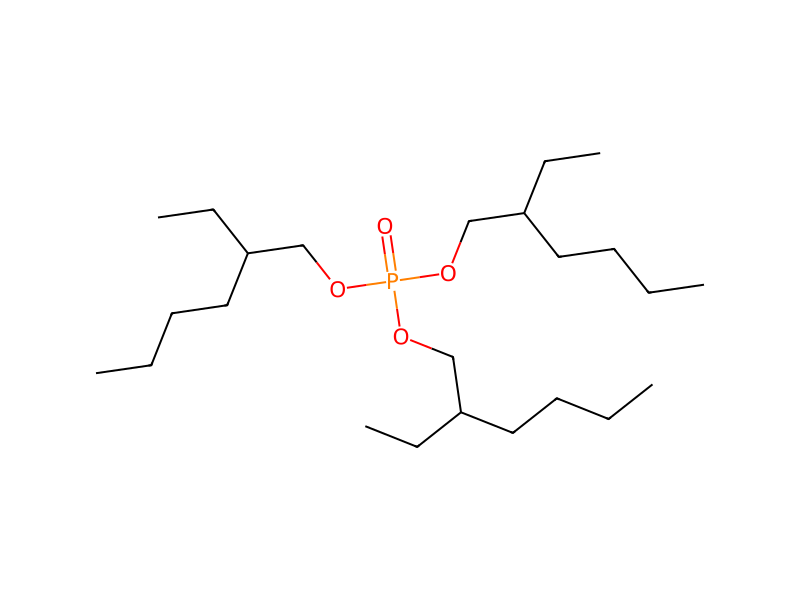
基本情報
- 標準SMILES
CCCCC(CC)COP(=O)(OCC(CC)CCCC)OCC(CC)CCCC- InChIKey
GTVWRXDRKAHEAD-UHFFFAOYSA-N- 分子式
- C24H51O4P
- 平均分子量
- 434.6 g/mol
- 単同位体質量
- 434.35249674
概要
Tris(2-ethylhexyl)phosphate is a clear colorless to pale yellow liquid with a slight sharp odor. (NTP, 1992)
名称と識別子
- 優先名称
- Tris(2-ethylhexyl) phosphate
- IUPAC
- tris(2-ethylhexyl) phosphate
- 現地名
- りん酸トリス(2-エチルヘキシル)
- 英語名
- Tris(2-ethylhexyl) phosphate
- 分子式
- C24H51O4P
- 分子量
- 434.63
名称と別名
名称をさらに表示
データベース識別子
- CAS
78-42-2- PubChem CID
- 6537
- DTXSID
DTXSID0021414- ChEMBL
CHEMBL1562290- ChEBI
CHEBI:181994- UNII
- BQC0BKB72S
- EC Number
- 201-116-6
- Nikkaji
- J1.953D
物性
構造計算による物性
- XLogP
- 8.9
- 極性表面積
- 44.8 Ų
- 水素結合供与体数
- 0
- 水素結合受容体数
- 4
- 回転可能結合数
- 21
- 重原子数
- 29
- 形式電荷
- 0
- 複雑度
- 345
実験および物理化学的性質
Density
0.9262 at 68 °F (NTP, 1992) - Less dense than water; will float
Relative density (water = 1): 0.93
0.9077 @25 °C
Solubility
less than 1 mg/mL at 64 °F (NTP, 1992)
Solubility in water at 20 °C: none
Flash Point
305 °F (NTP, 1992)
170 °C
Boiling Point
374 to 451 °F at 760 mmHg (decomposes) (NTP, 1992)
at 0.7kPa: 220 °C
226.9 °C @760 [mm Hg]
Melting Point
-94 °F (NTP, 1992)
-74 °C
-74 °C
Vapor Density
14.95 (NTP, 1992) - Heavier than air; will sink (Relative to Air)
Relative vapor density (air = 1): 15
Vapor Pressure
1.9 mmHg at 392 °F (NTP, 1992)
Vapor pressure, Pa at 20 °C:
0.03 [mm Hg] @20 °C
Physical Description
Tris(2-ethylhexyl)phosphate is a clear colorless to pale yellow liquid with a slight sharp odor. (NTP, 1992)
Other Solid; Liquid
COLOURLESS VISCOUS LIQUID.
物理化学的性質
- 融点
- -70 °C · -70°C
- 沸点
- 215 °C4 · 215 °C4 mm Hg(lit.)
- 比重(密度)
- 0.92 g/mL · 0.92 g/mL at 20 °C(lit.)
- 蒸気圧
- 2.1 mm · 2.1 mm Hg ( 20 °C)
- 屈折率
- 20 · n20/D 1.444(lit.)
- 闪点
- 230 °F · >230 °F
- 貯蔵温度
- 30 °C · Store below +30°C.
- 溶解性
- 0.001 g/l · <0.001g/l
- 外見
- 液体
- 比重
- 0.93 · 0.93
- 色
- 無色
- PH
- 7 · 7 (H2O, 20℃)
- 水溶解度
- 0.1 g/100 · <0.1 g/100 mL で 18 ºC
- BRN
- 1715839 · 1715839
- Henry's Law Constant
- 1.2 · 1.2×102 mol/(m3Pa) at 25℃, HSDB (2015)
- InChI
- 1S/C24H51O4P/c1-7-13-16-22(10-4)19-26-29(25,27-20-23(11-5)17-14-8-2)28-21-24(12-6)18-15-9-3/h22-24H,7-21H2,1-6H3
- InChIKey
- GTVWRXDRKAHEAD-UHFFFAOYSA-N
- SMILES
- CCCCC(CC)COP(=O)(OCC(CC)CCCC)OCC(CC)CCCC
- CAS データベース
- 78 · 78-42-2(CAS DataBase Reference)
- NISTの化学物質情報
- 2 · 2-Ethylhexanol phosphate (3:1)(78-42-2)
- EPAの化学物質情報
- Tris(2-ethylhexyl) phosphate (78-42-2)
- ECETOC JACC REPORT
- Tris(2-ethylhexyl) phosphate (78-42-2)
化学的性質
化学的特性Tris(2-ethylhexyl) phosphate, a clear, viscous liquid, is used as a component of vinyl stabilizers, grease additives, and flame-proofing compositions; however, it is used primarily as a plasticizer for vinyl plastic and synthetic rubber compounds. Tris(2-ethylhexyl) phosphate has been employed as a specialty flameretardant plasticizer for vinyl compositions where low temperature flexibility is critical, eg, in military tarpaulins. It can be included in blends with general purpose plasticizers such as phthalate esters to improve low temperature flexibility.
安全と法規制
GHS分類
GHS Classification
This chemical does not meet GHS hazard criteria for 52.7% (260 of 493) of all reports.
Warning
H315 (42%): Causes skin irritation [Warning Skin corrosion/irritation]
P264, P264+P265, P280, P302+P352, P305+P351+P338, P321, P332+P317, P337+P317, and P362+P364 (click each P-code to see the statement)
Aggregated GHS information provided per 493 reports by companies from 8 notifications to the ECHA C&L Inventory. Each notification may be associated with multiple companies.
Warning
危険有害性情報
Regulatory Information
Chemical: Phosphoric acid, tris(2-ethylhexyl) ester
Phosphoric acid, tris(2-ethylhexyl) ester is listed on the EPA's Chemical Data Reporting (CDR) system. Manufacturers and importers of Phosphoric acid, tris(2-ethylhexyl) ester are required to report information about their production and use of this chemical to the EPA under the Toxic Substances Control Act (TSCA). (40 eCFR Part 711)
REACH registered substance: Tris(2-ethylhexyl) phosphate (EC: 201-116-6)
Tris (2-ethylhexyl) phosphate: Does not have an individual approval but may be used under an appropriate group standard
Fire Hazards
This chemical is combustible. (NTP, 1992)
Combustible. Gives off irritating or toxic fumes (or gases) in a fire.
Health Hazards
SYMPTOMS: Symptoms of exposure to this compound include irritation of the skin and eyes. Skin contact may cause discomfort, itching, reddening and swelling of the skin. Eye contact may cause discomfort, redness, tearing and swelling. Other symptoms may include difficult breathing and pulmonary edema.
Hazard Classes and Categories
Skin Irrit. 2 (42%)
Skin corrosion/irritation - Category 2
Skin corrosion/irritation - Category 2
安全と保護具
Fire Fighting
Fires involving this material can be controlled with a dry chemical, carbon dioxide or Halon extinguisher. A water spray may also be used. (NTP, 1992)
Use water spray, powder, foam, carbon dioxide.
First Aid Measures
Fresh air, rest. Refer for medical attention.
Rinse skin with plenty of water or shower. Refer for medical attention .
First rinse with plenty of water for several minutes (remove contact lenses if easily possible), then refer for medical attention.
Rinse mouth. Induce vomiting (ONLY IN CONSCIOUS PERSONS!). Give one or two glasses of water to drink. Refer for medical attention .
First Aid
EYES: First check the victim for contact lenses and remove if present. Flush victim's eyes with water or normal saline solution for 20 to 30 minutes while simultaneously calling a hospital or poison control center. Do not put any ointments, oils, or medication in the victim's eyes without specific instructions from a physician. IMMEDIATELY transport the victim after flushing eyes to a hospital even if no symptoms (such as redness or irritation) develop.
Nonfire Spill Response
SMALL SPILLS AND LEAKAGE: If you spill this chemical, FIRST REMOVE ALL SOURCES OF IGNITION. Then, use absorbent paper to pick up all liquid spill material. Your contaminated clothing and absorbent paper should be sealed in a vapor-tight plastic bag for eventual disposal. Solvent wash all contaminated surfaces with 60-70% ethanol followed by washing with a soap and water solution. Do not reenter the contaminated area until the Safety Officer (or other responsible person) has verified that the area has been properly cleaned.
毒性情報
Signs and Symptoms
Redness. Pain.
Redness. Pain.
Carcinogen Classification
Tris(2-ethylhexyl) phosphate
TR-274: Toxicology and Carcinogenesis Studies of Tris(2-ethylhexyl)phosphate (CASRN 78-42-2) in F344/N Rats and B6C3F1 Mice (Gavage Studies) (1984 )
10/28/83
Equivocal Evidence
No Evidence
No Evidence
RAIS Toxicity Values
0.1
PPRTV Current
0.0032
PPRTV Current
EPA Provisional Peer-Reviewed Toxicity Values
Tris(2-ethylhexyl)phosphate
1 x 10^-1 mg/kg-day
PDF Document
Suggestive evidence of carcinogenic potential
2002
Hazard Quotient Level 0.1 or Cancer Risk Level 1E-06
1.70e+02
7.20e+02
2.40e+01
5.00e+01
1.20e+02
3.20e-03
Hazard Quotient Level 3 or Cancer Risk Level 1E-04
1.70e+04
7.20e+04
2.40e+03
5.00e+01
3.20e-03
1.00e-01
安全データ
- wgk
- 2
- tsca
- TSCA listed
- rtecs
- MP0770000
- 毒性
- LD50 orally in Rabbit: 37000 mg/kg LD50 dermal Rabbit 20000 mg/kg
- PRTR法
- 第一種指定化学物質
- hs_code
- 29190090
- risk_code
- 38
- 化審法
- (2)-2000
- 消防法
- 危-4-4-III
- hazard_code
- Xi
- safety_code
- 23-43-24/25
- 自然発火温度
- 370 °C
- 環境リスク評価
- リン酸トリス( 2-エチルヘキシル)(78-42-2)
- Hazard Classifications
- Skin Irrit. 2
- ストレージクラス
- 10 - Combustible liquids
- 有毒物質データの
- 78-42-2(Hazardous Substances Data)
化学と産業
用途と製造
General Manufacturing Information
Petroleum Lubricating Oil and Grease Manufacturing
Phosphoric acid, tris(2-ethylhexyl) ester: ACTIVE
応用分野
使用Solvent, antifoaming agent, plasticizer.
一般的な説明Clear colorless to pale yellow liquid with a slight sharp odor. Insoluble in water; Soluble in alcohol, acetone, and ether. Combustible.
調製方法
純化方法TEHP, in an equal volume of diethyl ether, is shaken with aqueous 5% HCl, and the organic phase is filtered to remove traces of pyridine (used as a solvent during manufacture) as its hydrochloride. This layer is shaken with aqueous Na2CO3, then water, and the ether is distilled off at room temperature. The ester is then filtered, dried for 12hours at 100o/15mm, and again filtered, then shaken intermittently for 2days with activated alumina (100g/L). It is decanted through a fine sintered-glass disc (with exclusion of moisture), and distilled under vacuum. [French & Muggleton J Chem Soc 5064 1957.] *Benzene can be used as a solvent (to give 0.4M solution) instead of ether. IR ( ): 1702, 1701, 481 and 478cm -1 [Bellamy & Becker J Chem Soc 475 1952]. The uranyl nitrate salt is purified by partial crystallisation from hexane [Siddall & Dukes J Am Chem Soc 81 790 1959, Siddall J Am Chem Soc 81 4176 1959]. [Beilstein 1 IV 1786.]
上流・下流製品情報
上流原料
下流製品
サプライヤー50 社
関連反応
現在のフィルター条件では反応記録がありません。
関連ノート
読み込み中…