4-クロロベンズアルデヒド
4-クロロベンズアルデヒド · 4-クロロベンゼンカルボアルデヒド · 1-ホルミル-4-クロロベンゼン · 1-クロロ-4-ホルミルベンゼン · p-クロロベンズアルデヒド · pクロロベンズアルデヒド · パラ‐クロロベンズアルデヒド · P‐クロロベンズアルデヒド
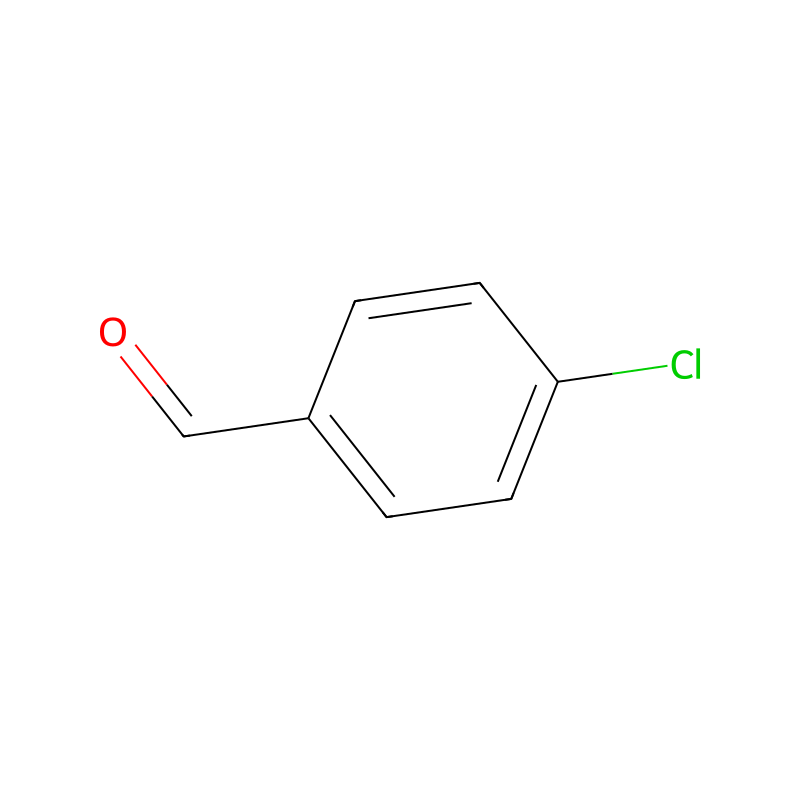
識別子と物理属性
| CAS No. | 104-88-1 |
|---|---|
| 分子式 | C7H5ClO |
| 平均分子量 | 140.56 g/mol |
| 単同位体質量 | 140.0028925 g/mol |
| SMILES | O=Cc1ccc(Cl)cc1 |
| InChIKey | AVPYQKSLYISFPO-UHFFFAOYSA-N |
| PubChem CID | 7726 |
| ChEMBL | CHEMBL1474 |
| EC No. | 203-247-4 |
| DTXSID | DTXSID2021860 |
| 現地名 | 4-クロロベンズアルデヒド |
化学・物理的性質
| XLogP | 2.1 |
|---|---|
| 極性表面積 | 17.1 |
| 水素結合供与体数 | 0 |
| 水素結合受容体数 | 1 |
| 回転可能結合数 | 1 |
| 重原子数 | 9 |
| 形式電荷 | 0 |
| 複雑度 | 95 |
| 密度 | 1.196 at 142 °F (NTP, 1992) - Denser than waterwill sink |
| 溶解度 | less than 1 mg/mL at 67.1 °F (NTP, 1992)935mg/l935mg/L(20℃) |
| 引火点 | 190 °F (NTP, 1992)52 °F |
| 沸点 | 415 to 417 °F at 760 mmHg (NTP, 1992)213-214℃ |
| 融点 | 111 to 117 °F (NTP, 1992)46 °C |
| 蒸気圧 | 0.18 [mmHg]8.75 atm ( 21 °C) |
| Physical Description | 4-chlorobenzaldehyde appears as colorless to yellow powder or white crystalline solid. Pungent odor. (NTP, 1992)Colorless to yellow solid with a pungent odor[CAMEO] Beige crystalline solid[Sigma-Aldrich MSDS] |
| Kovats Retention Index | 11161122.61113.211371107 |
| 蒸気密度 | 0.6 (vs air) |
| 屈折率 | 1.5550 (estimate) |
| 貯蔵条件 | Store below +30°C. |
| 外観・状態 | 液体 |
| 色 | 白色~淡黄色 |
| BRN | 385858 |
| 誘電率 | 72(0.0℃) |
| 安定性 | 安定していますが、空気と光に敏感です。強塩基、強還元剤、強酸化剤とは相容れない。 |
| InChI | 1S/C7H5ClO/c8-7-3-1-6(5-9)2-4-7/h1-5H |
| InChIKey | AVPYQKSLYISFPO-UHFFFAOYSA-N |
| SMILES | [H]C(=O)c1ccc(Cl)cc1 |
| LogP(分配係数) | 2.34 at 25℃ and pH7 |
| CAS データベース | 104-88-1(CAS DataBase Reference) |
| NISTの化学物質情報 | Benzaldehyde, 4-chloro-(104-88-1) |
| EPAの化学物質情報 | p-Chlorobenzaldehyde (104-88-1) |
化学的特性
4-chlorobenzaldehyde appears as colourless to light yellow crystalline powder. Insoluble in water, easily soluble in ethanol, ether, benzene, soluble in water, acetone. Can be volatilized with water vapor. It can produced by the oxidation of 4-chlorobenzyl alcohol. 4-chlorobenzaldehyde is the intermediate of fungicide tebuconazole and plant growth regulator uniconazole.
安全性と法規制
| GHS 分類 | WarningH302 (100%): Harmful if swallowed [Warning Acute toxicity, oral]H315 (99.6%): Causes skin irritation [Warning Skin corrosion/irritation]H317 (76.7%): May cause an allergic skin reaction [Warning Sensitization, Skin]H319 (99.6%): Causes serious eye irritation [Warning Serious eye damage/eye irritation]H335 (17.2%): May cause respiratory irritation [Warning Specific target organ toxicity, single exposureRespiratory tract irritation]H411 (81.5%): Toxic to aquatic life with long lasting effects [Hazardous to the aquatic environment, long-term hazard]P261, P264, P264+P265, P270, P271, P272, P273, P280, P301+P317, P302+P352, P304+P340, P305+P351+P338, P319, P321, P330, P332+P317, P333+P317, P337+P317, P362+P364, P391, P403+P233, P405, and P501 (click each P-code to see the statement)Aggregated GHS information provided per 227 reports by companies from 11 notifications to the ECHA C&L Inventory. Each notification may be associated with multiple companies.Information may vary between notifications depending on impurities, additives, and other factors. The percentage value in parenthesis indicates the notified classification ratio from companies that provide hazard codes. Only hazard codes with percentage values above 10% are shown. For more detailed information, please visit ECHA C&L website. |
|---|---|
| 規制情報 | Chemical: Benzaldehyde, 4-chloro-Status: Active Update: 13-09-2022 https://echa.europa.eu/registration-dossier/-/registered-dossier/2167Status: Active Update: 30-11-2012 https://echa.europa.eu/registration-dossier/-/registered-dossier/82984-Chlorobenzaldehyde: Does not have an individual approval but may be used under an appropriate group standard |
| 輸送ラベル(DOT) | Poison |
| 火災危険 | This chemical is combustible. (NTP, 1992) |
| 健康有害性 | SYMPTOMS: Symptoms of exposure to this compound include irritation of the skin, eyes and mucous membranes.ACUTE/CHRONIC HAZARDS: This chemical may be harmful by inhalation, ingestion or skin absorption. It is an irritant of the skin, eyes and mucous membranes. When heated to decomposition it emits toxic fumes of carbon monoxide, carbon dioxide and hydrogen chloride gas. (NTP, 1992) |
| 有害性の概要 | No mortalities observed in rats exposed by inhalation to 321 mg/m3 for 4 hours or 250 mg/m3 for 7 hoursCauses mild to severe skin and mild eye irritation in rabbits[IUCLID] Causes altered sleep time (including change in righting reflex), somnolence, and excitement in oral lethal-dose studies of mice and rats[RTECS] A skin, eye, and mucous membrane irritant[NTP] A skin and strong eye irritantHarmful by ingestion[Sigma-Aldrich MSDS] |
| 反応性グループ | AldehydesHydrocarbons, AromaticAryl Halides |
| Reactivity Profile | 4-CHLOROBENZALDEHYDE is sensitive to exposure to air. It is also sensitive to light. REACTIVITY: This chemical is incompatible with strong bases, strong oxidizers and strong reducing agents. (NTP, 1992) |
| Air and Water Reactions | This chemical is sensitive to exposure to air. Insoluble in water. |
| Hazard Classes and Categories | Acute Tox. 4 (100%)Skin Irrit. 2 (99.6%)Skin Sens. 1 (76.7%)Eye Irrit. 2A (99.6%)STOT SE 3 (17.2%)Aquatic Chronic 2 (81.5%)Acute toxicity (Oral) - Category 4Skin corrosion/irritation - Category 2Serious eye damage/eye irritation - Category 2BSpecific target organ toxicity - Single exposure - Category 2 (central nervous system)Hazardous to the aquatic environment (Acute) - Category 2Hazardous to the aquatic environment (Long-term) - Category 2 |
| CSL Reaction Information | CSL00161Chlorosulfonic acid + 4-ChlorobenzaldehydeReaction resulted in an explosion.ExplosiveNot AvailableUser Reported |
| 消火 | Fires involving this material can be controlled with a dry chemical, carbon dioxide or Halon extinguisher. A water spray may also be used. (NTP, 1992) |
| 応急処置 | EYES: First check the victim for contact lenses and remove if present. Flush victim's eyes with water or normal saline solution for 20 to 30 minutes while simultaneously calling a hospital or poison control center. Do not put any ointments, oils, or medication in the victim's eyes without specific instructions from a physician. IMMEDIATELY transport the victim after flushing eyes to a hospital even if no symptoms (such as redness or irritation) develop.SKIN: IMMEDIATELY flood affected skin with water while removing and isolating all contaminated clothing. Gently wash all affected skin areas thoroughly with soap and water. If symptoms such as redness or irritation develop, IMMEDIATELY call a physician and be prepared to transport the victim to a hospital for treatment.INHALATION: IMMEDIATELY leave the contaminated areatake deep breaths of fresh air. If symptoms (such as wheezing, coughing, shortness of breath, or burning in the mouth, throat, or chest) develop, call a physician and be prepared to transport the victim to a hospital. Provide proper respiratory protection to rescuers entering an unknown atmosphere. Whenever possible, Self-Contained Breathing Apparatus (SCBA) should be usedif not available, use a level of protection greater than or equal to that advised under Protective Clothing.INGESTION: DO NOT INDUCE VOMITING. If the victim is conscious and not convulsing, give 1 or 2 glasses of water to dilute the chemical and IMMEDIATELY call a hospital or poison control center. Be prepared to transport the victim to a hospital if advised by a physician. If the victim is convulsing or unconscious, do not give anything by mouth, ensure that the victim's airway is open and lay the victim on his/her side with the head lower than the body. DO NOT INDUCE VOMITING. IMMEDIATELY transport the victim to a hospital. (NTP, 1992) |
| 非火災時の漏出対応 | SMALL SPILLS AND LEAKAGE: Should a spill occur while you are handling this chemical, FIRST REMOVE ALL SOURCES OF IGNITION, then you should dampen the solid spill material with 60-70% ethanol and transfer the dampened material to a suitable container. Use absorbent paper dampened with 60-70% ethanol to pick up any remaining material. Seal the absorbent paper, and any of your clothes, which may be contaminated, in a vapor-tight plastic bag for eventual disposal. Solvent wash all contaminated surfaces with 60-70% ethanol followed by washing with a soap and water solution. Do not reenter the contaminated area until the Safety Officer (or other responsible person) has verified that the area has been properly cleaned.STORAGE PRECAUTIONS: You should protect this chemical from exposure to light. Keep the container tightly closed under an inert atmosphere, and store under refrigerated temperatures. (NTP, 1992) |
| Isolation and Evacuation | Excerpt from ERG Guide 154 [Substances - Toxic and/or Corrosive (Non-Combustible)]:IMMEDIATE PRECAUTIONARY MEASURE: Isolate spill or leak area in all directions for at least 50 meters (150 feet) for liquids and at least 25 meters (75 feet) for solids.SPILL: Increase the immediate precautionary measure distance, in the downwind direction, as necessary.FIRE: If tank, rail tank car or highway tank is involved in a fire, ISOLATE for 800 meters (1/2 mile) in all directionsalso, consider initial evacuation for 800 meters (1/2 mile) in all directions. (ERG, 2024) |
| Personal Protective Equipment (PPE) | RECOMMENDED RESPIRATOR: Where the neat test chemical is weighed and diluted, wear a NIOSH-approved half face respirator equipped with an organic vapor/acid gas cartridge (specific for organic vapors, HCl, acid gas and SO2) with a dust/mist filter. (NTP, 1992) |
| Toxicity Data | LC (rat) > 473 mg/m3/4hr |
| F | 8-9 |
| 水環境危害等級(WGK) | 2 |
| TSCA 収載状態 | TSCA listed |
| RTECS 番号 | CU5076000 |
| 輸送番号(UN) | UN 1219 3/PG 2 |
| 毒性 | LD50 orally in Rabbit: 840 mg/kg LD50 dermal Rat 5000 mg/kg |
| 税関コード | 29130000 |
| 危険文句(R) | 22-36/37/38-51/53-36/38 |
| 化審法 | (3)-1162 |
| 危険表示 | F,C,N,Xn,Xi |
| 安全措置(S) | 26-61-37/39-36 |
| 危険等級 | 9Acute Tox. 4 OralAquatic Chronic 2Eye Irrit. 2Skin Irrit. 2Skin Sens. 1 |
| 包装等級 | III |
| 自然発火温度 | 302 °C |
| 貯蔵分類 | 11 - Combustible Solids |
用途
用途
有機合成原料。
用途
染料中間体
使用
4-Chlorobenzaldehyde is used as an intermediate for the manufacture of dyestuffs, optical brighteners, pharmaceuticals, agricultural chemicals and metal finishing products.
一般的な説明
Colorless to yellow powder or white crystalline solid. Pungent odor.
製法・合成法
製造方法
4-Chlorobenzaldehyde can be obtained by chlorinated hydrolysis of p-chlorotoluene: add p-chlorotoluene and phosphorus trichloride to the reaction pot, raise the temperature to 155°C under light and pass chlorine. Control the temperature at 160-170℃ and pass chlorine to the calculated amount to obtain the chlorination solution. Add it to concentrated sulfuric acid with stirring, and stir for 5h at room temperature. let it stand and stratify, take the lower layer into ice water to crystallize, and filter it when it is cold to below 5℃. The filter cake was washed with ice water to obtain the crude product, distilled under reduced pressure and collected 108-111℃ (3.33kPa) fraction to obtain p-chlorobenzaldehyde.
純化方法
Crystallise it from EtOH/water (3:1), then sublime it twice at ~50o/2mm. [Beilstein 7 H 235, 7 IV 568.]