化工社化工社 化学情報印刷レポート · 研究参考用
エデト酸三ナトリウム
N-[2-[N,N-ビス(ソジオオキシカルボニルメチル)アミノ]エチル]-N-(ソジオオキシカルボニルメチル)アミノ酢酸 · 3,6-ビス[(ソジオオキシカルボニル)メチル]-3,6-ジアザオクタン二酸1-ナトリウム · N-(カルボキシメチル)-N'-(ソジオオキシカルボニルメチル)[N,N'-エチレンビス(グリシンナトリウム)] · EDTAトリナトリウム · エチレンジアミン-N,N,N',N'-四酢酸水素三ナトリウム · [2-[ビス(ソジオオキシカルボニルメチル)アミノ]エチル(ソジオオキシカルボニルメチル)アミノ]酢酸 · ベルセン9 · エチレンジアミン四酢酸トリナトリウム
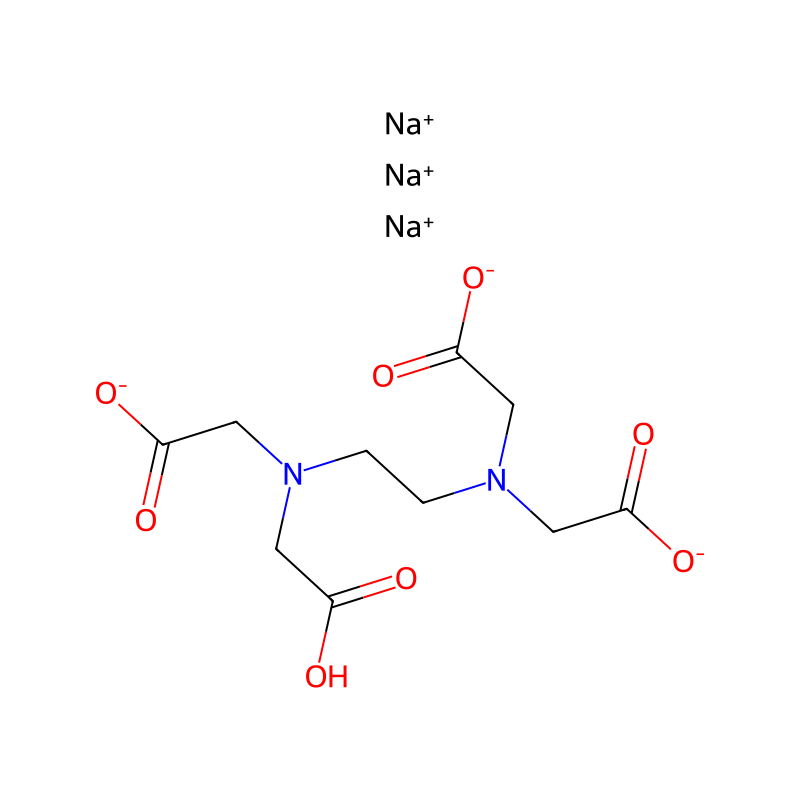
識別子と物理属性
| CAS No. | 150-38-9 |
|---|---|
| 分子式 | C10H13N2Na3O8 |
| 平均分子量 | 358.19 g/mol |
| 単同位体質量 | 358.03649822 g/mol |
| SMILES | O=C([O-])CN(CCN(CC(=O)[O-])CC(=O)O)CC(=O)[O-].[Na+].[Na+].[Na+] |
| InChIKey | QZKRHPLGUJDVAR-UHFFFAOYSA-K |
| PubChem CID | 9008 |
| ChEMBL | CHEMBL2028177 |
| ChEBI | CHEBI:63125 |
| EC No. | 205-758-8 |
| 現地名 | エデト酸三ナトリウム |
化学・物理的性質
| 極性表面積 | 164 |
|---|---|
| 水素結合供与体数 | 1 |
| 水素結合受容体数 | 10 |
| 回転可能結合数 | 8 |
| 重原子数 | 23 |
| 形式電荷 | 0 |
| 複雑度 | 351 |
| 密度 | 0.7215 (NTP, 1992) - Less dense than waterwill float1.69[at 20℃] |
| 溶解度 | 5 to 10 mg/mL at 70.7 °F (NTP, 1992)H2O: 無色透明~淡黄色212.9g/L at 20℃ |
| 融点 | greater than 572 °F (NTP, 1992)237 °C |
| Physical Description | Ethylenediamine tetraacetic acid, trisodium salt is an odorless white crystalline powder. pH (1% aqueous solution) 9.3. pH (10% aqueous solution) about 8.3-8.7. (NTP, 1992)Dry PowderLiquidWhite odorless solid[CAMEO] Fine white crystals[Sigma-Aldrich MSDS] |
| 蒸気圧 | 0.007Pa at 50℃ |
| 貯蔵条件 | Inert atmosphere,Room Temperature |
| 外観・状態 | 液体 |
| 色 | White to off-white |
| pH | 8 |
| Merck | 13,3545 |
| 安定性 | 安定。強力な酸化剤、銅、アルミニウムとは相容れない。 |
| 化粧品成分の機能 | キレート化 |
| InChI | InChI=1S/C10H16N2O8.3Na.2H2O/c13-7(14)3-11(4-8(15)16)1-2-12(5-9(17)18)6-10(19)20/h1-6H2,(H,13,14)(H,15,16)(H,17,18)(H,19,20)2*1H2/q3*+1/p-3 |
| InChIKey | OABSPZRQQUFHRY-UHFFFAOYSA-K |
| SMILES | N(CC([O-])=O)(CC(=O)O)CCN(CC([O-])=O)CC([O-])=O.O.O.[Na+].[Na+].[Na+] |
| LogP(分配係数) | -3.8 at 25℃ |
| CAS データベース | 150-38-9(CAS DataBase Reference) |
| EPAの化学物質情報 | Ethylenediaminetetraacetic acid trisodium salt (150-38-9) |
化学的特性
white powder
安全性と法規制
| GHS 分類 | This chemical does not meet GHS hazard criteria for 1% (2 of 197) of reports.DangerH302+H332 (53.3%): Harmful if swallowed or if inhaled [Warning Acute toxicity, oralacute toxicity, inhalation]H302 (87.8%): Harmful if swallowed [Warning Acute toxicity, oral]H318 (66%): Causes serious eye damage [Danger Serious eye damage/eye irritation]H319 (25.9%): Causes serious eye irritation [Warning Serious eye damage/eye irritation]H332 (62.9%): Harmful if inhaled [Warning Acute toxicity, inhalation]H373 (66%): May causes damage to organs through prolonged or repeated exposure [Warning Specific target organ toxicity, repeated exposure]P260, P261, P264, P264+P265, P270, P271, P280, P301+P317, P304+P340, P305+P351+P338, P305+P354+P338, P317, P319, P330, P337+P317, and P501 (click each P-code to see the statement)Aggregated GHS information provided per 197 reports by companies from 13 notifications to the ECHA C&L Inventory. Each notification may be associated with multiple companies.Reported as not meeting GHS hazard criteria per 2 of 197 reports by companies.There are 12 notifications provided by 195 of 197 reports by companies with hazard statement code(s).Information may vary between notifications depending on impurities, additives, and other factors. The percentage value in parenthesis indicates the notified classification ratio from companies that provide hazard codes. Only hazard codes with percentage values above 10% are shown. For more detailed information, please visit ECHA C&L website. |
|---|---|
| 規制情報 | Chemical: Glycine, N,Nâ²-1,2-ethanediylbis[N-(carboxymethyl)-, sodium salt (1:3)Glycine, N,N'-1,2-ethanediylbis[N-(carboxymethyl)-, sodium salt (1:3) is listed on the EPA's Chemical Data Reporting (CDR) system. Manufacturers and importers of Glycine, N,N'-1,2-ethanediylbis[N-(carboxymethyl)-, sodium salt (1:3) are required to report information about their production and use of this chemical to the EPA under the Toxic Substances Control Act (TSCA). (40 eCFR Part 711)Status: Active Update: 20-01-2023 https://echa.europa.eu/registration-dossier/-/registered-dossier/27615Trisodium EDTA: Does not have an individual approval but may be used under an appropriate group standard |
| その他の安全情報 | IMAP assessments - Glycine, N,N'-1,2-ethanediylbis[N-(carboxymethyl)-, trisodium salt: Human health tier I assessment |
| 火災危険 | Literature sources indicate that this compound is noncombustible. (NTP, 1992) |
| 健康有害性 | SYMPTOMS: Symptoms of exposure to this compound may include coughing, wheezing, respiratory distress and mucous membrane irritation upon inhalation. It is a strong chelating agent and ingestion of large amounts may cause hypocalcemic tetany with spontaneous recovery. This compound may cause skin irritation, an eye contact may cause pain and slight transient irritation.ACUTE/CHRONIC HAZARDS: When heated to decomposition this chemical may emit toxic fumes of carbon monoxide, carbon dioxide, oxides of nitrogen and ammonia. It may also emit very toxic fumes of disodium oxide. This compound may present a dust explosion hazard. (NTP, 1992) |
| 有害性の概要 | No evidence of carcinogenicity in mice or rats[NTP] Causes changes in tubules (including acute renal failure and necrosis) in intraperitoneal lethal-dose studies of mice[RTECS] May cause skin and eye irritationInhalation may cause coughing, wheezing, respiratory distress, and mucous membrane irritation[NTP] An irritant[Sigma-Aldrich MSDS] See Edetic acid. |
| 反応性グループ | Amines, Phosphines, and PyridinesSalts, Basic |
| Reactivity Profile | Aqueous solutions of ETHYLENEDIAMINE TETRAACETIC ACID, TRISODIUM SALT react with aluminum to produce hydrogen. Oxidizers should be avoided. (NTP, 1992) |
| Air and Water Reactions | Slightly water soluble. |
| Hazard Classes and Categories | Acute Tox. 4 (87.8%)Eye Dam. 1 (66%)Eye Irrit. 2 (25.9%)Acute Tox. 4 (62.9%)STOT RE 2 (66%) |
| 消火 | Fires involving this material can be controlled with a dry chemical, carbon dioxide or Halon extinguisher. (NTP, 1992) |
| 応急処置 | EYES: First check the victim for contact lenses and remove if present. Flush victim's eyes with water or normal saline solution for 20 to 30 minutes while simultaneously calling a hospital or poison control center. Do not put any ointments, oils, or medication in the victim's eyes without specific instructions from a physician. IMMEDIATELY transport the victim after flushing eyes to a hospital even if no symptoms (such as redness or irritation) develop.SKIN: IMMEDIATELY flood affected skin with water while removing and isolating all contaminated clothing. Gently wash all affected skin areas thoroughly with soap and water. If symptoms such as redness or irritation develop, IMMEDIATELY call a physician and be prepared to transport the victim to a hospital for treatment.INHALATION: IMMEDIATELY leave the contaminated areatake deep breaths of fresh air. If symptoms (such as wheezing, coughing, shortness of breath, or burning in the mouth, throat, or chest) develop, call a physician and be prepared to transport the victim to a hospital. Provide proper respiratory protection to rescuers entering an unknown atmosphere. Whenever possible, Self-Contained Breathing Apparatus (SCBA) should be usedif not available, use a level of protection greater than or equal to that advised under Protective Clothing.INGESTION: DO NOT INDUCE VOMITING. If the victim is conscious and not convulsing, give 1 or 2 glasses of water to dilute the chemical and IMMEDIATELY call a hospital or poison control center. Be prepared to transport the victim to a hospital if advised by a physician. If the victim is convulsing or unconscious, do not give anything by mouth, ensure that the victim's airway is open and lay the victim on his/her side with the head lower than the body. DO NOT INDUCE VOMITING. IMMEDIATELY transport the victim to a hospital. (NTP, 1992) |
| 非火災時の漏出対応 | SMALL SPILLS AND LEAKAGE: If you spill this chemical, you should dampen the solid spill material with water, then transfer the dampened material to a suitable container. Use absorbent paper dampened with water to pick up any remaining material. Seal your contaminated clothing and the absorbent paper in a vapor-tight plastic bag for eventual disposal. Wash all contaminated surfaces with a soap and water solution. Do not reenter the contaminated area until the Safety Officer (or other responsible person) has verified that the area has been properly cleaned.STORAGE PRECAUTIONS: You should store this chemical under ambient temperatures, and keep it away from all oxidizing materials. (NTP, 1992) |
| Personal Protective Equipment (PPE) | RECOMMENDED RESPIRATOR: Where the neat test chemical is weighed and diluted, wear a NIOSH-approved half face respirator equipped with an organic vapor/acid gas cartridge (specific for organic vapors, HCl, acid gas and SO2) with a dust/mist filter. (NTP, 1992) |
| 毒性の概要 | Safe in the present practices of use and concentration. Ingredient, concentration, and use information are available in documents discoverable at https://cir-reports.cir-safety.org |
| Carcinogen Classification | Trisodium ethylenediaminetetra-acetate trihydrate (EDTA)TR-011: Bioassay of Trisodium Ethylenediaminetetraacetate Trihydrate (EDTA) for Possible Carcinogenicity (CASRN 150-38-9) (1977 )07/25/77No Evidence |
| 水環境危害等級(WGK) | 3 |
| TSCA 収載状態 | TSCA listed |
| RTECS 番号 | AH5250000 |
| 税関コード | 29173990 |
| 危険文句(R) | 36/37/38 |
| 化審法 | 優先評価化学物質 |
| 危険表示 | Xi |
| 安全措置(S) | 26-36-24/25-22-36/37 |
| 危険等級 | Acute Tox. 4 InhalationAcute Tox. 4 OralEye Dam. 1STOT RE 2 Inhalation |
| 貯蔵分類 | 11 - Combustible Solids |
用途
使用
chelating agent, antioxidant
一般的な説明
Odorless white crystalline powder. pH (1% aqueous solution) 9.3. pH (10% aqueous solution) about 8.3-8.7.