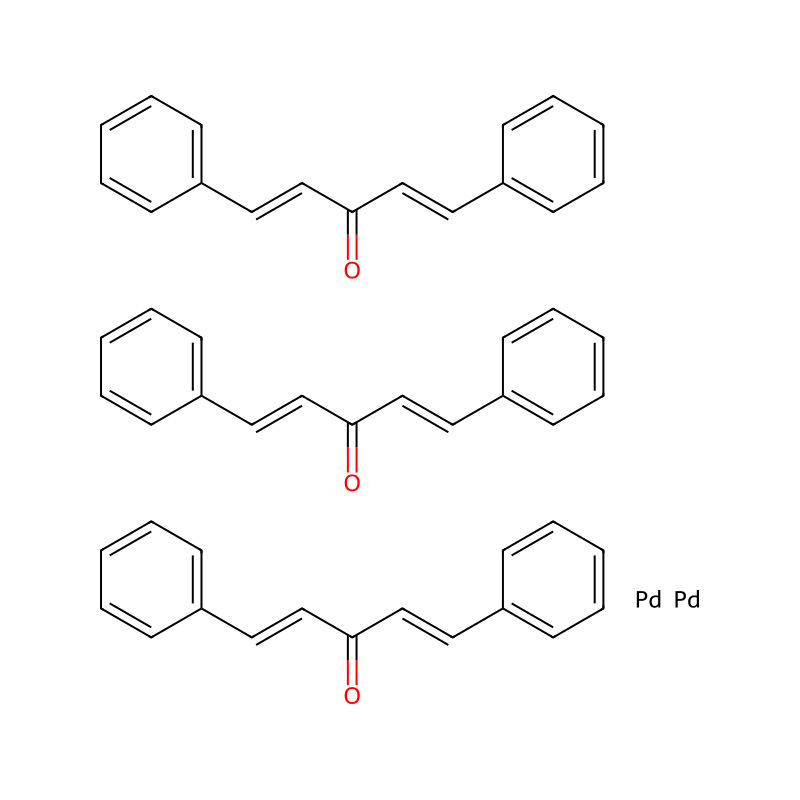
識別子と物理属性
| CAS No. | 51364-51-3 |
|---|
| 分子式 | C51H42O3Pd2 |
|---|
| 平均分子量 | 915.7 g/mol |
|---|
| 単同位体質量 | 914.12036 g/mol |
|---|
| SMILES | O=C(/C=C/c1ccccc1)/C=C/c1ccccc1.O=C(/C=C/c1ccccc1)/C=C/c1ccccc1.O=C(/C=C/c1ccccc1)/C=C/c1ccccc1.[Pd].[Pd] |
|---|
| InChIKey | CYPYTURSJDMMMP-WVCUSYJESA-N |
|---|
| PubChem CID | 9811564 |
|---|
化学・物理的性質
| 極性表面積 | 51.2 |
|---|
| 水素結合供与体数 | 0 |
|---|
| 水素結合受容体数 | 3 |
|---|
| 回転可能結合数 | 12 |
|---|
| 重原子数 | 56 |
|---|
| 形式電荷 | 0 |
|---|
| 複雑度 | 272 |
|---|
安全性と法規制
| 健康影響 | Contact with palladium may cause palladium sensitivity and allergy. Animal studies have shown that palladium may damage the liver and kidney. (L798) |
|---|
| 毒性の概要 | Due to their ability to form strong complexes with both inorganic and organic ligands, palladium ions can disturb cellular equilibria, replace other essential ions, and interact with functional groups of macromolecules, such as proteins or DNA. Palladium complexes binding to DNA and RNA leads to strand breakage. Palladium ions are able to inhibit most major cellular functions, including DNA and RNA synthesis. Palladium compounds have been shown to bind to and inhibit various enzymes, including creatine kinase and prolyl hydroxylase. (L798) |
|---|
| Signs and Symptoms | Skin contact with palladium may cause contact dermatitis, erythema, and oedema. (L798) |
|---|
| Carcinogen Classification | No indication of carcinogenicity to humans (not listed by IARC). |
|---|