Benzyloxycarbonyl-L-proline
Z-PRO-OH · CBZ-PRO-OH · Z-Pro · CBZ-L-PROLINE · N-CBZ-L-PROLINE · CBZ-L-Pro · Z-L-PRO-OH · Z-PROLINE
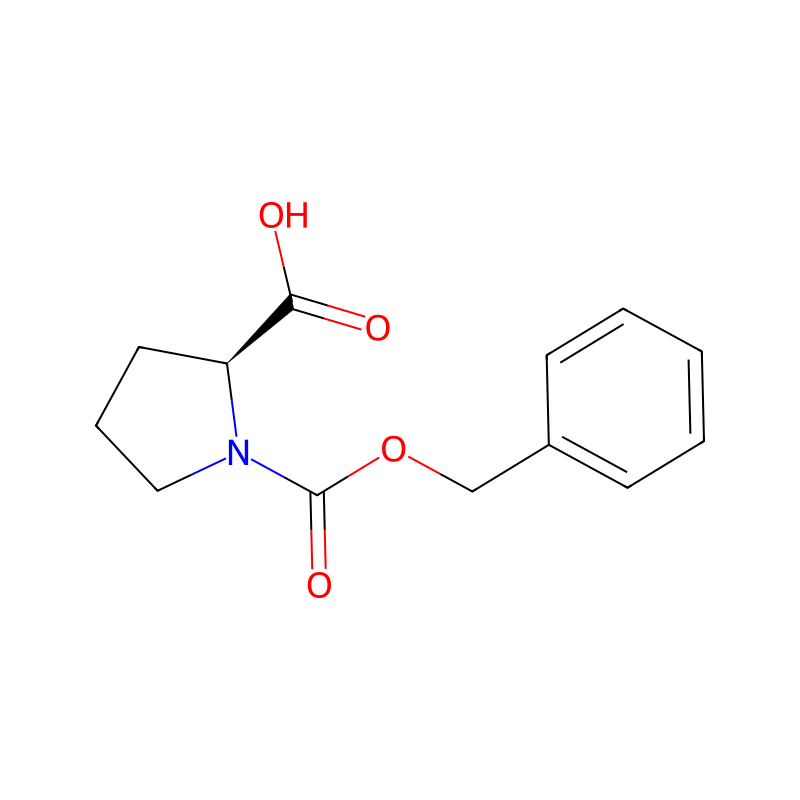
식별자 및 물리적 특성
| CAS No. | 1148-11-4 |
|---|---|
| 분자식 | C13H15NO4 |
| 평균 분자량 | 249.26 g/mol |
| 단동위원소 질량 | 249.10010796 g/mol |
| SMILES | O=C(O)[C@@H]1CCCN1C(=O)OCc1ccccc1 |
| InChIKey | JXGVXCZADZNAMJ-NSHDSACASA-N |
| PubChem CID | 101987 |
| ChEMBL | CHEMBL3276375 |
| EC No. | 214-557-4 |
| DTXSID | DTXSID40150856 |
화학 및 물리적 성질
| XLogP | 1.7 |
|---|---|
| 극성 표면적 | 66.8 |
| 수소 결합 공여자 수 | 1 |
| 수소 결합 수용자 수 | 4 |
| 회전 가능 결합 수 | 4 |
| 무거운 원자 수 | 18 |
| 형식 전하 | 0 |
| 복잡도 | 312 |
| 녹는점 | 75-77 °C |
| 끓는 점 | 392.36°C (rough estimate) |
| 밀도 | 1.1952 (rough estimate) |
| 굴절률 | -40 ° (C=2, EtOH) |
| 저장 조건 | Sealed in dry,Room Temperature |
| 용해도 | 메탄올에 대한 용해도, 거의 투명함. |
| 물리적 상태 | 결정질 분말 또는 결정 |
| pKa(산도 계수) | 3.99±0.20(Predicted) |
| 색상 | 흰색에서 황백색까지 |
| BRN | 88579 |
| 주요 응용 | 펩타이드 합성 |
| InChI | InChI=1S/C13H15NO4/c15-12(16)11-7-4-8-14(11)13(17)18-9-10-5-2-1-3-6-10/h1-3,5-6,11H,4,7-9H2,(H,15,16)/t11-/m0/s1 |
| InChIKey | JXGVXCZADZNAMJ-NSHDSACASA-N |
| SMILES | N1(C(OCC2=CC=CC=C2)=O)CCC[C@H]1C(O)=O |
화학적 성질
white to light yellow crystal powder
안전 및 규제
| GHS 분류 | This chemical does not meet GHS hazard criteria for 37.5% (3 of 8) of reports.DangerH315 (37.5%): Causes skin irritation [Warning Skin corrosion/irritation]P261, P264, P264+P265, P271, P272, P280, P302+P352, P304+P340, P305+P351+P338, P305+P354+P338, P317, P319, P321, P332+P317, P333+P317, P337+P317, P362+P364, P403+P233, P405, and P501 (click each P-code to see the statement)Aggregated GHS information provided per 8 reports by companies from 6 notifications to the ECHA C&L Inventory. Each notification may be associated with multiple companies. |
|---|---|
| Hazard Classes and Categories | Skin Irrit. 2 (37.5%) |
| 수질 위해 등급(WGK) | 3 |
| RTECS 번호 | UY0745000 |
| 관세 코드 | 29339900 |
| 위험 문구(R) | 62-36/37/38-20/21/22 |
| 위험 표시 | Xn |
| 안전 문구(S) | 22-24/25-36-26 |
| 위험 등급 | IRRITANT |
| 저장 분류 | 11 - Combustible Solids |
용도
용도
N-(Benzyloxycarbonyl)-L-proline is a potent in vitro and in vivo inhibitor of prolidase; a specific peptidase that cleaves dipeptides with a C-terminal prolyl and hydroxylprolyl residue. It is also used in the synthesis of N-(L-Prolyl)-β-alanine which is a derivative of the naturally occurring beta amino acid β-Alanine.
제조 및 합성 방법
제조 방법
Caution! All procedures must be carried out in an efficient fume cupboard, wearing latex gloves and chemical-proof safety goggles. ι-Proline (10.0 g, 8.7 mmol) was dissolved in 2 m sodium hydroxide solution (40 mL), and the solution was cooled to ice-water temperature. Z-Cl (20.5 g, 12 mmol) was added portionwise, with vigorous stirring or occasional shaking, over a period of 30 min at 0–5 °C to the solution of l-proline. The ice bath was then removed and stirring or occasional shaking was continued for 30 min while the reaction mixture warmed to room temperature. The mixture was then acidified to Congo red by the gradual addition of concentrated hydrochloric acid, and the oil was extracted into ethyl acetate. The extract was dried over magnesium sulfate, the mixture was filtered, and the filtrate was concentrated in vacuo. The residue was extracted/triturated with warm tetrachloromethane. The washings were decanted and the residue was further purified by recrystallization from ethyl acetate/petroleum ether.