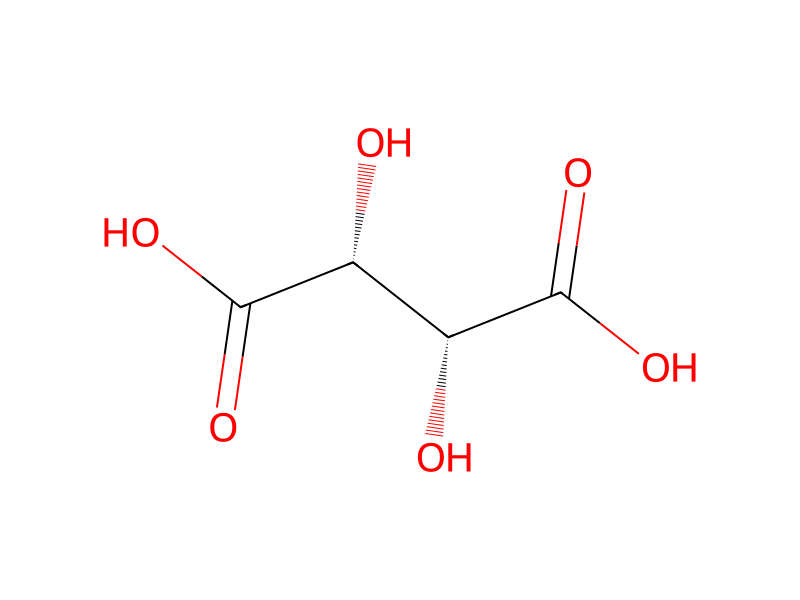
기본 정보
- 표준 SMILES
O=C(O)[C@H](O)[C@@H](O)C(=O)O- InChIKey
FEWJPZIEWOKRBE-JCYAYHJZSA-N- 분자식
- C4H6O6
- 평균 분자량
- 150.09 g/mol
개요
L-tartaric acid is the L-enantiomer of tartaric acid. It is a conjugate acid of a L-tartrate(1-). It is an enantiomer of a D-tartaric acid.
이름 및 식별자
- 우선 이름
- L-Tartaric acid
- IUPAC
- (2R,3R)-2,3-dihydroxybutanedioic acid
- 현지명
- lamB단백질(곰팡이)
- 영어명
- lamB protein (fungal)
- 분자식
- C4H6O6
- 분자량
- 150.08684
이름 및 동의어
이름 더 보기
데이터베이스 식별자
- CAS
144814-09-5- ChEMBL
CHEMBL1236315- ChEBI
CHEBI:15671- UNII
- 4J4Z8788N8、W4888I119H
- EC Number
- 201-766-0、205-105-7
- Nikkaji
- J31.839F
물성
구조 계산 물성
- XLogP
- -1.9
- 극성 표면적
- 115 Ų
- 수소 결합 공여자 수
- 4
- 수소 결합 수용자 수
- 6
- 회전 가능 결합 수
- 3
- 무거운 원자 수
- 10
- 형식 전하
- 0
- 복잡도
- 134
실험 및 물리화학적 성질
Chemical Classes
Other Classes -> Organic Acids
Other Classes -> Organic Acids
Fragrances
Fragrance Ingredient ((+)-Tartaric acid) -> IFRA transparency List
Fragrance Ingredient (Tartaric acid (d-, l-, dl-, meso-)) -> IFRA transparency List
LogP
-0.76 (calculated)
-1.2
Density
Relative density (water = 1): 1.79
1.76 @25 °C
Solubility
582 mg/mL at 20 °C
Solubility in water, g/l at 20 °C: 1400 (very soluble)
soluble in water and alcohol; 1 gm in 0.8 ml water
1 g in 3 ml 95% alcohol (in ethanol)
Human Drugs
FDA approved drugs -> Active ingredient
FDA approved drugs -> Active ingredient
Melting Point
Between 168 °C and 170 °C
169 °C
206 °C
안전 및 규제
GHS 분류
GHS Classification
This chemical does not meet GHS hazard criteria for 0.9% (44 of 4731) of reports.
Danger
H302 (42.5%): Harmful if swallowed [Warning Acute toxicity, oral]
P261, P264, P264+P265, P270, P271, P272, P280, P301+P317, P302+P352, P304+P340, P305+P351+P338, P305+P354+P338, P317, P319, P321, P330, P332+P317, P333+P317, P337+P317, P362+P364, P403+P233, P405, and P501 (click each P-code to see the statement)
Aggregated GHS information provided per 4731 reports by companies from 33 notifications to the ECHA C&L Inventory. Each notification may be associated with multiple companies.
This chemical does not meet GHS hazard criteria for 5.1% (26 of 506) of reports.
유해성 정보
Regulatory Information
Chemical: Butanedioic acid, 2,3-dihydroxy- (2R,3R)-
Chemical: Butanedioic acid, 2,3-dihydroxy-, (R*,R*)-(.+-.)-
Regulation (EC) No 1333/2008 (amended)
Butanedioic acid, 2,3-dihydroxy- (2R,3R)- is listed on the EPA's Chemical Data Reporting (CDR) system. Manufacturers and importers of Butanedioic acid, 2,3-dihydroxy- (2R,3R)- are required to report information about their production and use of this chemical to the EPA under the Toxic Substances Control Act (TSCA). (40 eCFR Part 711)
Status: Active Update: 04-02-2022 https://echa.europa.eu/registration-dossier/-/registered-dossier/15126
Status: Active Update: 03-10-2022 https://echa.europa.eu/registration-dossier/-/registered-dossier/34095
Other Safety Information
IMAP assessments - Butanedioic acid, 2,3-dihydroxy-, (R*,R*)-(.+-.)-: Human health tier I assessment
IMAP assessments - Butanedioic acid, 2,3-dihydroxy- [R-(R*,R*)]-: Human health tier I assessment
Hazards Summary
Causes burns; Inhalation of aerosol may cause pulmonary edema; [ICSC] An irritant; [Acros Organics MSDS]
A local irritant; [Merck Index] May cause serious eye injury; [ECHA REACH Registrations] Maximum total daily intake of tartrate of 0-6 mg/kg (unconditional acceptance) and 6-20 mg/kg (conditional acceptance); [JECFA] A skin and strong eye irritant; [Alfa Aesar MSDS]
Hazard Classes and Categories
Skin Irrit. 2 (22.1%)
Acute Tox. 4 (42.5%)
안전 및 보호
First Aid Measures
Fresh air, rest. Seek medical attention if you feel unwell.
Remove contaminated clothes. Rinse skin with plenty of water or shower.
Rinse with plenty of water for several minutes (remove contact lenses if easily possible). Refer immediately for medical attention.
Rinse mouth. Give one or two glasses of water to drink. Seek medical attention if you feel unwell.
Spillage Disposal
Personal protection: particulate filter respirator adapted to the airborne concentration of the substance. Sweep spilled substance into covered containers. If appropriate, moisten first to prevent dusting. Store and dispose of according to local regulations.
독성 정보
Signs and Symptoms
Cough. Sore throat. Burning sensation.
Redness.
Redness. Pain. Severe burns.
Cough. Sore throat. Burning sensation. Nausea. Vomiting.
Non-Human Toxicity Excerpts
The authors of this 2022 publication looked at ASPCA Animal Poison Control Center electronic database reports of dogs that developed acute kidney injury following ingestion of cream of tartar (potassium bitartrate) or tamarinds. They noted that the clinical signs, laboratory findings, and histopathologic lesions were similar to those reported in the grape and raisin toxicosis found in dogs. Given the sensitivity of dogs to tartaric acid, the authors proposed that tartaric acid is the likely toxic component associated with both grape and tamarind acute kidney injury. These authors also noted that detartration (removal of tartrates) of processed products could explain the lack of reported toxicosis following exposure to agents such as grape juice, jam, and wine. Further, the authors noted that thermal decomposition of tartaric acid may explain the anecdotal observation that cooked grapes and raisins
화학 및 산업
약리 정보
Pharmacodynamics
Tartaric acid is used to generate carbon dioxide through interaction with sodium bicarbonate following oral administration. Carbon dioxide extends the stomach and provides a negative contrast medium during double contrast radiography. In high doses, this agent acts as a muscle toxin by inhibiting the production of malic acid, which could cause paralysis and maybe death.
Absorption, Distribution and Excretion
Oral or parenteral doses of monosodium 14C-L(+)-tartrate (400 mg/kg) are rapidly excreted by rats and a proportion completely metabolized to CO2. The oral dose was well-absorbed.
Only about 15-20% of consumed tartaric acid is secreted in the urine unchanged.
용도 및 제조
Uses
Used as a synergist for antioxidants, acid, emulsifier, sequestrant, and flavoring agent; [JECFA]
Levo form of dextrorotatory tartaric acid; Found throughout nature and classified as a fruit acid; Used in soft drinks and foods, as an acidulant, complexing agent, pharmaceutic aid (buffering agent), in photography, tanning, ceramics, and to make tartrates; Diethyl and dibutyl ester derivatives are commercially significant for use in lacquers and in textile printing; [Merck Index] Used as an intermediate, in construction and ceramics applications, in cleaning products, cosmetics/personal care products, and metal surface treatments (including galvanic and electroplating products); [ECHA REACH Registrations] Used as a flavoring agent, anticaking agent, drying agent, firming agent, humectant, leavening agent, and pH control agent for foods; [FDA] Permitted for use as an inert ingredient in non-food pesticide products; [EPA]
Electroplating [Category: Plate]
Use (kg; approx.) in Germany (2009): >1000
Industry Uses
Other
The authors report that the electrowinning of ternary lithium-ion battery leachates using tartaric acid achieves 99.1% cobalt purity in a batch mode, and high puriity and high recovery of metallic cobalt, nickel , and manganese dioxide in a scalable flow system.
Use Classification
EPA Safer Chemical Functional Use Classes -> Processing Aids and Additives
Safer Chemical Classes -> Green half-circle - The chemical is expected to be of low concern
Food additives
Fragrance Ingredients
Fragrance Ingredients
Flavouring Agent -> FLAVOURING_AGENTFood Additives -> ACID; ANTIOXIDANT_SYNERGIST; EMULSIFIER; SEQUESTRANT; SYNERGIST -> JECFA Functional Classes
General Manufacturing Information
Food, beverage, and tobacco product manufacturing
Butanedioic acid, 2,3-dihydroxy- (2R,3R)-: ACTIVE
관련 반응
현재 필터 조건에 해당하는 반응 기록이 없습니다.
연결된 노트
불러오는 중…