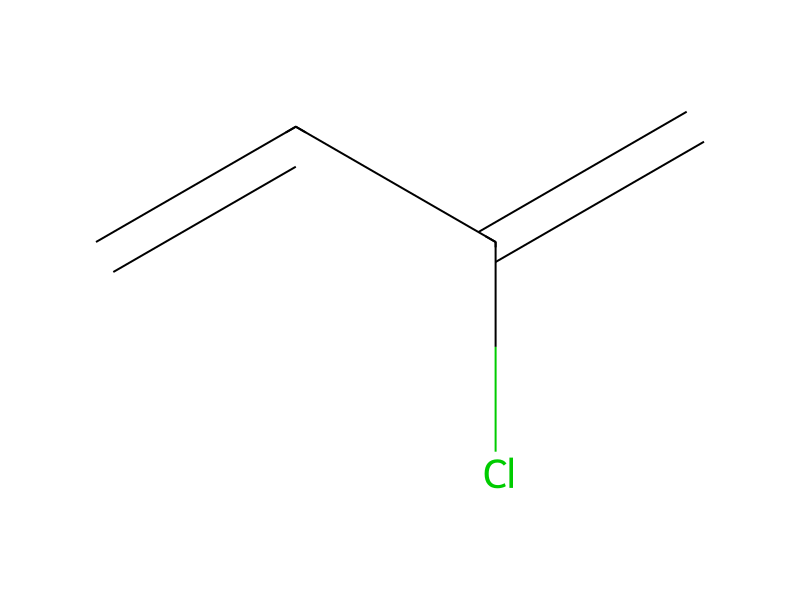
기본 정보
- 표준 SMILES
C=CC(=C)Cl- InChIKey
YACLQRRMGMJLJV-UHFFFAOYSA-N- 분자식
- C4H5Cl
- 평균 분자량
- 88.5355 g/mol
이름 및 식별자
- 우선 이름
- Polychloroprene
- 현지명
- 네오프렌
- 영어명
- Polychloroprene
- 분자식
- C4H5Cl
- 분자량
- 88.5355
이름 및 동의어
이름 더 보기
데이터베이스 식별자
- CAS
9010-98-4
물성
물리화학적 성질
- 녹는점
- 260 °C · >260 °C
- 밀도
- 1.23 g/mL · 1.23 g/mL at 25 °C(lit.)
- 저장 조건
- -196 °C · -196°C
- 물리적 상태
- 울퉁불퉁한 고체
- 색상
- 흰색에서 베이지색
- Dielectric constant
- 6 · 6.0(Ambient)
- InChI
- InChI=1S/C4H5Cl/c1-3-4(2)5/h3H,1-2H2
- InChIKey
- YACLQRRMGMJLJV-UHFFFAOYSA-N
- SMILES
- C=C(Cl)C=C
- EPA
- Chloroprene polymer (9010-98-4)
화학적 성질
The appearance of neoprene is milky white, beige or light brown flakes or lumps. Its density is 1.23–1.25 g.cm–3. The solubility parameter δ of neoprene is 9.2–9.41. Neoprene is soluble in toluene, xylene, chloroform, and dichloroethane, and slightly soluble in acetone, methyl ethyl ketone, ethyl acetate, cyclohexane but insoluble in n-hexane and solvent gasoline. Neoprene has good physical, chemical and mechanical properties. In comparison with natural rubber, it is much denser, more resistant to water and hydrocarbon solvents, less permeable to many gases, and was more resistant to degradation by oxygen, ozone, hydrogen chloride, hydrogen fluoride, and other chemicals. It has certain flame retardance. The decomposition temperature is 230–260°C, and it can be used for a long time at 80–100°C.
안전 및 규제
안전 데이터
- wgk
- 3
- tsca
- TSCA listed
- rtecs
- EI9640000
- safety_code
- 24/25
- 기존화학 물질
- KE-05560
- 스토리지 클래스
- 11 - Combustible Solids
- 유해 물질 데이터
- 9010-98-4(Hazardous Substances Data)
화학 및 산업
응용 분야
개요Neoprene, also known as polychloroprene and chloroprene rubber, is an elastomer produced by polymerization of chloroprene.
역사Polychloroprene was discovered in 1930 at E. I. DuPont de Nemours & Co. inWilmington Delaware. The discovery grew out of a need to develop a synthetic substitute for natural rubber. DuPont first marketed this first commercially successful synthetic elastomer as DuPrene in 1933. In response to new technology development that significantly improved the product and manufacturing process, the name was changed to Neoprene in 1936. The current commercially acceptable generic name for this class of chlorinated elastomers is CR or chloroprene rubber. polychloroprene structure
용도Polychloroprene is a (Solid) Mechanical rubber products, lining oil-loading hose and reaction equipment, adhesive cement, binder for rocket fuels, coatings for electric wiring, gaskets and seals. (Liquid) Specialty items made by dipping or electrophoresis from the latex. (Foam) Adhesive tape to replace metal fasteners for automotive accessories, seat cushions, carpet backing, sealant
제조 방법
생산 방법Commercial polychloroprene rubber is manufactured by aqueous free-radical emulsion polymerization followed by isolation of the solid polymer by one of several processes: freeze roll isolation, drum drying , extruder isolation, precipitation and drying or spray drying. Isolation of powdered polychloroprene has been reviewed. Of the methods cited, freeze roll and drum drying isolation are commercially important. The large-scale commercial manufacture of polychloroprene consists of eight or nine unit operations: (1) Monomer solution makeup Water solution makeup (2) Emulsification (3) Polymerization (4) Stripping of residual monomer (5) Peptization for chloroprene–sulfur copolymers (6) Freeze roll isolation Drum drying (7) Drying of freeze-rolled film (8) Roping (9) Cutting and packaging (25kg)
Polychloroprene is made from one of two starting materials, acetylene or butadiene. Acetylene can be dimerized and then chloronated to form chloroprene. Alternatively, when adequate butadiene is available, this can be directly halogenated (eqs. 7 and 8). In either case, the chloroprene product can then be polymerized to polychloroprene. Essentially a butadiene elastomer with chlorine present in the backbone,the polymer exhibits excellent tensile strength and low hysteresis, much like natural rubber. Tensile strength properties up to 28 MPa are possible with the proper reinforcing system (see FILLERS). The polarity imparted by the chlorine atom improves the oil and solvent resistance approaching those of nitrile polymers. The polymer can be protected with para-phenylenediamine antiozonants to give ozone resistance, and heat aging is also good. As a result, chloroprene elastomers are used in a wide variety of applications needing a balance of such properties.
상·하류 제품 정보
상류 원료
하류 제품
공급사50 곳
추가 설명
정의ChEBI: A macromolecule composed of repeating (2Z)-2-chlorobut-2-ene-1,4-diyl units.
관련 반응
현재 필터 조건에 해당하는 반응 기록이 없습니다.
연결된 노트
불러오는 중…