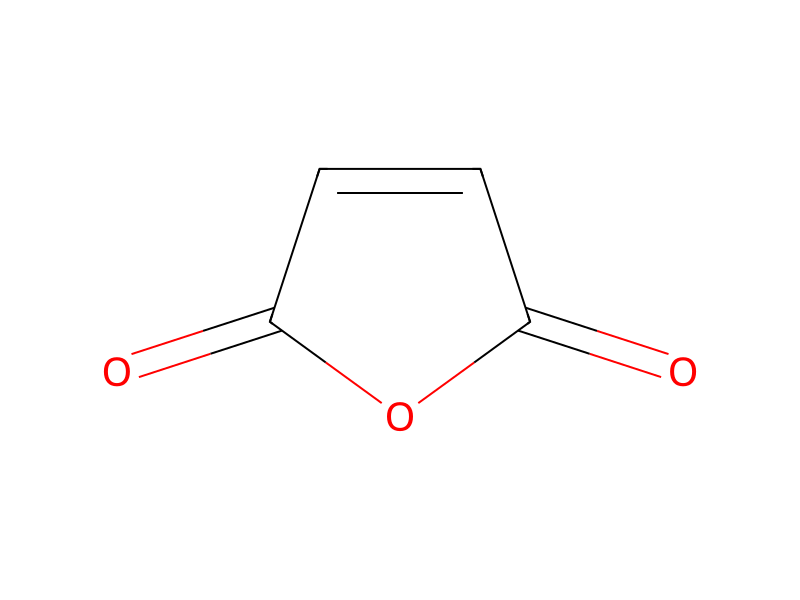
기본 정보
- 표준 SMILES
O=C1C=CC(=O)O1- InChIKey
FPYJFEHAWHCUMM-UHFFFAOYSA-N- 분자식
- C4H2O3
- 평균 분자량
- 98.06 g/mol
개요
Maleic anhydride appears as colorless crystalline needles, flakes, pellets, rods, briquettes, lumps or a fused mass. Melts at 113 °F. Shipped both as a solid and in the molten state. Vapors, fumes and dusts strong irritate the eyes, skin and mucous membranes. Flash point 218 °F. Autoignition temperature 890 °F. Used to make paints and plastics and other chemicals.
이름 및 식별자
- 우선 이름
- Maleic Anhydride
- IUPAC
- furan-2,5-dione
- 현지명
- 2,5-푸란디온,동종중합체,나트륨염
- 영어명
- 2,5-Furandione, homopolymer, sodium salt
- 분자식
- C4H2O3
- 분자량
- 98.06
이름 및 동의어
이름 더 보기
데이터베이스 식별자
- CAS
70247-90-4- ChEMBL
CHEMBL374159- ChEBI
CHEBI:474859- UNII
- V5877ZJZ25
- EC Number
- 203-571-6、606-024-3
- Nikkaji
- J2.419H
물성
구조 계산 물성
- XLogP
- -0.1
- 극성 표면적
- 43.4 Ų
- 수소 결합 공여자 수
- 0
- 수소 결합 수용자 수
- 3
- 회전 가능 결합 수
- 0
- 무거운 원자 수
- 7
- 형식 전하
- 0
- 복잡도
- 129
실험 및 물리화학적 성질
Chemical Classes
Hazardous Air Pollutants (HAPs)
Corrosives
LogP
log Kow = 1.62
1.62 (calculated)
Odor
Pungent odor
... Irritating, choking odor
Density
1.43 at 59 °F (USCG, 1999) - Denser than water; will sink
0.934 at 20 °C/4 °C
1.5 g/cm³
1.43 at 59 °F
1.314 @ 60°C
1.48
Color/Form
Orthorhombic needles from chloroform; commercial grades furnished in fused form, as briquettes
Colorless needles or white lumps or pellets
Needles from ether or chloroform
Solubility
Soluble; decomposes in hot solvent (NTP, 1992)
In water: reaction with water
Soluble in water, forming maleic acids
Solubility at 25 °C: 227 g/100 g acetone; 112 g/100 g ethyl acetate; 52.5 g/100 g chloroform; 50 g/100 g benzene; 23.4 g/100 toluene; 19.4 g/100 g o-xylene; 0.60 g/100 g carbon tetrachloride; 0.25 g/100 g ligroin; soluble in dioxane; soluble in alcohol with ester formation
Soluble in ether
Solubility in water: reaction, releasing heat
물리화학적 성질
- EPA
- 2 · 2,5-Furandione, homopolymer, sodium salt (70247-90-4)
안전 및 규제
GHS 분류
GHS Classification
Danger
H302: Harmful if swallowed [Warning Acute toxicity, oral]
P233, P260, P261, P264, P264+P265, P270, P271, P272, P280, P284, P301+P317, P301+P330+P331, P302+P352, P302+P361+P354, P304+P340, P305+P354+P338, P316, P317, P319, P321, P330, P333+P317, P342+P316, P362+P364, P363, P403, P405, and P501 (click each P-code to see the statement)
This chemical does not meet GHS hazard criteria for < 0.1% (2 of 4575) of reports.
Danger
H302 (> 99.9%): Harmful if swallowed [Warning Acute toxicity, oral]
유해성 정보
Regulatory Information
Chemical: 2,5-Furandione
Hazard Traits - Respiratory Toxicity
Regulation (EC) No 258/1997
2,5-Furandione is listed on the EPA's Chemical Data Reporting (CDR) system. Manufacturers and importers of 2,5-Furandione are required to report information about their production and use of this chemical to the EPA under the Toxic Substances Control Act (TSCA). (40 eCFR Part 711)
Status: Active Update: 02-05-2023 https://echa.europa.eu/registration-dossier/-/registered-dossier/15798
Maleic anhydride: Does not have an individual approval but may be used under an appropriate group standard
Fire Hazards
Behavior in Fire: When heated above 300 °F in the presence of various materials may generate heat and carbon dioxide. Will explode if confined. (USCG, 1999)
· Combustible material: may burn but does not ignite readily.
Combustible. Many reactions may cause fire or explosion. See Chemical dangers Finely dispersed particles form explosive mixtures in air.
Fire Potential
Great care must be taken with the molten and vapor as material in this state is flammable. The material is a combustible solid... .
Combustible solid, but may be difficult to ignite.
FIRE AND EXPLOSION HAZARDS: Combustible solid. Dust cloud may be exploded by flame or spark.
Health Hazards
Inhalation causes coughing, sneezing, throat irritation. Skin contact causes irritation and redness. Vapors cause severe eye irritation; photophobia and double vision may occur. (USCG, 1999)
· TOXIC and/or CORROSIVE; inhalation, ingestion or contact (skin, eyes) with vapors, dusts or substance may cause severe injury, burns or death.
Hazards Summary
Maleic anhydride is used in the formulation of resins. Exposure to maleic anhydride may occur from accidental releases to the environment or in workplaces where it is produced or used. Acute (short-term) inhalation exposure of humans to maleic anhydride has been observed to cause irritation of the respiratory tract and eye irritation. Chronic (long-term) exposure to maleic anhydride has been observed to cause chronic bronchitis, asthma-like attacks, and upper respiratory tract and eye irritation in workers. In some people, allergies have developed so that lower concentrations can no longer be tolerated. Kidney effects were observed in rats chronically exposed to maleic anhydride via gavage (experimentally placing the chemical in the stomach). EPA has not classified maleic anhydride for carcinogenicity.
Causes respiratory distress and lung hemorrhage in rats inhaling 86 mg/m3 six hours/day, five days/week for four weeks; Causes severe corneal ulcerations after instillation into rabbit eyes; A dermal sensitizer based on animal testing and limited data in humans; [ACGIH] Solid form causes first degree burns on short exposure; [CHRIS] Maleic anhydride is a skin irritant. [Quick CPC] Maleic anhydride is a severe eye irritant; [HSDB] Causes occupational asthma: a 34 year old male developed asthma 1 month after starting work in a plant manufacturing polyurethane products. The patient showed a dual asthmatic response after specific inhalation challenge with maleic anhydride. [Reference #1] Maleic anhydride can cause contact urticaria. [Occupational allergic contact urticaria from maleic anhydride. Kanerva L, et al. Contact Dermatitis. 2000 Mar;42(3):170-2. No abstract available.] Danger of skin and airway sensitization; [MAK] See ACID ANHYDRIDES.
DOT ID and Guide
2215 156
2215 156
Special Reports
Rakovszky Fezekas G; Toxicology Of Maleic Acid Anhydride; Munkavedelem 24 (4-6): 31 (1978). A review with 10 references on the toxicology of maleic anhydride.
USEPA; Chemical Hazard Information Profile: Maleic Anhydride (1978) EPA-560/11-80-011
Patterson RM et al; Assessment of Maleic Anhydride as a Potential Air Pollution Problem; NTIS Report PB-258363 (1976)
USEPA; Health and Environmental Effects Profile: Maleic Anhydride No.122 (1980)
For more Special Reports (Complete) data for MALEIC ANHYDRIDE (6 total), please visit the HSDB record page.
안전 및 보호
Fire Fighting
Excerpt from ERG Guide 156 [Substances - Toxic and/or Corrosive (Combustible / Water-Sensitive)]:
Use water spray, alcohol-resistant foam, carbon dioxide. NO powder.
First Aid Measures
Fresh air, rest. Half-upright position. Refer immediately for medical attention.
First rinse with plenty of water for at least 15 minutes, then remove contaminated clothes and rinse again. Wear protective gloves when administering first aid. Refer immediately for medical attention.
Rinse with plenty of water for several minutes (remove contact lenses if easily possible). Refer immediately for medical attention.
Rinse mouth. Give nothing to drink. Do NOT induce vomiting. Refer immediately for medical attention.
Accidental Release Measures
· CALL 911. Then call emergency response telephone number on shipping paper. If shipping paper not available or no answer, refer to appropriate telephone number listed on the inside back cover.
· ELIMINATE all ignition sources (no smoking, flares, sparks or flames) from immediate area.
First Aid
EYES: First check the victim for contact lenses and remove if present. Flush victim's eyes with water or normal saline solution for 20 to 30 minutes while simultaneously calling a hospital or poison control center. Do not put any ointments, oils, or medication in the victim's eyes without specific instructions from a physician. IMMEDIATELY transport the victim after flushing eyes to a hospital even if no symptoms (such as redness or irritation) develop.
General First Aid:
(General first aid procedures)
Firefighting Hazards
Water stream or foam may cause frothing. Use dry chemical, carbon dioxide, or water spray.
Reacts violently with fire extinguishing agents such as powder.
Exposure Control and Personal Protection
· Wear positive pressure self-contained breathing apparatus (SCBA).
0.08 [mg/m3], (can also occur as vapor and aerosol)[German Research Foundation (DFG)]
Fire Fighting Procedures
Wear self-contained breathing apparatus for firefighting if necessary.
Use water spray, alcohol-resistant foam, dry chemical or carbon dioxide.
Storage Conditions
Keep container tightly closed in a dry and well-ventilated place. Moisture sensitive. Storage class (TRGS 510): Non-combustible, corrosive hazardous materials
Outside or detached storage is preferred. Store in cool, dry, well-ventilated location. Separate from alkalies, alkali metals, amines, and oxidizing materials.
Cleanup Methods
Pick up and arrange disposal without creating dust. Sweep up and shovel. Keep in suitable, closed containers for disposal.
Prevent further leakage or spillage if safe to do so. Do not let product enter drains. Discharge into the environment must be avoided.
ACCIDENTAL RELEASE MEASURES /Personal precautions, protective equipment and emergency procedures/ Use personal protective equipment. Avoid dust formation. Avoid breathing vapors, mist or gas. Ensure adequate ventilation. Evacuate personnel to safe areas. Avoid breathing dust.
Ventilate area of spill. For small quantities, sweep onto paper or other suitable material, place in an appropriate container and burn in a safe place (such as fume hood). Large quantities may be reclaimed; however, if this is not practical, dissolve in a flammable solvent (such as alcohol) and atomize in a suitable combustion chamber equipped with an appropriate effluent gas cleaning device. Large quantities should be collected in the most convenient and safe manner for reclamation or disposal in a secured sanitary landfill.
Disposal Methods
Generators of waste (equal to or greater than 100 kg/mo) containing this contaminant, EPA hazardous waste number U147, must conform with USEPA regulations in storage, transportation, treatment and disposal of waste.
Maleic anhydride is a waste chemical stream constituent which may be subjected to ultimate disposal by controlled incineration. Controlled incineration; care must be taken that complete oxidation to nontoxic products occurs.
A good candidate for rotary kiln incineration at a temperature range of 820 to 1,600 °C and residence times of seconds for liquids and gases, and hours for solids. A good candidate for fluidized bed incineration at a temperature range of 450 to 980 °C and residence times of seconds for liquids and gases, and longer for solids.
/Product/ Offer surplus and non-recyclable solutions to a licensed disposal company. Contact a licensed professional waste disposal service to dispose of this material. Dissolve or mix the material with a combustible solvent and burn in a chemical incinerator equipped with an afterburner and scrubber. /Contaminated packaging/ Dispose of as unused product.
독성 정보
Interactions
Maleic anhydride retarded the carcinogenic activity of benzo(a)pyrene and dibenzo(a,h)anthazene when applied together with these carcinogens to mice dermally.
The effects of a mixture of biphenyl plus diphenyl-ether and maleic-anhydride on mortality and cholinesterase activity were studied in mice and rats. To determine median lethal dose (LD50), the compounds were introduced into the stomachs of white-mice or white-rats in a 3% starch solution. The data was treated by probit analysis. The LD50 for the mixture was 3210 mg/kg for white-mice and 5480 mg/kg for white-rats. The LD50 of maleic-anhydride for these species was 465 mg/kg and 850 mg/kg, respectively. The combined actions of the mixture and maleic-anhydride were studied at their LD50s in 90 white-mice. The biological effect of the combined administration equaled the sum expected from the addition of the toxic effect of each substance. To explain any cumulative properties of the mixture and maleic-anhydride, white-rats were treated orally for 20 days with 3% starch solutions of 0.1 LD50 of the mixture in the first group, 0.1 LD50 maleic-anhydride in the second group, 0.05 LD50 of each in the third group, and only starch solution in the fourth, control group. No animals died, but toward the end of the experiment, all test animals were less active than controls. Cholinesterase activity was not altered in any group. The threshold doses for depression of blood cholinesterase was determined to be 0.152 mg/L for maleic-anhydride and 0.126 mg/L for the mixture. When these doses were combined and administered to white-rats, an additive depression of cholinesterase activity was seen. .../It was concluded/ that the toxic effects of the mixture and maleic-anhydride are additive.
Target Organs
Urinary
Eyes, skin, respiratory system
Ecotoxicity Values
LC50; Species: Lepomis macrochirus (Bluegill); Conditions: static, aeration by "oxygenation interface method" (contact between pure oxygen and test sample); test organisms acclimated to test temperature for 10-14 days; 20 °C, pH 6.9-7.5, dechlorinated water, total hardness 84.0-163.0 mg/L (as CaCO3), 5 mg O2/L or higher; Concentration: 150 mg/L for 24 hr
LC50; Species: Lepomis macrochirus (Bluegill); Conditions: static, aeration by "oxygenation interface method" (contact between pure oxygen and test sample); test organisms acclimated to test temperature for 10-14 days; 20 °C, pH 6.9-7.5, dechlorinated water, total hardness 84.0-163.0 mg/L (as CaCO3), 5 mg O2/L or higher; Concentration: 138 mg/L for 48 hr
LC50; Species: Leuciscus idus melanotus (Golden orfe); Conditions: static; test organisms acclimated in drinking water; 10 °C, pH 3.1-5.5; Concentration: 275 mg/L for 48 hr
EC50; Species: Daphnia magna (Water flea); Conditions: static, 20 °C, pH 8.0; test solution neutralized; Concentration: 5600 mg/L for 24 hr; Effect: immobilization
For more Ecotoxicity Values (Complete) data for MALEIC ANHYDRIDE (11 total), please visit the HSDB record page.
Environmental Fate
TERRESTRIAL FATE: Based on a classification scheme(1), an estimated Koc value of 1(SRC), determined from a structure estimation method(2), indicates that maleic anhydride is expected to have very high mobility in soil(SRC). However, maleic anhydride hydrolyzes rapidly in water forming maleic acid with hydrolysis half-lives of 3.32 and 0.37 minutes at 0 and 25.1 °C respectively(3). Therefore, potential leaching in soil is expected to be dominated by degradation to maleic acid(SRC). Volatilization of maleic anhydride from moist soil surfaces is not expected to be an important fate process due to hydrolysis(SRC). Maleic anhydride is not expected to volatilize from dry soil surfaces(SRC) based upon a vapor pressure of 0.25 mm Hg at 25 °C(4). Various biodegradation screening tests have found maleic anhydride to be readily biodegradable(5,6). However, available biodegradation rates for maleic anhydride are expected to reflect the hydrolysis product maleic acid(SRC).
AQUATIC FATE: Based on a classification scheme(1), an estimated Koc value of 1(SRC), determined from a structure estimation method(2), indicates that maleic anhydride is not expected to adsorb to suspended solids and sediment(SRC). Volatilization from water surfaces is expected(3) based upon an estimated Henry's Law constant of 3.9X10⁻⁶ atm-cu m/mole(SRC), developed using a fragment constant estimation method(2). However, maleic anhydride hydrolyzes rapidly in water forming maleic acid with hydrolysis half-lives of 3.32 and 0.37 minutes at 0 and 25.1 °C, respectively(3). Therefore, volatilization is not expected to be an important fate process in water due to hydrolysis(SRC). Bioconcentration of maleic anhydride in aquatic organisms is unlikely due its rapid hydrolysis(SRC). Various biodegradation screening tests have found maleic anhydride to be readily biodegradable(5,6). However, available biodegradation rates for maleic anhydride are expected to reflect the hydrolysis product maleic acid(SRC).
ATMOSPHERIC FATE: According to a model of gas/particle partitioning of semivolatile organic compounds in the atmosphere(1), maleic anhydride, which has a vapor pressure of 0.25 mm Hg at 25 °C(2) is expected to exist solely as a vapor in the ambient atmosphere. Vapor-phase maleic anhydride is degraded in the atmosphere by reaction with photochemically-produced hydroxyl radicals(SRC); the half-life for this reaction in air is estimated to be 11 days(SRC), calculated from its rate constant of 1.45X10⁻¹² cu cm/molecule-sec at 23 °C(3). Vapor-phase maleic anhydride is also degraded in the atmosphere by reaction with ozone(SRC); the half-life for this reaction in air is estimated to be 6.5 days, calculated from its estimated rate constant of 0.18X10⁻¹⁷ cu cm/molecule-sec at 25 °C that was derived using a structure estimation method(4). The nitrate radical (NO3) is the dominant atmospheric oxidant during the night-time in most atmospheric environments(5). Vapor-phase maleic anhydride is degraded in the atmosphere by reaction with nitrate radicals(SRC); the half-life for this reaction in air is estimated to be 8 hours(SRC), calculated from its rate constant of 1.0X10⁻¹³ cu cm/molecule-sec at 25 °C(6). Removal of maleic anhydride via reaction with hydroxyl radicals, ozone and nitrate radicals leads to the formation of dicarbonyls(7). Maleic anhydride absorb at wavelengths >290 nm(6) and, therefore, may be susceptible to direct photolysis by sunlight(SRC). In the vapor phase, hydrolysis of maleic anhydride is completed in 21 hr at 96% relative humidity while no hydrolysis occurs at 50% relative humidity(8).
Exposure Routes
The substance can be absorbed into the body by inhalation of its aerosol, through the skin and by ingestion.
inhalation, ingestion, skin and/or eye contact
Toxicity Summary
IDENTIFICATION AND USE: Maleic anhydride is a solid substance appearing as colorless needles or white crystalline solid. Maleic anhydride is an intermediate, which is used in a wide range of products, mainly in the manufacture of unsaturated polyester resins. HUMAN EXPOSURE AND TOXICITY: Maleic anhydride is irritating to skin in humans. Severe skin burns and itching have been reported following dermal contact. Dust or vapor has been reported to cause conjunctivitis, inflammation and swelling of the eyelids, severe lacrymation and photophobia. Case reports of respiratory irritation, and feelings of nasal irritation and pulmonary discomfort in a volunteer study indicate that maleic anhydride is a respiratory irritant. In the volunteer study, impairment of smell was also reported. A single worker showed a positive skin reaction to a patch test, indicating that skin sensitisation was present. Repeated exposure of workers is associated with asthma as evidenced by a number of case reports. It is not known if the asthma has an immunological background. ANIMAL STUDIES: Inhalation exposure for 6 hours to up to 199 mg/cu m of maleic anhydride vapor did not cause mortality in rats. At the highest concentration, signs of eye and nose irritation were observed. Direct contact with maleic anhydride powder caused severe skin irritation in rabbits, and a 1% solution was highly irritating to their eyes. The principal effects identified in four-week and six-month inhalation studies in rats, hamsters, and Rhesus monkeys were lesions in the respiratory tract including the nose, trachea and lungs. In two rat studies (90 days or 90 and 183 days), dietary administration of maleic anhydride resulted in nephritis. In a two-generation rat study with gavage administration, no effects on fertility were found, however the pregnancy rate of the control group was exceptionally low (50-70%). The only developmental effect seen was a slight reduction in body-weight of pups from the first litter of the first generation, at this dose level (150 mg/kg b.w./day) severe toxicity including mortality was found in the parental animals. Maleic anhydride was negative in the Ames test. An in vitro chromosome aberration test showed a positive effect. An in vivo chromosome aberration test was negative. No treatment-related differences in tumor incidence were found in a dietary carcinogenicity study in rats. ECOTOXICITY STUDIES: Median tolerance limit for Gambusia affinis (mosquitofish) was found to be 240 mg/L/24 or 48 hr and 230 mg/L/96 hr in a static test done in pond water of high turbidity; 20-23 °C, pH 5.8-8.0, aerated; fish treated with terramycin to prevent or treat tail-rot disease. The LC100 was 320 mg/L/24 hr.
Ecotoxicity Excerpts
/AQUATIC SPECIES/ Median tolerance limit for Gambusia affinis (mosquitofish) was found to be 240 mg/L/24 or 48 hr and 230 mg/L/96 hr in a static test done in pond water of high turbidity (128-<25 ppm at the end of the test); 20-23 °C, pH 5.8-8.0, aerated; fish treated with terramycin to prevent or treat tail-rot disease. The LC100 was 320 mg/L/24 hr.
Signs and Symptoms
Burning sensation. Cough. Sore throat. Shortness of breath. Wheezing.
Redness. Pain. Serious skin burns.
Redness. Pain. Severe burns.
Burns in mouth and throat. Nausea. Vomiting. Diarrhoea. Severe thirst. Shock or collapse.
irritation nose, upper respiratory system; conjunctivitis; photophobia (abnormal visual intolerance to light), double vision; bronchial asthma; dermatitis
규제 정보
RCRA Requirements
U147; As stipulated in 40 CFR 261.33, when 2,5-furandione, as a commercial chemical product or manufacturing chemical intermediate or an off-specification commercial chemical product or a manufacturing chemical intermediate, becomes a waste, it must be managed according to Federal and/or State hazardous waste regulations. Also defined as a hazardous waste is any residue, contaminated soil, water, or other debris resulting from the cleanup of a spill, into water or on dry land, of this waste. Generators of small quantities of this waste may qualify for partial exclusion from hazardous waste regulations (40 CFR 261.5).
TSCA Requirements
Pursuant to section 8(d) of TSCA, EPA promulgated a model Health and Safety Data Reporting Rule. The section 8(d) model rule requires manufacturers, importers, and processors of listed chemical substances and mixtures to submit to EPA copies and lists of unpublished health and safety studies. Maleic anhydride is included on this list. Effective date: 9/10/84; Sunset date: 9/10/94.
FIFRA Requirements
Residues of maleic acid and maleic anhydride are exempted from the requirement of a tolerance when used in accordance with good agricultural practice as inert (or occasionally active) ingredients in pesticide formulations applied to growing crops only. Use: Stabilizer. Limit: For pesticide formulations applied to apples with a minimum preharvest interval of 21 days.
Atmospheric Standards
This action promulgates standards of performance for equipment leaks of Volatile Organic Compounds (VOC) in the Synthetic Organic Chemical Manufacturing Industry (SOCMI). The intended effect of these standards is to require all newly constructed, modified, and reconstructed SOCMI process units to use the best demonstrated system of continuous emission reduction for equipment leaks of VOC, considering costs, non air quality health and environmental impact and energy requirements. Maleic anhydride is produced, as an intermediate or a final product, by process units covered under this subpart.
Listed as a hazardous air pollutant (HAP) generally known or suspected to cause serious health problems. The Clean Air Act, as amended in 1990, directs EPA to set standards requiring major sources to sharply reduce routine emissions of toxic pollutants. EPA is required to establish and phase in specific performance based standards for all air emission sources that emit one or more of the listed pollutants. Maleic anhydride is included on this list.
CERCLA Reportable Quantities
Persons in charge of vessels or facilities are required to notify the National Response Center (NRC) immediately, when there is a release of this designated hazardous substance, in an amount equal to or greater than its reportable quantity of 5000 lb or 2270 kg. The toll free number of the NRC is (800) 424-8802. The rule for determining when notification is required is stated in 40 CFR 302.4 (section IV.D.3.b).
Clean Water Act Requirements
Maleic anhydride is designated as a hazardous substance under section 311(b)(2)(A) of the Federal Water Pollution Control Act and further regulated by the Clean Water Act Amendments of 1977 and 1978. These regulations apply to discharges of this substance. This designation includes any isomers and hydrates, as well as any solutions and mixtures containing this substance.
안전 데이터
- tsca
- TSCA listed
- 기존화학 물질
- KE-22840
화학 및 산업
약리 정보
Absorption, Distribution and Excretion
Dogs were fed 60 mg/kg/day maleic anhydride for 990 days. The plasma levels of maleic anhydride were determined. An uptake rate constant of 3.49X10⁻³/day and an elimination rate constant of 8.32X10⁻²/day were calculated assuming a one compartment model. According to the model 99% of steady state was reached by day 55 of the study. The dogs were maintained at steady state for the final 35 days of study.
The substance can be absorbed into the body by inhalation of its aerosol, through the skin and by ingestion.
Signs of central nervous system depression were observed in rats in a single-dose inhalation study, indicating that absorption occurs via this route.
A study of plasma levels in dogs following long-term (90 days) dietary administration of maleic anhydride at a concentration of 60 mg/kg b.w indicates that the substance is absorbed via this route. Plasma concentrations were measured on day 1, 3, 12, 29 and 90. It was calculated that a steady plasma level was reached after 55 days. In male dogs the plasma concentration was 1.8-3.5 ug/L
Maleic anhydride has a rather low order of toxicity via the dermal route indicating limited absorption via this route.
용도 및 제조
Uses
Maleic anhydride is used primarily in the formation of unsaturated polyester resins for use in boats, autos, trucks, buildings, piping, and electrical goods. Lube oil adhesives synthesized from maleic anhydride are used to prolong oil-change intervals and improve engine efficiency. Maleic anhydride is also used to make copolymers, pesticides, and other organic compounds, and in Diels-Alder syntheses.
Used in Diel-Alder syntheses; copolymerization reactions; and manufacturing of alkyd-type resins, dye intermediates, pharmaceuticals, and pesticides (Malathion). [Merck Index] Other uses are coatings, epoxies, and paper sizing resins; [ACGIH]
Pulp and Paper Processing [Category: Industry]
In Diels-Alder syntheses (as a dienophile), manufacture of alkyd-type of resins, dye intermediates, pharmaceuticals, agricultural chemicals (maleic hydrazide, malathion), in copolymerization reactions.
... Fumaric and tartaric acid manufacture; pesticides; preservative for oils and fats; permanent-press resins (textiles), Diels-Alder reactions.
Because of its properties as a dicarboxylic anhydride with a double bond, MA /maleic anhydride/ can be used for both polycondensation and polyaddition. Polyester and alkyd resins, lacquers, plasticizers, copolymers, and lubricants are the most important technical end products. Examples of industrially important copolymers are: MA-styrene (for engineering plastics) and MA-acrylic acid (used in the detergent industry). Polyester and alkyd resins, in particular, are used in the production of fiberglass reinforced plastics, in the construction and electrical industries, and in pipeline and marine construction. ... Smaller amounts of MA are used in the production of pesticides (captan, malathion) and growth inhibitors (maleic acid hydrazide). ... When added to drying oils, MA reduces the drying time and improves the coating quality of lacquers.
U.S. Exports
(1975) 9.25 x 10+8 LBS
(1978) 1.31X10+9 G
(1983) 2.26X10+9 G
(1985) 1.23X10+10 g
U.S. Imports
(1977) 3.41X10+9 G
(1982) 6.25X10+8 G
(1985) 1.89X10+9 g
U.S. Production
2023: 250,000,000 - <400,000,000 lb
(1974) 2.90 x 10+8 LBS
(1977) 1.33X10+11 G
(1982) 1.18X10+11 G
(1985) 1.78X10+11 g
For more U.S. Production (Complete) data for MALEIC ANHYDRIDE (18 total), please visit the HSDB record page.
Consumption Patterns
Comonomer for unsaturated polyester resins, 52%; chem int for lube oil additives, 12%; chem int for fumaric acid, 11%; chem int for agricultural chemicals, 9%; comonomer for other copolymers, 5%; Chem int for malic acid, 4%; all other uses, 7% (1981)
End use pattern: Unsaturated polyester resins, 53%; fumaric & malic acid, 10%; agricultural chem, 8%; lube oil additives, 7%; maleic co-polymers, 7%; miscellaneous, 16% (1985)
Consumption: Maleic Anhydride. Unsaturated polyester resins, 51%; lube oil additives, 12%; food acidulants (fumaric and malic acids), 14%; copolymers, 7%; agricultural chemicals, 6%; exports, 5%; miscellaneous, 5%.
Demand: Maleic anhydride. 1988: 429 million lb; 1989: 446 million lb; 1993 /projected/: 520 million lb. (Includes exports, but not imports, which totaled 2.5 million lb last year).
Methods of Manufacturing
May be prepared by sublimation of maleic acid and P2O5 under reduced pressure. ... Commercial production by catalytic vapor-phase oxidation of benzene or other suitable hydrocarbons.
Maleic anhydride is produced by reaction of butane with oxygen using the vanadium phosphorus oxide heterogeneous catalyst ...
Vapor-phase oxidation of benzene with atmospheric oxygen with V2O5 catalyst at 400 °C.
... By-product in mfr of phthalic anhydride from o-xylene
Production: Oxidation of benzene ... Dehydration of aqueous maleic acid solutions ... Oxidation of C4 Hydrocarbons.
Formulations/Preparations
Minimum assay of 99.5%
Grade: Technical; rods, flakes, lumps, briquettes and molten.
General Manufacturing Information
All Other Basic Inorganic Chemical Manufacturing
2,5-Furandione: ACTIVE
Maleic anhydride is readily hydrolyzed to maleic acid under aqueous conditions. As a result, these two chemicals are presented because of the conditions used to test their toxicity. The only difference may be due to the potential for maleic anhydride to form haptens by acylating with amino acids, resulting in an immunological response (dermal and respiratory sensitization).
In addition to making maleic anhydride by a conventional n-butene fixed bed process, a new process based on a fluidized bed reactor system has been commercialized.
관련 반응
현재 필터 조건에 해당하는 반응 기록이 없습니다.
연결된 노트
불러오는 중…