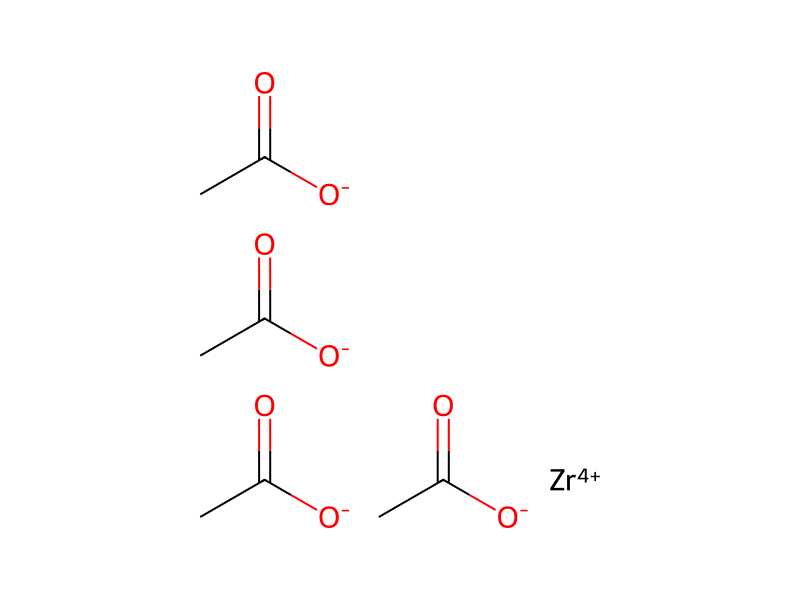
기본 정보
- 표준 SMILES
CC(=O)[O-].CC(=O)[O-].CC(=O)[O-].CC(=O)[O-].[Zr+4]- InChIKey
MFFVROSEPLMJAP-UHFFFAOYSA-J- 분자식
- C8H12O8Zr
- 평균 분자량
- 327.4 g/mol
개요
Zirconium acetate appears as an clear amber aqueous solution. Weak vinegar odor. (USCG, 1999)
이름 및 식별자
- 우선 이름
- Zirconium acetate
- IUPAC
- zirconium(4+) tetraacetate
- 현지명
- 지르코늄아세테이트
- 영어명
- Zirconium acetate
- 분자식
- C4H6O5Zr
- 분자량
- 225.31144
이름 및 동의어
이름 더 보기
데이터베이스 식별자
- CAS
126506-71-6- EC Number
- 221-759-6、224-179-1、231-492-7
- Nikkaji
- J205.653D
물성
구조 계산 물성
- 극성 표면적
- 161 Ų
- 수소 결합 공여자 수
- 0
- 수소 결합 수용자 수
- 8
- 회전 가능 결합 수
- 0
- 무거운 원자 수
- 17
- 형식 전하
- 0
- 복잡도
- 25.5
실험 및 물리화학적 성질
Physical Description
Zirconium acetate appears as an clear amber aqueous solution. Weak vinegar odor. (USCG, 1999)
Liquid; CBI; Other Solid
Aqueous solution is faint yellow; [MSDSonline]
Stability/Shelf Life
Stable under recommended storage conditions.
Zirconium acetate aq solution containing 22% zirconium oxide ... /is/ stable at room temperature.
Available as 13% ZrO2 (aqueous solution) ... stable at room temperature, but temperature of hydrolysis decreases with pH.
화학적 성질
(22% ZrO2 solution) Tacky, resinous, amorphous mass. D 1.46, fp 7C. Becomes solid on heating.
안전 및 규제
GHS 분류
GHS Classification
This chemical does not meet GHS hazard criteria for 2% (5 of 246) of reports.
Danger
H315 (15.9%): Causes skin irritation [Warning Skin corrosion/irritation]
P264, P264+P265, P280, P302+P352, P305+P351+P338, P305+P354+P338, P317, P321, P332+P317, P337+P317, and P362+P364 (click each P-code to see the statement)
Aggregated GHS information provided per 246 reports by companies from 6 notifications to the ECHA C&L Inventory. Each notification may be associated with multiple companies.
H413 (92.3%): May cause long lasting harmful effects to aquatic life [Hazardous to the aquatic environment, long-term hazard]
유해성 정보
Regulatory Information
Chemical: Acetic acid, zirconium(2+) salt
Chemical: Acetic acid, zirconium(4+) salt
Chemical: Acetic acid, zirconium salt
Acetic acid, zirconium salt (1:?) is listed on the EPA's Chemical Data Reporting (CDR) system. Manufacturers and importers of Acetic acid, zirconium salt (1:?) are required to report information about their production and use of this chemical to the EPA under the Toxic Substances Control Act (TSCA). (40 eCFR Part 711)
Status: Active Update: 29-07-2022 https://echa.europa.eu/registration-dossier/-/registered-dossier/13796
Acetic acid, zirconium(4+) salt: Does not have an individual approval but may be used as a component in a product covered by a group standard. It is not approved for use as a chemical in its own right.
OSHA Standards
Permissible Exposure Limit: Table Z-1 8-hr Time Weighted Avg: 5 mg/cu m. /Zirconium compounds (as Zr)/
Vacated 1989 OSHA PEL TWA 5 mg/cu m; STEL 10 mg/cu m is still enforced in some states. /Zirconium compounds (as Zr)/
Reactivity Profile
ZIRCONIUM ACETATE has weak oxidizing or reducing powers. Redox reactions can however still occur. The majority of compounds in this class are slightly soluble or insoluble in water. If soluble in water, then the solutions are usually neither strongly acidic nor strongly basic. These compounds are not water-reactive.
NIOSH Recommendations
Recommended Exposure Limit: 10 Hour Time-Weighted Average: 5 mg/cu m /Zirconium compounds (as Zr)/ [Note: The REL applies to all zirconium compounds (as Zr) except zirconium tetrachloride.]
Recommended Exposure Limit: 15 Minute Short Term Exposure Limit: 10 mg/cu m /Zirconium compounds (as Zr)/ [Note: The REL applies to all zirconium compounds (as Zr) except Zirconium tetrachloride.]
Hazard Classes and Categories
Skin Irrit. 2 (15.9%)
Aquatic Chronic 4 (92.3%)
안전 및 보호
Fire Fighting Procedures
Suitable extinguishing media: Use water spray, alcohol-resistant foam, dry chemical or carbon dioxide.
Advice for firefighters: Wear self-contained breathing apparatus for firefighting if necessary.
Cleanup Methods
Accidental release measures: Personal precautions, protective equipment and emergency procedures: Use personal protective equipment. Avoid breathing vapors, mist or gas. Ensure adequate ventilation.; Environmental precautions: Do not let product enter drains.; Methods and materials for containment and cleaning up: Soak up with inert absorbent material and dispose of as hazardous waste. Keep in suitable, closed containers for disposal.
1. Ventilate area of spill. 2. Collect spilled material in the most convenient and safe manner and deposit in sealed containers for reclamation... . /Zirconium compound (as Zr)/
Disposal Methods
Product: Offer surplus and non-recyclable solutions to a licensed disposal company. Contact a licensed professional waste disposal service to dispose of this material. Dissolve or mix the material with a combustible solvent and burn in a chemical incinerator equipped with an afterburner and scrubber. Contaminated packaging: Dispose of as unused product.
SRP: Recycle any unused portion of the material for its approved use or return it to the manufacturer or supplier. Ultimate disposal of the chemical must consider: the material's impact on air quality; potential migration in air, soil or water; effects on animal, aquatic and plant life; and conformance with environmental and public health regulations. If it is possible or reasonable use an alternative chemical product with less inherent propensity for occupational harm/injury/toxicity or environmental contamination.
Preventive Measures
Precautions for safe handling: Avoid contact with skin and eyes. Avoid inhalation of vapor or mist.
Appropriate engineering controls: Handle in accordance with good industrial hygiene and safety practice. Wash hands before breaks and at the end of workday.
Gloves must be inspected prior to use. Use proper glove removal technique (without touching glove's outer surface) to avoid skin contact with this product. Dispose of contaminated gloves after use in accordance with applicable laws and good laboratory practices. Wash and dry hands.
SRP: The scientific literature for the use of contact lenses by industrial workers is inconsistent. The benefits or detrimental effects of wearing contact lenses depend not only upon the substance, but also on factors including the form of the substance, characteristics and duration of the exposure, the uses of other eye protection equipment, and the hygiene of the lenses. However, there may be individual substances whose irritating or corrosive properties are such that the wearing of contact lenses would be harmful to the eye. In those specific cases, contact lenses should not be worn. In any event, the usual eye protection equipment should be worn even when contact lenses are in place.
Threshold Limit Values (TLV)
5.0 [mg/m3], as Zr
10.0 [mg/m3], as Zr
8 hr Time Weighted Avg (TWA): 5 mg/cu m; 15 min Short Term Exposure Limit (STEL): 10 mg/cu m. /Zirconium and compounds, as Zr/
A4; Not classifiable as a human carcinogen. /Zirconium and compounds, as Zr/
Personal Protective Equipment (PPE)
Rubber gloves; chemical goggles or face shield (USCG, 1999)
Eye/face protection: Safety glasses with side-shields conforming to EN166. Use equipment for eye protection tested and approved under appropriate government standards such as NIOSH (US) or EN 166(EU).
Skin protection: Handle with gloves.
Body Protection: Impervious clothing. The type of protective equipment must be selected according to the concentration and amount of the dangerous substance at the specific workplace.
Respiratory protection: Where risk assessment shows air-purifying respirators are appropriate use a full-face respirator with multipurpose combination (US) or type ABEK (EN 14387) respirator cartridges as a backup to engineering controls. If the respirator is the sole means of protection, use a full-face supplied air respirator. Use respirators and components tested and approved under appropriate government standards such as NIOSH (US) or CEN (EU).
For more Personal Protective Equipment (PPE) (Complete) data for ZIRCONIUM ACETATE (12 total), please visit the HSDB record page.
Immediately Dangerous to Life or Health (IDLH)
25 mg Zr/m3 (NIOSH, 2024)
25.0 [mg/m3], as Zr
25 mg/cu m /Zirconium compounds (as Zr)/
독성 정보
Toxicity Summary
IDENTIFICATION AND USE: Zirconium acetate is used for preparation of water repellents, and other chemicals. HUMAN EXPOSURE AND TOXICITY: Contact with eyes or skin may cause irritation. In an in vitro reconstructed human epidermis model 20 uL of a solution containing 40.7% of anhydrous zirconium acetate was applied to tissues. The exposure time was 15 minutes, and the observation period was 42 hr. Based on the mean cell viability (109%) when compared to the negative control, the test item was considered not irritant. ANIMAL STUDIES: Zirconium acetate has no systemic toxic effect on the rat following dermal exposure over a 24 hour period at a level of 2000 mg/kg. The lack of mortality demonstrates the LD50 to be greater than 2000 mg/kg. Zirconium acetate solution does not elicit any sensitization response in mice following dermal exposure. The No Observed Adverse Effect Level (NOAEL) for systemic toxicity, reproductive toxicity and for developmental toxicity was considered to be >/= 1000 mg/kg bw/day for males and females rats. According to results in a bovine corneal study, zirconium acetate should be classified as corrosive or severely irritant to the eye. A bacterial reverse mutation assay (e.g. Ames test) concluded that the test item zirconium acetate does not induce reverse mutation in Salmonella typhimurium or Escherichia coli in the absence or presence of S9 metabolism. In a mammalian cell gene mutation assay zirconium acetate solution did not induce mutation at the TK locus of L5178Y mouse lymphoma cells in vitro in the absence or presence of S9 metabolic activation. Zirconium acetate solution did not induce structural chromosomal aberrations in hamster ovary cells after in vitro treatment.
Human Toxicity Excerpts
/ALTERNATIVE and IN VITRO TESTS/ An in vitro reconstructed human epidermis model /was used/. The test system EPISKINTM is a reconstructed human epidermis (RhE) model, which in its overall design (the use of human derived epidermis keratinocytes as cell source and use of representative tissue and cytoarchitecture) closely mimics the biochemical and physiological properties of the upper parts of the human skin, i.e., the epidermis. 20 uL of test solution /(a solution containing 40.7% of anhydrous zirconium acetate)/ was applied to tissues. The exposure time was 15 minutes, and the observation period was 42 hr. Based on the mean cell viability (109%) when compared to the negative control, the test item was considered not irritant.
Non-Human Toxicity Excerpts
/LABORATORY ANIMALS: Acute Exposure/ The results indicate that the test item, /zirconium acetate solution/, has no systemic toxic effect on the rat following dermal exposure over a 24 hour period at a level of 2000 mg/kg of zirconium acetate. The lack of mortality demonstrates the LD50 to be greater than 2000 mg/kg.
/LABORATORY ANIMALS: Acute Exposure/ /In a/ mouse local lymph node assay, mice were treated with 25 uL of /zirconium acetate solution (40.7% of zirconium acetate anhydrous) applied/ to dorsal ear surface days 1, 2, and 3. ... No signs of toxicity (clinical signs or toxicologically relevant body weight losses) were observed at any tested concentrations. The evaluation of visible reactions showed no erythema at any of the tested concentrations. The evaluation of ear thickness indicated that the reaction was acceptable (increase of less than 25% compared to Day 1) at the concentration of 100% (undiluted test item). The evaluation of ear punch weight indicated that the reaction was acceptable (increased less than 25% with respect to the negative control) at all the investigated concentrations. No mortality and no significant clinical signs were recorded in animals treated at any dose level. The results obtained in this study indicate that zirconium acetate solution (40.7% as zirconium acetate, anhydrous) does not elicit any sensitization response in mice following dermal exposure.
/LABORATORY ANIMALS: Subchronic or Prechronic Exposure/ Three groups of 4 rats per sex were administered zirconium acetate by oral gavage at doses of 100, 300 and 1000 mg/kg bw/day (expressed as zirconium acetate anhydrous). The test item (a solution containing 40.7% of zirconium acetate anhydrous) was formulated using purified water as vehicle. Animals were exposed for a duration of 32 consecutive days for males and up to 50 consecutive days for females. Sporadic effects were noted among the various parameters investigated; however, they were determined to be either not treatment-related or of no toxicological relevance. Therefore, on the basis of the results obtained in this study, the No Observed Adverse Effect Level (NOAEL) for systemic toxicity was considered to be >/=1000 mg/kg bw/day for males and females.
/LABORATORY ANIMALS: Developmental or Reproductive Toxicity/ Three groups of 4 rats per sex were administered with zirconium acetate by oral gavage at doses of 100, 300 and 1000 mg/kg bw/day (expressed as zirconium acetate anhydrous). The test item (a solution containing 40.7 % of zirconium acetate anhydrous) was formulated using purified water as vehicle. Animals were exposed for a duration of 32 consecutive days for males and up to 50 consecutive days for females. After two weeks of dosing, males and females were mated for a period of two weeks. Males were sacrificed following the mating period while dosing continued for pregnant females through post partum Day 4, at which time all surviving dams and pups were sacrificed. No effects on reproduction or development were observed in any dose group. Therefore, on the basis of the results obtained in the study, the No Observed Adverse Effect Level (NOAEL) for reproductive toxicity and for developmental toxicity was considered to be >/=1000 mg/kg bw/day.
For more Non-Human Toxicity Excerpts (Complete) data for ZIRCONIUM ACETATE (8 total), please visit the HSDB record page.
Probable Routes of Human Exposure
NIOSH (NOES Survey 1981-1983) has statistically estimated that 13,795 workers (5,829 of these were female) were potentially exposed to zirconium acetate in the US(1). Occupational exposure to zirconium acetate may occur through inhalation of dust and dermal contact with this compound at workplaces where zirconium acetate is produced or used(SRC).
Antidote and Emergency Treatment
/SRP:/ Immediate first aid: Ensure that adequate decontamination has been carried out. If patient is not breathing, start artificial respiration, preferably with a demand valve resuscitator, bag-valve-mask device, or pocket mask, as trained. Perform CPR if necessary. Immediately flush contaminated eyes with gently flowing water. Do not induce vomiting. If vomiting occurs, lean patient forward or place on the left side (head-down position, if possible) to maintain an open airway and prevent aspiration. Keep patient quiet and maintain normal body temperature. Obtain medical attention. /Poisons A and B/
/SRP:/ Basic treatment: Establish a patent airway (oropharyngeal or nasopharyngeal airway, if needed). Suction if necessary. Watch for signs of respiratory insufficiency and assist ventilations if needed. Administer oxygen by nonrebreather mask at 10 to 15 L/min. Monitor for pulmonary edema and treat if necessary ... . Monitor for shock and treat if necessary ... . Anticipate seizures and treat if necessary ... . For eye contamination, flush eyes immediately with water. Irrigate each eye continuously with 0.9% saline (NS) during transport ... . Do not use emetics. For ingestion, rinse mouth and administer 5 mL/kg up to 200 mL of water for dilution if the patient can swallow, has a strong gag reflex, and does not drool ... . Cover skin burns with dry sterile dressings after decontamination ... . /Poisons A and B/
/SRP:/ Advanced treatment: Consider orotracheal or nasotracheal intubation for airway control in the patient who is unconscious, has severe pulmonary edema, or is in severe respiratory distress. Positive-pressure ventilation techniques with a bag valve mask device may be beneficial. Consider drug therapy for pulmonary edema ... . Consider administering a beta agonist such as albuterol for severe bronchospasm ... . Monitor cardiac rhythm and treat arrhythmias as necessary ... . Start IV administration of D5W TKO /SRP: "To keep open", minimal flow rate/. Use 0.9% saline (NS) or lactated Ringer's (LR) if signs of hypovolemia are present. For hypotension with signs of hypovolemia, administer fluid cautiously. Watch for signs of fluid overload ... . Treat seizures with diazepam (Valium) or lorazepam (Ativan) ... . Use proparacaine hydrochloride to assist eye irrigation ... . /Poisons A and B/
화학 및 산업
용도 및 제조
Uses
Used to make water repellents and other chemicals; [HSDB] Available as zirconium acetate solution with 22-27% acetic acid; [MSDSonline]
Preparation of water repellents, other chemicals.
General Manufacturing Information
Pharmaceutical and Medicine Manufacturing
Acetic acid, zirconium(4+) salt (4:1): ACTIVE
Acetic acid, zirconium salt (1:?): ACTIVE
Naturally occurring zirconium contains five isotopes. Thirty-one other radioactive isotopes and isomers are known to exist.
응용 분야
용도Waterproofing textiles, precipitation of proteins, starch, etc.; for textile and paper coatings.
공급사4 곳
관련 반응
현재 필터 조건에 해당하는 반응 기록이 없습니다.
연결된 노트
불러오는 중…