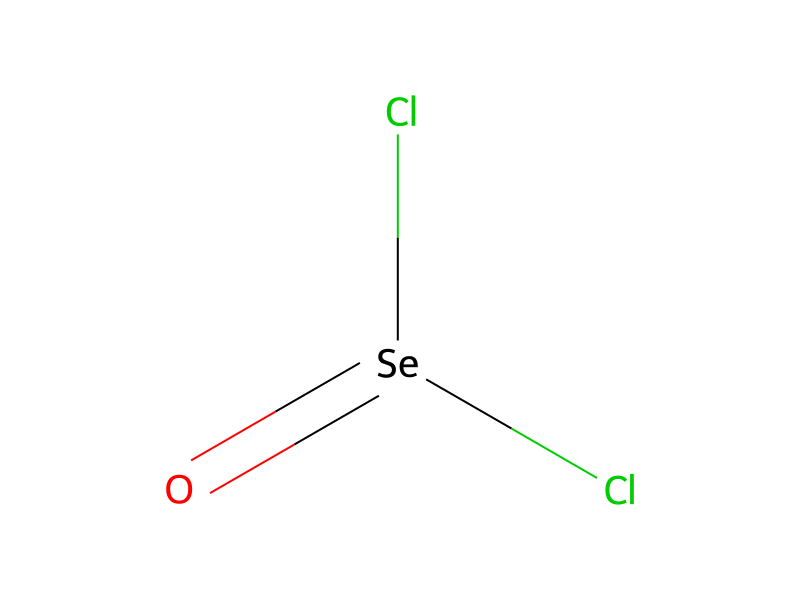
기본 정보
- 표준 SMILES
O=[Se](Cl)Cl- InChIKey
LIRMPIXWGWLNND-UHFFFAOYSA-N- 분자식
- Cl2OSe
- 평균 분자량
- 165.87 g/mol
- 단동위원소 질량
- 165.84914128
개요
Selenium oxychloride appears as a colorless to light-colored liquid. Insoluble in water and denser than water. Contact may severely irritate skin, eyes and mucous membranes. May be toxic by ingestion, inhalation and skin absorption. Used to make other chemicals.
이름 및 식별자
- 우선 이름
- Selenium oxychloride
- IUPAC
- Selenous dichloride
- 현지명
- 옥시염화 셀레늄
- 영어명
- Selenium Oxychloride
- 분자식
- Cl2OSe
- 분자량
- 165.87
이름 및 동의어
이름 더 보기
데이터베이스 식별자
- CAS
7791-23-3- PubChem CID
- 24647
- DTXSID
DTXSID50884438- UNII
- 1G57T5401W
- EC Number
- 232-244-0
- Nikkaji
- J95.310E
물성
구조 계산 물성
- 극성 표면적
- 17.1 Ų
- 수소 결합 공여자 수
- 0
- 수소 결합 수용자 수
- 1
- 회전 가능 결합 수
- 0
- 무거운 원자 수
- 4
- 형식 전하
- 0
- 복잡도
- 29
실험 및 물리화학적 성질
Chemical Classes
Other Classes -> Other Inorganic Compounds
Corrosives
Density
2.44 at 60.8 °F (EPA, 1998) - Denser than water; will sink
2.44 g/cu cm at 16 °C/4 °C
Relative density (water = 1): 2.42
2.42 @ 22°C
Solubility
Miscible with carbon tetrachloride, chloroform, carbon disulfide, benzene, toluene
Solubility in water at 20 °C: decomposes
Solubility in water: reaction
Boiling Point
356 °F at 760 mmHg (EPA, 1998)
180 °C
176.4 °C
176.4 °C @760 [mm Hg]
Decomposition
It is decomposed by water to form hydrochloric acid, a corrosive material.
When heated to decomposition ... emits very toxic fumes of /hydrogen chloride and selenium/.
Melting Point
47.3 °F (EPA, 1998)
8.5 °C
8.5 °C
10.9 °C
Vapor Pressure
1 mmHg at 94.6 °F (EPA, 1998)
0.05 [mmHg]
1 mm Hg at 34.8 °C
Vapor pressure, Pa at 34.8 °C: 132
2.9 [mm Hg] @25 °C
물리화학적 성질
- 녹는점
- 9 °C · 9 °C
- 끓는 점
- 180 °C · 180 °C(lit.)
- 밀도
- 2.43 g/mL · 2.43 g/mL at 25 °C(lit.)
- 굴절률
- 1.651 · 1.651
- 인화점
- 176.4 °C · 176.4°C
- 용해도
- 클로로포름, 이황화탄소 및 벤젠과 혼합 가능.
- 물리적 상태
- 액체
- 색상
- 노란색
- Specific Gravity
- 2.42 · 2.42
- 수용성
- 4 · CCl4, CHCl3, CS2, 벤젠, 톨루엔 [MER06]과 혼화성
- Merck
- 14 · 14,8435
- Dielectric constant
- 46 · 46.0
- 안정성
- 안정적이지만 물과 습기와 반응합니다. 물, 칼륨, 인과 호환되지 않습니다.
- InChI
- 1S/Cl2OSe/c1-4(2)3
- InChIKey
- LIRMPIXWGWLNND-UHFFFAOYSA-N
- SMILES
- Cl[Se](Cl)=O
- EPA
- Selenium oxychloride (7791-23-3)
화학적 성질
Selenium oxychloride is a colorless to yellowish liquid. Fumes in air.
안전 및 규제
GHS 분류
GHS Classification
Danger
H301 (100%): Toxic if swallowed [Danger Acute toxicity, oral]
P260, P261, P264, P270, P271, P273, P280, P301+P316, P301+P330+P331, P302+P361+P354, P304+P340, P305+P354+P338, P316, P319, P321, P330, P363, P391, P403+P233, P405, and P501 (click each P-code to see the statement)
Aggregated GHS information provided per 43 reports by companies from 3 notifications to the ECHA C&L Inventory. Each notification may be associated with multiple companies.
유해성 정보
Regulatory Information
Chemical: Seleninyl chloride
The New Jersey Worker and Community Right to Know Act requires public and private employers to provide information about hazardous substances at their workplaces. (N.J.S.A. 34:5A-1 et. seq.)
Fire Hazards
When this material is heated to decomposition, or in contact with acids or acid fumes, highly toxic chloride and selenium fumes are evolved. Hydrochloric acid and selenious acid are produced by reaction with water. Decomposed by water. Reacts violently with powdered antimony, red and white phosphorus, disilver oxide, lead oxides, and potassium. Avoid water, moist air. (EPA, 1998)
· Non-combustible, substance itself does not burn but may decompose upon heating to produce corrosive and/or toxic fumes.
Not combustible. Gives off irritating or toxic fumes (or gases) in a fire.
Health Hazards
This material is very toxic and may cause death or permanent injury after very short exposures to small quantities. Inhalation of small quantities may be corrosive and irritating to the respiratory tract. It can burn and irritate the skin and eyes and cause burns when ingested. Long-term exposure to selenium compounds may be a cause of amyotrophic lateral sclerosis in humans. Populations at special risk include those with a history of dermatitis, chronic bronchitis, skin allergies, respiratory tract infections, liver or kidney disease, jaundice, or albuminuria. Women of child-bearing age are also considered at risk. (EPA, 1998)
· TOXIC and/or CORROSIVE; inhalation, ingestion or contact (skin, eyes) with vapors, dusts or substance may cause severe injury, burns or death.
Special Reports
WHO; Environ Health Criteria: Selenium 58: 1-306 (1987). EHC are designed for scientists and administrators responsible for the establishment of safety standards and regulations and provide basic scientific risk evaluations of a wide range of chemicals and groups of chemicals.[Available from, as of April 1, 2011: http://www.inchem.org/documents/ehc/ehc/ehc58.htm#SectionNumber:7.1]
RCRA Requirements
D002; A solid waste containing selenium oxychloride may become characterized as a hazardous waste when subjected to testing for corrosivity as stipulated in 40 CFR 261.22, and if so characterized, must be managed as a hazardous waste.
D003; A solid waste containing selenium oxychloride may become characterized as a hazardous waste when subjected to testing for reactivity as stipulated in 40 CFR 261.23, and if so characterized, must be managed as a hazardous waste.
D010; A solid waste containing selenium (such as selenium oxychloride) may or may not become characterized as a hazardous waste when subjected to the Toxicity Characteristic Leaching Procedure listed in 40 CFR 261.24, and if so characterized, must be managed as a hazardous waste.
안전 및 보호
Fire Fighting
Cool containers that are exposed to flames with water until well after the fire is out. Stay upwind; keep out of low areas. Wear positive pressure breathing apparatus and special protective clothing.
In case of fire in the surroundings, use appropriate extinguishing media.
First Aid Measures
Fresh air, rest. Half-upright position. Artificial respiration may be needed. Refer for medical attention.
Remove contaminated clothes. Rinse skin with plenty of water or shower. Refer for medical attention .
First rinse with plenty of water for several minutes (remove contact lenses if easily possible), then refer for medical attention.
Rinse mouth. Do NOT induce vomiting. Refer for medical attention .
Accidental Release Measures
· CALL 911. Then call emergency response telephone number on shipping paper. If shipping paper not available or no answer, refer to appropriate telephone number listed on the inside back cover.
· ELIMINATE all ignition sources (no smoking, flares, sparks or flames) from immediate area.
First Aid
Signs and Symptoms of Selenium Oxychloride Exposure: Signs and symptoms of acute exposure to selenium oxychloride may include dermatitis and burns to the skin, eye and nasal irritation, a burning sensation in the nostrils, headache, a garliclike odor on the breath, fever, nausea, and vomiting (coffee grounds in appearance). Irritation of the gastrointestinal tract may also be observed. Lassitude, dizziness, hypotension (low blood pressure), decreased peripheral pulse, dyspnea (difficulty in breathing), pulmonary edema, cardiopulmonary arrest, and coma have also been reported.
General First Aid:
Exposure Control and Personal Protection
· Wear positive pressure self-contained breathing apparatus (SCBA).
0.02 [mg/m3], as Se, inhalable fraction[German Research Foundation (DFG)]
Fire Fighting Procedures
If material on fire or involved in fire: Extinguish fire using agent suitable for type of surrounding fire. Material itself does not burn or burns with difficulty. Use dry chemical, dry sand, or carbon dioxide. Do not use water on material itself. If large quantities of combustibles are involved, use water in flooding quantities as spray and fog. Keep run-off water out of sewers and water sources. Use water spray to knock down vapors.
Wear appropriate chemical protective gloves, boots, and goggles. Wear positive pressure self-contained breathing apparatus when fighting fires involving this material. If contact with the material is anticipated, wear appropriate chemical protective clothing.
Cleanup Methods
SRP: Wastewater from contaminant suppression, cleaning of protective clothing/equipment, or contaminated sites should be contained and evaluated for subject chemical or decomposition product concentrations. Concentrations shall be lower than applicable environmental discharge or disposal criteria. Alternatively, pretreatment and/or discharge to a permitted wastewater treatment facility is acceptable only after review by the governing authority and assurance that "pass through" violations will not occur. Due consideration shall be given to remediation worker exposure (inhalation, dermal and ingestion) as well as fate during treatment, transfer and disposal. If it is not practicable to manage the chemical in this fashion, it must be evaluated in accordance with EPA 40 CFR Part 261, specifically Subpart B, in order to determine the appropriate local, state and federal requirements for disposal.
Environmental considerations: Air spill: Apply water spray or mist to knock down vapors.
Environmental considerations: Water spill: Use natural barriers or oil spill control booms to limit spill travel. Remove trapped material with suction hoses.
Environmental considerations: Land spill: Dig a pit, pond, lagoon, holding area to contain liquid or solid material. /SRP: If time permits, pits, ponds, lagoons, soak holes, or holding areas should be sealed with an impermeable flexible membrane liner./ Dike surface flow using soil, sand bags, foamed polyurethane, or foamed concrete. Absorb bulk liquid with fly ash, cement powder, or commerical sorbents. /Selenium oxychloride, poisonous liquid, N.O.S./
1. Ventilate area of spill. 2. Collect spilled material in most convenient & safe manner & deposit in sealed containers for reclamation or for disposal in a secured sanitary landfill. Liq containing selenium & its inorganic cmpd should be absorbed in vermiculite, dry sand, earth, or similar material.
Spillage Disposal
Personal protection: complete protective clothing including self-contained breathing apparatus. Ventilation. Collect leaking and spilled liquid in sealable containers as far as possible. Absorb remaining liquid in dry sand or inert absorbent. Then store and dispose of according to local regulations.
Preventive Measures
If material not on fire and not involved in fire: Keep material out of water sources and sewers. Neutralize spilled material with crushed limestone, soda ash, or lime.
Personnel protection: Avoid breathing dusts, and fumes from burning material. Keep upwind. Avoid bodily contact with the material. Do not handle broken packages unless wearing appropriate personal protective equipment. Wash away any material which may have contacted the body with copious amounts of soap and water.
SRP: Contaminated protective clothing should be segregated in such a manner so that there is no direct personal contact by personnel who handle, dispose, or clean the clothing. The completeness of the cleaning procedures should be considered before the decontaminated protective clothing is returned for reuse by the workers. Contaminated clothing should not be taken home at the end of shift, but should remain at employee's place of work for cleaning.
SRP: Wastewater from contaminant suppression, cleaning of protective clothing/equipment, or contaminated sites should be contained and evaluated for subject chemical or decomposition product concentrations. Concentrations shall be lower than applicable environmental discharge or disposal criteria. Alternatively, pretreatment and/or discharge to a permitted wastewater treatment facility is acceptable only after review by the governing authority and assurance that "pass through" violations will not occur. Due consideration shall be given to remediation worker exposure (inhalation, dermal and ingestion) as well as fate during treatment, transfer and disposal. If it is not practicable to manage the chemical in this fashion, it must be evaluated in accordance with EPA 40 CFR Part 261, specifically Subpart B, in order to determine the appropriate local, state and federal requirements for disposal.
For more Preventive Measures (Complete) data for SELENIUM OXYCHLORIDE (11 total), please visit the HSDB record page.
독성 정보
Health Effects
Chronic oral exposure to high concentrations of selenium compounds can produce a disease called selenosis. The major signs of selenosis are hair loss, nail brittleness, and neurological abnormalities (such as numbness and other odd sensations in the extremities). Animal studies have shown that selenium may also affect sperm production and the female reproductive cycle. (L619)
Exposure Routes
The substance can be absorbed into the body by inhalation of its vapour and by ingestion.
Oral (L619) ; inhalation (L619) ; dermal (L619)
Toxicity Summary
Selenium readily substitutes for sulfur in biomolecules and in many biochemical reactions, especially when the concentration of selenium is high and the concentration of sulfur is low. Inactivation of the sulfhydryl enzymes necessary for oxidative reactions in cellular respiration, through effects on mitochondrial and microsomal electron transport, might contribute to acute selenium toxicity. Selenomethionine (a common organic selenium compound) also appears to randomly substitute for methionine in protein synthesis. This substitution may affect the structure and functionability of the protein, for example, by altering disulfide bridges. Inorganic forms of selenium appear to react with tissue thiols by redox catalysis, resulting in formation of reactive oxygen species and causing damage by oxidative stress. (L619)
Signs and Symptoms
Burning sensation. Cough. Laboured breathing. Sore throat. Shortness of breath. Symptoms may be delayed.
Redness. Pain. Blisters. Skin burns.
Redness. Pain. Severe deep burns.
Burning sensation. Sore throat. Nausea. Abdominal cramps. Vomiting. Abdominal pain. Diarrhoea. Shock or collapse.
Short-term oral exposure to high concentrations of selenium may cause nausea, vomiting, and diarrhea. Brief exposures to high levels of elemental selenium or selenium dioxide in air can result in respiratory tract irritation, bronchitis, difficulty breathing, and stomach pains. Longer-term exposure to either of these air-borne forms can cause respiratory irritation, bronchial spasms, and coughing. (L619)
Human Toxicity Excerpts
/SIGNS AND SYMPTOMS/ Short-term Exposure: Inhalation of large quantities of ... selenium oxychloride may cause severe breathing difficulties which may not appear for several hours after exposure. Skin contact with ... selenium oxychloride may cause skin burns.
/SIGNS AND SYMPTOMS/ Selenium oxychloride readily destroys skin on contact, causing third degree burns unless immediately removed with water.
/SIGNS AND SYMPTOMS/ Contact with the skin can cause severe burns. It is toxic by skin absorption and by inhalation.
/SIGNS AND SYMPTOMS/ Selenium oxychloride is strongly vesicant and will rapidly destroy the skin upon contact unless immediately removed by washing.
For more Human Toxicity Excerpts (Complete) data for SELENIUM OXYCHLORIDE (8 total), please visit the HSDB record page.
Populations at Special Risk
... Applicants who will be working with more reactive ... cmpd such as ... selenium oxychloride should /be protected if they/ have had history of dermatitis, chronic bronchitis or any ... skin allergy of resp tract infection. Also those ... with history of liver or kidney disease, jaundice or albuminuria should be excluded. Careful consideration must be given to /SRP: protecting employees during their reproductive years/.
Probable Routes of Human Exposure
Selenium oxychloride may enter the body through the skin.
... by skin absorption and by inhalation.
Antidote and Emergency Treatment
Immediate first aid: Ensure that adequate decontamination has been carried out. If patient is not breathing, start artificial respiration, preferably with a demand-valve resuscitator, bag-valve-mask device, or pocket mask, as trained. Perform CPR as necessary. Immediately flush contaminated eyes with gently flowing water. Do not induce vomiting. If vomiting occurs, lean patient forward or place on left side (head-down position, if possible) to maintain an open airway and prevent aspiration. Keep patient quiet and maintain normal body temperature. Obtain medical attention. /Selenium and Related Compounds/
Basic treatment: Establish a patent airway (oropharyngeal or nasopharyngeal airway, if needed). Suction if necessary. Watch for signs of respiratory insufficiency and assist ventilations if necessary. Administer oxygen by nonrebreather mask at 10 to 15 L/min. Monitor for shock and treat if necessary ... . Monitor for pulmonary edema and treat if necessary ... . Treat seizures if necessary ... . For eye contamination, flush eyes immediately with water. Irrigate each eye continuously with 0.9% saline (NS) during transport ... . Do not use emetics. For ingestion, rinse mouth and administer 5 mL/kg up to 200 mL of water for dilution if the patient can swallow, has a strong gag reflex, and does not drool. Administer activated charcoal ... . /Selenium and Related Compounds/
Advanced treatment: Consider orotracheal or nasotracheal intubation for airway control in the patient who is unconscious, has severe pulmonary edema, or is in severe respiratory distress. Positive-pressure ventilation techniques with a bag valve mask device may be beneficial. Consider drug therapy for pulmonary edema ... . Consider administering a beta agonist such as albuterol for severe bronchospasm ... .Monitor cardiac rhythm and treat arrhythmias if necessary ... . Start IV administration of D5W /SRP: "To keep open", minimal flow rate/. Use 0.9% saline (NS) or lactated Ringer's (LR) if signs of hypovolemia are present. For hypotension with signs of hypovolemia, administer fluid cautiously. Consider vasopressors if patient is hypotensive with a normal fluid volume. Watch for signs of fluid overload ... . Treat seizures with diazepam or lorazepam ... . Use proparacaine hydrochloride to assist eye irrigation ... . /Selenium and Related Compounds/
Emergency and supportive measures. Maintain an open airway and assist ventilation if necessary. Administer supplemental oxygen. Treat coma, convulsions, bronchospasm, hypotension, and pulmonary edema if they occur. Since hypotension is often multifactorial, evaluate and optimize volume status, peripheral vascular resistance, and myocardial contractility. Observe for at least 6 hours after exposure. ... /Selenium/
Decontamination: Inhalation. Immediately remove the victim from exposure and give supplemental oxygen if available. Skin and eyes. Remove contaminated clothing and wash exposed skin with soap and copious water. Irrigate exposed eyes with copious tepid water or saline. Ingestion. Ingestion of elemental selenium or selenium salts does not usually benefit from GI decontamination. In light of the risk of severe corrosive GI injury, gastric lavage plus activated charcoal may be of value for ingestion s of selenious acid seen within 1 hour. Invitro experiments indicate that vitamin C can reduce selenium salts to elemental selenium, which poorly absorbed. Its use has not been studied in vivo, but oral or nasogastric administration of several grams of ascorbic acid has been recommended. /Selenium/
규제 정보
RCRA Requirements
D002; A solid waste containing selenium oxychloride may become characterized as a hazardous waste when subjected to testing for corrosivity as stipulated in 40 CFR 261.22, and if so characterized, must be managed as a hazardous waste.
D003; A solid waste containing selenium oxychloride may become characterized as a hazardous waste when subjected to testing for reactivity as stipulated in 40 CFR 261.23, and if so characterized, must be managed as a hazardous waste.
D010; A solid waste containing selenium (such as selenium oxychloride) may or may not become characterized as a hazardous waste when subjected to the Toxicity Characteristic Leaching Procedure listed in 40 CFR 261.24, and if so characterized, must be managed as a hazardous waste.
Atmospheric Standards
Listed as a hazardous air pollutant (HAP) generally known or suspected to cause serious health problems. The Clean Air Act, as amended in 1990, directs EPA to set standards requiring major sources to sharply reduce routine emissions of toxic pollutants. EPA is required to establish and phase in specific performance based standards for all air emission sources that emit one or more of the listed pollutants. Selenium oxychloride is included on this list.
CERCLA Reportable Quantities
Releases of CERCLA hazardous substances are subject to the release reporting requirement of CERCLA section 103, codified at 40 CFR part 302, in addition to the requirements of 40 CFR part 355. Selenium oxychloride is an extremely hazardous substance (EHS) subject to reporting requirements when stored in amounts in excess of its threshold planning quantity (TPQ) of 500 lbs.
State Drinking Water Standards
(AZ) ARIZONA 10 ug/L /Selenium/
(NY) NEW YORK 10 ug/L /Selenium/
State Drinking Water Guidelines
(AZ) ARIZONA 45 ug/L /Selenium/
(CT) CONNECTICUT 10 ug/L /Selenium/
(ME) MAINE 35 ug/L /Selenium/
(MN) MINNESOTA 30 ug/L /Selenium/
안전 데이터
- wgk
- 3
- tsca
- TSCA listed
- rtecs
- VS7000000
- ridadr
- UN 2879
- 독성
- LD50 s.c. in rabbits: 7 mg/kg (Wilber)
- HS 번호
- 28121099
- risk_code
- 14-23/25-33-35-50/53
- hazard_code
- T,N
- safety_code
- 26-36/37/39-45-60-61-28-20/21
- 포장분류
- I
- 위험 등급
- 8
- 기존화학 물질
- KE-30919
- Hazard Classifications
- Acute Tox. 3 InhalationAcute Tox. 3 OralAquatic Acute 1Aquatic Chronic 1STOT RE 2
- 스토리지 클래스
- 6.1A - Combustible acute toxic Cat. 1 and 2very toxic hazardous materials
- 유해 물질 데이터
- 7791-23-3(Hazardous Substances Data)
- 함량 및 규제정보
- 물질구분: 유독물질; 혼합물(제품)함량정보: 셀레늄 또는 그 화합물과 셀렌화합물을 1% 이상 함유한 혼합물
- 유해화학물질 필터링
- 97-1-134
화학 및 산업
약리 정보
Metabolism/Metabolites
Selenium may be absorbed through inhalation and ingestion, while some selenium compounds may also be absorbed dermally. Once in the body, selenium is distributed mainly to the liver and kidney. Selenium is an essential micronutrient and is a component of glutathione peroxidase, iodothyronine 5'-deiodinases, and thioredoxin reductase. Organic selenium is first metabolized into inorganic selenium. Inorganic selenium is reduced stepwise to the intermediate hydrogen selenide, which is either incorporated into selenoproteins after being transformed to selenophosphate and selenocysteinyl tRNA or excreted into the urine after being transformed into methylated metabolites of selenide. Elemental selenium is also methylated before excretion. Selenium is primarily eliminated in the urine and feces, but certain selenium compounds may also be exhaled. (L619)
용도 및 제조
Uses
Used as a chlorinating agent and plasticizer; Also used as a solvent for sulfur, selenium, tellurium, rubber, Bakelite, gums, resins, celluloid, gelatin, glue, and asphalt; [HSDB]
Chlorinating agent and resin plasticizer used in the chemical industry
Solvent for sulfur, selenium, tellurium, rubber, bakelite, gums, resins, glue, asphalt and other materials
Selenium oxydichloride is used occasionally as a polar solvent for synthetic phenolic resins. (L729)
Methods of Manufacturing
Prepared by passing chlorine into SeO2 suspended in carbon tetrachloride ... By dehydration of dichloroselenious acid.
Selenium oxyhalides ... are prepared by the addition of a halogen to a dry mixture or a carbon tetrachloride suspension of selenium and selenium dioxide. /Selenium oxyhalides/
The action of halogens or halides on elemental selenium yields various selenium halides, depending on the temperature and stoichiometric ratio. /Selenium halides/
From SOCl2 and SeO2, ... FROM AlCl3 and SeO2.
응용 분야
용도selenium oxychloride is used as solvent.
일반 설명A colorless to light-colored liquid. Insoluble in water and denser than water. Contact may severely irritate skin, eyes and mucous membranes. May be toxic by ingestion, inhalation and skin absorption. Used to make other chemicals.
제조 방법
생산 방법Selenium oxychloride (SeOCl2) is a powerful solvent, chlorinating agent, and resin plasticizer used in the chemical industry.
상·하류 제품 정보
상류 원료
하류 제품
공급사18 곳
관련 반응
현재 필터 조건에 해당하는 반응 기록이 없습니다.
연결된 노트
불러오는 중…