다이드제인
다이드제인 · 7-Hydroxy-3-(4-hydroxyphenyl)-4H-chromen-4-one · Daidzein 486-66-8 · 4’,7-dihydroxy-isoflavon · 4,7-Dihydroxyisoflavone(Daidzein) · 7-HYDROXY-3-(4-HYDROXY-PHENYL)-CHROMEN-4-ONE · k251b · GMP-5
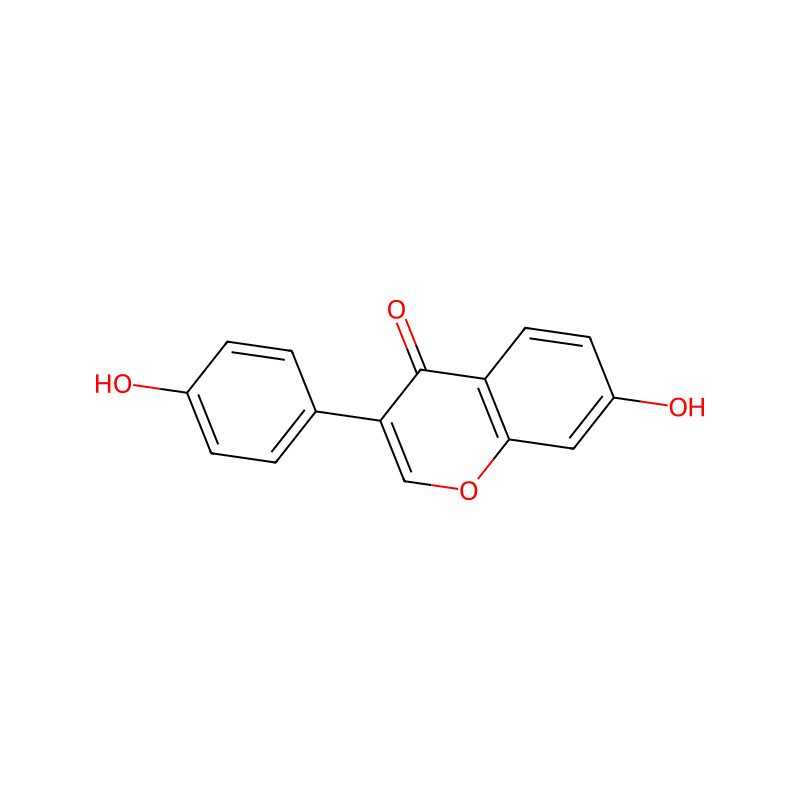
식별자 및 물리적 특성
| CAS No. | 486-66-8 |
|---|---|
| 분자식 | C15H10O4 |
| 평균 분자량 | 254.24 g/mol |
| 단동위원소 질량 | 254.0579088 g/mol |
| SMILES | O=c1c(-c2ccc(O)cc2)coc2cc(O)ccc12 |
| InChIKey | ZQSIJRDFPHDXIC-UHFFFAOYSA-N |
| PubChem CID | 5281708 |
| ChEMBL | CHEMBL8145 |
| ChEBI | CHEBI:28197 |
| EC No. | 207-635-4 |
| DTXSID | DTXSID9022310 |
| 현지명 | 다이드제인 |
화학 및 물리적 성질
| XLogP | 2.5 |
|---|---|
| 극성 표면적 | 66.8 |
| 수소 결합 공여자 수 | 2 |
| 수소 결합 수용자 수 | 4 |
| 회전 가능 결합 수 | 1 |
| 무거운 원자 수 | 19 |
| 형식 전하 | 0 |
| 복잡도 | 382 |
| 의약품 | Pharmaceuticals -> Listed in ZINC15 |
| 지질 | Polyketides [PK] -> Flavonoids [PK12] -> Isoflavonoids [PK1205] |
| Endocrine Disruptors | Potential endocrine disrupting compound |
| 녹는점 | 323 °C315-323°C (dec.) |
| Physical Description | Solid |
| Collision Cross Section | 155.8 Ų [M+H]+ [CCS Type: DTBuffer gas: N2Ionization: ESI+Dataset: TOXCASTSource Identifier: DTXSID9022310]162.33 Ų [M-H]- [CCS Type: DTMethod: stepped-field]172 Ų [M+Na]+ |
| 끓는 점 | 317.45°C (rough estimate) |
| 밀도 | 1.1629 (rough estimate) |
| 굴절률 | 1.4300 (estimate) |
| 저장 조건 | 2-8°C |
| 용해도 | DMSO: 10mg/mL |
| 물리적 상태 | 가루 |
| pKa(산도 계수) | 7.01±0.20(Predicted) |
| 색상 | 흰색에서 황백색까지 |
| 생물학적 소스 | synthetic |
| 용해도 | 불용성 |
| Merck | 14,2801 |
| BRN | 231523 |
| 주요 응용 | 음식 및 음료 |
| 화장품 원료 기능 | 피부 컨디셔닝 - 기타 |
| InChI | 1S/C15H10O4/c16-10-3-1-9(2-4-10)13-8-19-14-7-11(17)5-6-12(14)15(13)18/h1-8,16-17H |
| InChIKey | ZQSIJRDFPHDXIC-UHFFFAOYSA-N |
| SMILES | Oc1ccc(cc1)C2=COc3cc(O)ccc3C2=O |
| LogP(분배 계수) | 2.632 (est) |
| EPA | 4H-1-Benzopyran-4-one, 7-hydroxy-3-(4-hydroxyphenyl)- (486-66-8) |
화학적 성질
Off-White Crystalline Solid
안전 및 규제
| GHS 분류 | This chemical does not meet GHS hazard criteria for 3.7% (3 of 81) of reports.WarningH315 (95.1%): Causes skin irritation [Warning Skin corrosion/irritation]P264, P264+P265, P280, P302+P352, P305+P351+P338, P321, P332+P317, P337+P317, and P362+P364 (click each P-code to see the statement)Aggregated GHS information provided per 81 reports by companies from 5 notifications to the ECHA C&L Inventory. Each notification may be associated with multiple companies. |
|---|---|
| 규제 정보 | 4H-1-Benzopyran-4-one, 7-hydroxy-3-(4-hydroxyphenyl)-: Does not have an individual approval but may be used as a component in a product covered by a group standard. It is not approved for use as a chemical in its own right. |
| Hazard Classes and Categories | Skin Irrit. 2 (95.1%) |
| Carcinogen Classification | No indication of carcinogenicity to humans (not listed by IARC). |
| 수질 위해 등급(WGK) | 3 |
| RTECS 번호 | DJ3100040 |
| 관세 코드 | 29329990 |
| 위험 문구(R) | 36/38 |
| 위험 표시 | Xi |
| 안전 문구(S) | 24-26-37/39 |
| 위험 등급 | IRRITANTEye Irrit. 2Skin Irrit. 2 |
| 저장 분류 | 11 - Combustible Solids |
용도
개요
Daidzein mainly comes from leguminous plants, the seeds of soybean (dadou), red clover grass, or all Pueraria roots. Its medicinal value was first recorded in Shen Nong Ben Cao Jing 2838 BC.Daidzein, one of the main soy isoflavones, is also the main component of radix puerariae (Gegen) which is the dry root of kudzu leguminous plants. Radix puerariae can reduce fever, produce saliva, and relieve diarrhea. Its chemical composition is complicated, including puerarin, xyloside, soy flavonoids, soybean flavonoid glycosides, beta-sitosterol, daidzin, daidzein. The main effective components are puerarin and daidzein
역사
Daidzein is a kind of isoflavone compound, which was first synthetized by researchers in China. It has been widely used in drugs, food supplements, and cosmetics. Because of two phenolic hydroxyl structures, Daidzein has poor water solubility, poor liposolubility, and strong first-pass effect, leading to the low bioavailability of oral absorption, which limits its widely clinical usage. Ipriflavone is a kind of isoflavone modified from Daidzein, which has been used for the treatment of osteoporosis in Japan and some European countries. The effects of a series of amino alkoxy derivatives of ipriflavones on inhibiting the bone absorption were evaluated. The researchers found that 7-amino alkoxy derivative works best. When Daidzein was alkylated or acylated at 7-hydroxyl selectively, the stability was increased, and thus the proliferation of MCF-7 cell was inhibited.
용도
Inactive analog of Genistein (Cat. #G350000). Blocks the G1 phase of the cell cycle in Swiss 3T3 cells by inhibiting casein kinase II activity1. Daidzein has also been shown to inhibit the action of GABA on recombinant GABAA receptors2. uv max:250 nm (log e 4.44)
일반 설명
Daidzein is an endocrine-active estrogenic isoflavone. This phytoestrogen is capable to bind to estrogen to exert estrogenic effects in vivo. It can naturally be found in soybean seed and flour.