
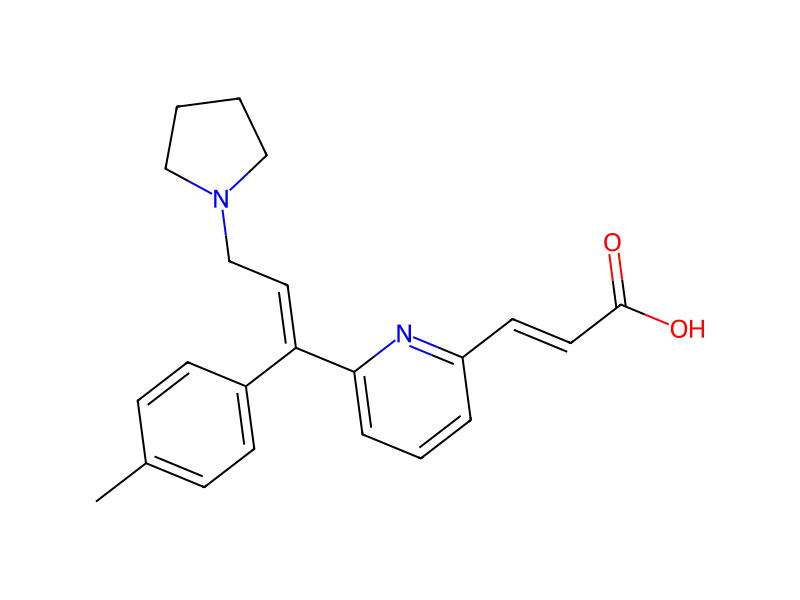
기본 정보
- 표준 SMILES
Cc1ccc(/C(=C\CN2CCCC2)c2cccc(/C=C/C(=O)O)n2)cc1- InChIKey
PWACSDKDOHSSQD-IUTFFREVSA-N- 분자식
- C22H24N2O2
- 평균 분자량
- 348.4 g/mol
- 단동위원소 질량
- 348.18377801
개요
Acrivastine is a member of the class of pyridines that is (pyridin-2-yl)acrylic acid substituted at position 6 by a [(1E)-1-(4-methylphenyl)-3-(pyrrolidin-1-yl)prop-1-en-1-yl group. It is a non-sedating antihistamine used for treatment of hayfever, urticaria, and rhinitis. It has a role as a H1-receptor antagonist. It is a member of pyridines, a N-alkylpyrrolidine, an olefinic compound and an alpha,beta-unsaturated monocarboxylic acid.
이름 및 식별자
- 우선 이름
- Acrivastine
- IUPAC
- (E)-3-[6-[(E)-1-(4-methylphenyl)-3-pyrrolidin-1-ylprop-1-enyl]-2-pyridinyl]prop-2-enoic acid
이름 및 동의어
ACRIVASTINE87848-99-5SemprexAcrivastinaAcrivastinumBW 825CBW-825CBW A825CDTXSID6022555(E)-6-((E)-3-(1-Pyrrolidinyl)-1-p-tolylpropenyl)-2-pyridineacrylic acid2-Propenoic acid, 3-(6-(1-(4-methylphenyl)-3-(1-pyrrolidinyl)-1-propenyl)-2-pyridinyl)-, (E,E)-A20F9XAI7W
이름 더 보기
CHEBI:83168Benadryl Allgy Relief Plus DecongestDTXCID702555BW825C(2E)-3-{6-[(1E)-1-(4-methylphenyl)-3-(pyrrolidin-1-yl)prop-1-en-1-yl]pyridin-2-yl}prop-2-enoic acid(2E)-3-{6-[(1E)-1-(4-methylphenyl)-3-(pyrrolidin-1-yl)prop-1-en-1-yl]pyridin-2-yl}acrylic acid(2E)-3-(6-((1E)-1-(4-methylphenyl)-3-(pyrrolidin-1-yl)prop-1-en-1-yl)pyridin-2-yl)acrylic acid(2E)-3-(6-((1E)-1-(4-methylphenyl)-3-(pyrrolidin-1-yl)prop-1-en-1-yl)pyridin-2-yl)prop-2-enoic acid
데이터베이스 식별자
- CAS
87848-99-5- PubChem CID
- 5284514
- DTXSID
DTXSID6022555- ChEMBL
CHEMBL1224- ChEBI
CHEBI:83168- UNII
- A20F9XAI7W
- EC Number
- 618-080-6
- Nikkaji
- J22.097C
물성
구조 계산 물성
- XLogP
- 1.6
- 극성 표면적
- 53.4 Ų
- 수소 결합 공여자 수
- 1
- 수소 결합 수용자 수
- 4
- 회전 가능 결합 수
- 6
- 무거운 원자 수
- 26
- 형식 전하
- 0
- 복잡도
- 514
실험 및 물리화학적 성질
DrugsPharmaceuticals -> Listed in ZINC15
Human Drugs
Breast Feeding; Lactation; Milk, Human; Antihistamines
FDA approved drugs -> Active ingredient
FDA approved drugs -> Active ingredient
Collision Cross Section193.9 Ų [M+H]+ [CCS Type: TW; Method: Major Mix IMS/Tof Calibration Kit (Waters)]
안전 및 규제
GHS 분류
GHS Classification
This chemical does not meet GHS hazard criteria for 50% (1 of 2) of reports.
H413 (50%): May cause long lasting harmful effects to aquatic life [Hazardous to the aquatic environment, long-term hazard]
P273, and P501 (click each P-code to see the statement)
Aggregated GHS information provided per 2 reports by companies from 2 notifications to the ECHA C&L Inventory.
유해성 정보
Hazard Classes and CategoriesAquatic Chronic 4 (50%)
독성 정보
HepatotoxicityAcrivastine has not been linked to liver enzyme elevations or to instances of clinically apparent liver injury. Its relative safety may relate to its rapid metabolism and use in low dosages.
Drug Induced Liver Injury
Drug-Induced Liver Injury Severity and Toxicity (DILIst)
Acrivastine
DILI Negative
Oral
DOI:10.1016/j.drudis.2019.09.022
Effects During Pregnancy and Lactation◉ Summary of Use during Lactation
화학 및 산업
약리 정보
ATC Code
R - Respiratory system
QR - Respiratory system
Protein BindingAcrivastine binding to human plasma proteins was 50 ± 2.0%.
Biological Half-LifeThe mean terminal half-life for acrivastine was 1.9 ± 0.3 hours following single oral doses and increased to 3.5 ± 1.9 hours at steady state. The terminal half-life for the propionic acid metabolite was 3.8 ± 1.4 hours.
FDA Pharmacological Classification
A20F9XAI7W
ACRIVASTINE
Mechanisms of Action [MoA] - Histamine H1 Receptor Antagonists
Established Pharmacologic Class [EPC] - Histamine-1 Receptor Antagonist
Acrivastine is a Histamine-1 Receptor Antagonist. The mechanism of action of acrivastine is as a Histamine H1 Receptor Antagonist.
MeSH Pharmacological Classification
A class of non-sedating drugs that bind to but do not activate histamine receptors (DRUG INVERSE AGONISM), thereby blocking the actions of histamine or histamine agonists. These antihistamines represent a heterogenous group of compounds with differing chemical structures, adverse effects, distribution, and metabolism. Compared to the early (first generation) antihistamines, these non-sedating antihistamines have greater receptor specificity, lower penetration of BLOOD-BRAIN BARRIER, and are less likely to cause drowsiness or psychomotor impairment.
Absorption, Distribution and Excretion
Acrivastine was absorbed rapidly from the combination capsule following oral administration and was as bioavailable as a solution of acrivastine. After administration of SEMPREX-D Capsules, maximum plasma acrivastine concentrations were achieved at 1.14 ± 0.23 hour.
A mass balance study in 7 healthy volunteers showed that acrivastine is primarily eliminated by the kidneys. Over a 72-hour collection period, about 84% of the administered total radioactivity was recovered in urine and about 13% in feces, for a combined recovery of about 97%.
0.46 ± 0.05 L/kg
2.9 ± 0.7 mL/min/kg
Metabolite PathwaysAcrivastine H1-Antihistamine Action
관련 반응
2건

연결된 노트
불러오는 중…