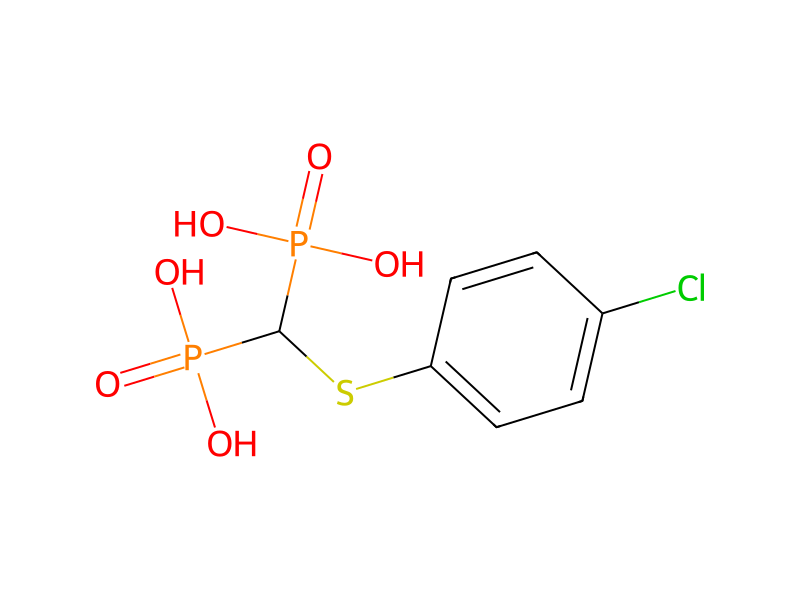
기본 정보
- 표준 SMILES
O=P(O)(O)C(Sc1ccc(Cl)cc1)P(=O)(O)O- InChIKey
DKJJVAGXPKPDRL-UHFFFAOYSA-N- 분자식
- C7H9ClO6P2S
- 평균 분자량
- 318.61 g/mol
- 단동위원소 질량
- 317.92835995
개요
Tiludronic acid is an organochlorine compound.
이름 및 식별자
- 우선 이름
- Tiludronic Acid
- IUPAC
- [(4-chlorophenyl)sulfanyl-phosphonomethyl]phosphonic acid
- 현지명
- 틸루드론산
- 영어명
- Tiludronic acid
- 분자식
- C7H9ClO6P2S
- 분자량
- 318.61
이름 및 동의어
이름 더 보기
데이터베이스 식별자
- CAS
89987-06-4- PubChem CID
- 60937
- DTXSID
DTXSID10237966- ChEMBL
CHEMBL1350- ChEBI
CHEBI:9598- UNII
- 6PNS59HP4Y
- EC Number
- 618-322-0
- Nikkaji
- J476.064F
물성
구조 계산 물성
- XLogP
- -0.3
- 극성 표면적
- 140 Ų
- 수소 결합 공여자 수
- 4
- 수소 결합 수용자 수
- 7
- 회전 가능 결합 수
- 4
- 무거운 원자 수
- 17
- 형식 전하
- 0
- 복잡도
- 324
실험 및 물리화학적 성질
물리화학적 성질
- 녹는점
- 174 · 174-177 °C
- 끓는 점
- 600.7 · 600.7±65.0 °C(Predicted)
- 밀도
- 1.82 · 1.82±0.1 g/cm3(Predicted)
- 저장 조건
- room temp
- 용해도
- 2 O: · H2O: >10mg/mL, 투명
- 산도 계수 (pKa)
- 1 · pK1 10.85; pK2 6.90; pK3 2.95; pK4 1.30(at 25℃)
- 물리적 상태
- 가루
- 색상
- 흰색에서 황백색까지
- 수용성
- 2 O: · H2O: >10mg/mL, clear
- InChI
- 1S/C7H9ClO6P2S.2Na.H2O/c8-5-1-3-6(4-2-5)17-7(15(9,10)11)16(12,13)14;;;/h1-4,7H,(H2,9,10,11)(H2,12,13,14);;;1H2/q;2*+1;/p-2
- InChIKey
- SZVJRJRMQCKFON-UHFFFAOYSA-L
- SMILES
- O.[Na+].[Na+].OP([O-])(=O)C(Sc1ccc(Cl)cc1)P(O)([O-])=O
안전 및 규제
독성 정보
Drug Induced Liver Injury
Drug-Induced Liver Injury Severity and Toxicity (DILIst)
tiludronate
DILI Negative
Oral
DOI:10.1016/j.drudis.2019.09.022
안전 데이터
- wgk
- 3
- 스토리지 클래스
- 11 - Combustible Solids
화학 및 산업
약리 정보
ATC Code
M - Musculo-skeletal system
QM - Musculo-skeletal system
Pharmacodynamics
Tiludronic acid is a bisphosphonate that prevents osteoclasts from resorbing bone. The duration of action is quite long due to the slow clearance from the bone, and the therapeutic window is wide. Patients should be counselled regarding the risk of upper GI mucosal irritation as well as gastric and duodenal ulcers.
Mechanism of Action
Bisphosphonates are taken into the bone where they bind to hydroxyapatite. Bone resorption by osteoclasts causes local acidification, releasing the bisphosphonate, which is taken into the osteoclast by fluid-phase endocytosis. Endocytic vesicles become acidified, releasing bisphosphonates into the cytosol of osteoclasts where they act. Osteoclasts mediate resorption of bone. When osteoclasts bind to bone they form podosomes, ring structures of F-actin. Tiludronate inhibits protein-tyrosine-phosphatase, which increases tyrosine phosphorylation, and disrupts podosome formation. Tiludronic acid also inhibits V-ATPases in the osteoclast, though the exact subunits are unknown, preventing F-actin from forming podosomes. Disruption of the podosomes causes osteoclasts to detach from bones, preventing bone resorption.
FDA Pharmacological Classification
6PNS59HP4Y
TILUDRONIC ACID
Established Pharmacologic Class [EPC] - Bisphosphonate
Chemical Structure [CS] - Diphosphonates
Tiludronic acid is a Bisphosphonate.
Absorption, Distribution and Excretion
A single 400mg dose of tiludronic acid reaches a Cmax of 3.35±1.07mg/L, with a Tmax of 1.7—0.9h, and and AUC of 27.2±9.0mg\*h/L. Tiludronic acid has an oral bioavailability of 2-11% with an average of 6%.
Tiludronic acid is 60% eliminated in the urine as the unchanged parent drug.
The volume of distribution of tiludronic acid is estimated to be between 30L and 60L. Due to the unknown clearance rate from bone, this may underestimate the true volume of distribution.
Tiludronic acid has a renal clearance of 0.68L/h in healthy subjects and 0.47L/h in subjects with Paget's disease. Approximately 50% of tilurdronic acid binds to bone but the rate of clearance from the bone is unknown.
상·하류 제품 정보
상류 원료
공급사9 곳
관련 반응
현재 필터 조건에 해당하는 반응 기록이 없습니다.
연결된 노트
불러오는 중…