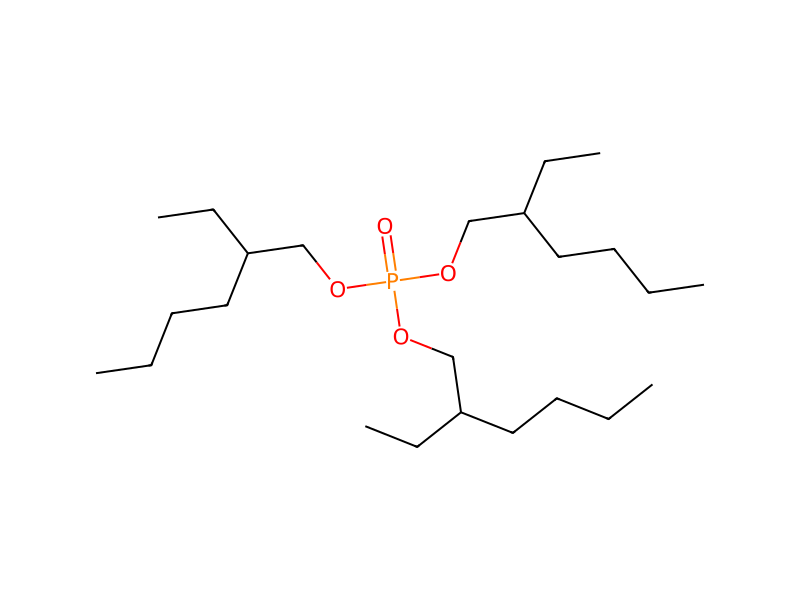
기본 정보
- 표준 SMILES
CCCCC(CC)COP(=O)(OCC(CC)CCCC)OCC(CC)CCCC- InChIKey
GTVWRXDRKAHEAD-UHFFFAOYSA-N- 분자식
- C24H51O4P
- 평균 분자량
- 434.6 g/mol
- 단동위원소 질량
- 434.35249674
개요
Tris(2-ethylhexyl)phosphate is a clear colorless to pale yellow liquid with a slight sharp odor. (NTP, 1992)
이름 및 식별자
- 우선 이름
- Tris(2-ethylhexyl) phosphate
- IUPAC
- tris(2-ethylhexyl) phosphate
- 현지명
- 트리옥틸 인산염
- 영어명
- Tris(2-ethylhexyl) phosphate
- 분자식
- C24H51O4P
- 분자량
- 434.63
이름 및 동의어
이름 더 보기
데이터베이스 식별자
- CAS
78-42-2- PubChem CID
- 6537
- DTXSID
DTXSID0021414- ChEMBL
CHEMBL1562290- ChEBI
CHEBI:181994- UNII
- BQC0BKB72S
- EC Number
- 201-116-6
- Nikkaji
- J1.953D
물성
구조 계산 물성
- XLogP
- 8.9
- 극성 표면적
- 44.8 Ų
- 수소 결합 공여자 수
- 0
- 수소 결합 수용자 수
- 4
- 회전 가능 결합 수
- 21
- 무거운 원자 수
- 29
- 형식 전하
- 0
- 복잡도
- 345
실험 및 물리화학적 성질
Density
0.9262 at 68 °F (NTP, 1992) - Less dense than water; will float
Relative density (water = 1): 0.93
0.9077 @25 °C
Solubility
less than 1 mg/mL at 64 °F (NTP, 1992)
Solubility in water at 20 °C: none
Flash Point
305 °F (NTP, 1992)
170 °C
Boiling Point
374 to 451 °F at 760 mmHg (decomposes) (NTP, 1992)
at 0.7kPa: 220 °C
226.9 °C @760 [mm Hg]
Melting Point
-94 °F (NTP, 1992)
-74 °C
-74 °C
Vapor Density
14.95 (NTP, 1992) - Heavier than air; will sink (Relative to Air)
Relative vapor density (air = 1): 15
Vapor Pressure
1.9 mmHg at 392 °F (NTP, 1992)
Vapor pressure, Pa at 20 °C:
0.03 [mm Hg] @20 °C
Physical Description
Tris(2-ethylhexyl)phosphate is a clear colorless to pale yellow liquid with a slight sharp odor. (NTP, 1992)
Other Solid; Liquid
COLOURLESS VISCOUS LIQUID.
물리화학적 성질
- 녹는점
- -70 °C · -70°C
- 끓는 점
- 215 °C4 · 215 °C4 mm Hg(lit.)
- 밀도
- 0.92 g/mL · 0.92 g/mL at 20 °C(lit.)
- 증기압
- 2.1 mm · 2.1 mm Hg ( 20 °C)
- 굴절률
- 20 · n20/D 1.444(lit.)
- 인화점
- 230 °F · >230 °F
- 저장 조건
- 30 °C · Store below +30°C.
- 용해도
- 0.001 g/L · <0.001g/L
- 물리적 상태
- 액체
- Specific Gravity
- 0.93 · 0.93
- 색상
- 무색
- 수소이온지수(pH)
- 7 · 7 (H2O, 20℃)
- 수용성
- 18 °C에서 · 18°C에서 <0.1g/100mL
- BRN
- 1715839 · 1715839
- Henry's Law Constant
- 1.2 · 1.2×102 mol/(m3Pa) at 25℃, HSDB (2015)
- InChI
- 1S/C24H51O4P/c1-7-13-16-22(10-4)19-26-29(25,27-20-23(11-5)17-14-8-2)28-21-24(12-6)18-15-9-3/h22-24H,7-21H2,1-6H3
- InChIKey
- GTVWRXDRKAHEAD-UHFFFAOYSA-N
- SMILES
- CCCCC(CC)COP(=O)(OCC(CC)CCCC)OCC(CC)CCCC
- NIST
- 2 · 2-Ethylhexanol phosphate (3:1)(78-42-2)
- EPA
- Tris(2-ethylhexyl) phosphate (78-42-2)
- ECETOC JACC REPORT
- Tris(2-ethylhexyl) phosphate (78-42-2)
화학적 성질
Tris(2-ethylhexyl) phosphate, a clear, viscous liquid, is used as a component of vinyl stabilizers, grease additives, and flame-proofing compositions; however, it is used primarily as a plasticizer for vinyl plastic and synthetic rubber compounds. Tris(2-ethylhexyl) phosphate has been employed as a specialty flameretardant plasticizer for vinyl compositions where low temperature flexibility is critical, eg, in military tarpaulins. It can be included in blends with general purpose plasticizers such as phthalate esters to improve low temperature flexibility.
안전 및 규제
GHS 분류
GHS Classification
This chemical does not meet GHS hazard criteria for 52.7% (260 of 493) of all reports.
Warning
H315 (42%): Causes skin irritation [Warning Skin corrosion/irritation]
P264, P264+P265, P280, P302+P352, P305+P351+P338, P321, P332+P317, P337+P317, and P362+P364 (click each P-code to see the statement)
Aggregated GHS information provided per 493 reports by companies from 8 notifications to the ECHA C&L Inventory. Each notification may be associated with multiple companies.
Warning
유해성 정보
Regulatory Information
Chemical: Phosphoric acid, tris(2-ethylhexyl) ester
Phosphoric acid, tris(2-ethylhexyl) ester is listed on the EPA's Chemical Data Reporting (CDR) system. Manufacturers and importers of Phosphoric acid, tris(2-ethylhexyl) ester are required to report information about their production and use of this chemical to the EPA under the Toxic Substances Control Act (TSCA). (40 eCFR Part 711)
REACH registered substance: Tris(2-ethylhexyl) phosphate (EC: 201-116-6)
Tris (2-ethylhexyl) phosphate: Does not have an individual approval but may be used under an appropriate group standard
Fire Hazards
This chemical is combustible. (NTP, 1992)
Combustible. Gives off irritating or toxic fumes (or gases) in a fire.
Health Hazards
SYMPTOMS: Symptoms of exposure to this compound include irritation of the skin and eyes. Skin contact may cause discomfort, itching, reddening and swelling of the skin. Eye contact may cause discomfort, redness, tearing and swelling. Other symptoms may include difficult breathing and pulmonary edema.
Hazard Classes and Categories
Skin Irrit. 2 (42%)
Skin corrosion/irritation - Category 2
Skin corrosion/irritation - Category 2
안전 및 보호
Fire Fighting
Fires involving this material can be controlled with a dry chemical, carbon dioxide or Halon extinguisher. A water spray may also be used. (NTP, 1992)
Use water spray, powder, foam, carbon dioxide.
First Aid Measures
Fresh air, rest. Refer for medical attention.
Rinse skin with plenty of water or shower. Refer for medical attention .
First rinse with plenty of water for several minutes (remove contact lenses if easily possible), then refer for medical attention.
Rinse mouth. Induce vomiting (ONLY IN CONSCIOUS PERSONS!). Give one or two glasses of water to drink. Refer for medical attention .
First Aid
EYES: First check the victim for contact lenses and remove if present. Flush victim's eyes with water or normal saline solution for 20 to 30 minutes while simultaneously calling a hospital or poison control center. Do not put any ointments, oils, or medication in the victim's eyes without specific instructions from a physician. IMMEDIATELY transport the victim after flushing eyes to a hospital even if no symptoms (such as redness or irritation) develop.
Nonfire Spill Response
SMALL SPILLS AND LEAKAGE: If you spill this chemical, FIRST REMOVE ALL SOURCES OF IGNITION. Then, use absorbent paper to pick up all liquid spill material. Your contaminated clothing and absorbent paper should be sealed in a vapor-tight plastic bag for eventual disposal. Solvent wash all contaminated surfaces with 60-70% ethanol followed by washing with a soap and water solution. Do not reenter the contaminated area until the Safety Officer (or other responsible person) has verified that the area has been properly cleaned.
독성 정보
Signs and Symptoms
Redness. Pain.
Redness. Pain.
Carcinogen Classification
Tris(2-ethylhexyl) phosphate
TR-274: Toxicology and Carcinogenesis Studies of Tris(2-ethylhexyl)phosphate (CASRN 78-42-2) in F344/N Rats and B6C3F1 Mice (Gavage Studies) (1984 )
10/28/83
Equivocal Evidence
No Evidence
No Evidence
RAIS Toxicity Values
0.1
PPRTV Current
0.0032
PPRTV Current
EPA Provisional Peer-Reviewed Toxicity Values
Tris(2-ethylhexyl)phosphate
1 x 10^-1 mg/kg-day
PDF Document
Suggestive evidence of carcinogenic potential
2002
Hazard Quotient Level 0.1 or Cancer Risk Level 1E-06
1.70e+02
7.20e+02
2.40e+01
5.00e+01
1.20e+02
3.20e-03
Hazard Quotient Level 3 or Cancer Risk Level 1E-04
1.70e+04
7.20e+04
2.40e+03
5.00e+01
3.20e-03
1.00e-01
안전 데이터
- wgk
- 2
- tsca
- TSCA listed
- rtecs
- MP0770000
- 독성
- LD50 orally in Rabbit: 37000 mg/kg LD50 dermal Rabbit 20000 mg/kg
- HS 번호
- 29190090
- risk_code
- 38
- hazard_code
- Xi
- safety_code
- 23-43-24/25
- 기존화학 물질
- KE-34815
- 자연 발화 온도
- 370 °C
- Hazard Classifications
- Skin Irrit. 2
- 스토리지 클래스
- 10 - Combustible liquids
- 유해 물질 데이터
- 78-42-2(Hazardous Substances Data)
화학 및 산업
용도 및 제조
General Manufacturing Information
Petroleum Lubricating Oil and Grease Manufacturing
Phosphoric acid, tris(2-ethylhexyl) ester: ACTIVE
응용 분야
용도Solvent, antifoaming agent, plasticizer.
일반 설명Clear colorless to pale yellow liquid with a slight sharp odor. Insoluble in water; Soluble in alcohol, acetone, and ether. Combustible.
상·하류 제품 정보
상류 원료
하류 제품
공급사50 곳
관련 반응
현재 필터 조건에 해당하는 반응 기록이 없습니다.
연결된 노트
불러오는 중…