
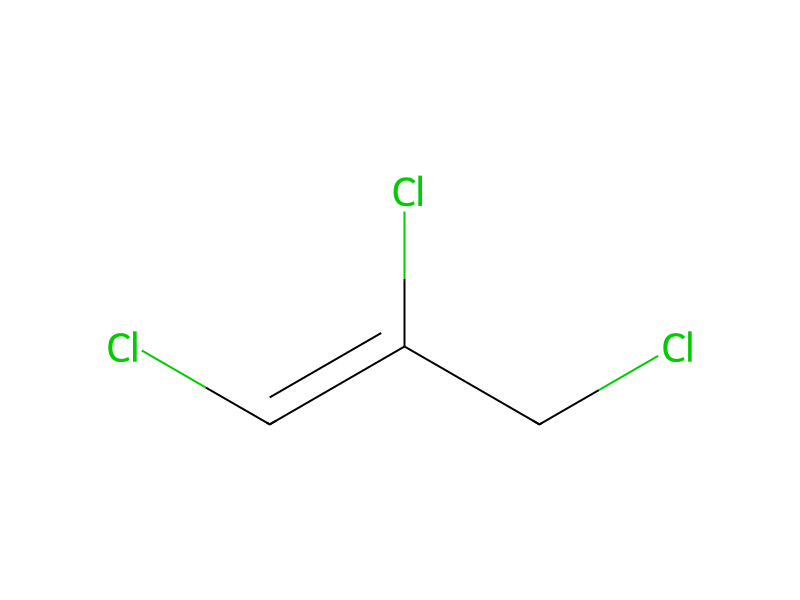
기본 정보
- 표준 SMILES
ClC=C(Cl)CCl- InChIKey
HIILBTHBHCLUER-UHFFFAOYSA-N- 분자식
- C3H3Cl3
- 평균 분자량
- 145.41 g/mol
- 단동위원소 질량
- 143.93003314
개요
1,2,3-trichloropropene appears as an amber liquid. May be absorbed through the skin. Vapors are heavier than air. Contact with vapors or liquid may cause burns or irritation.
이름 및 식별자
- 우선 이름
- 1,2,3-Trichloro-1-propene
- IUPAC
- 1,2,3-trichloroprop-1-ene
이름 및 동의어
1,2,3-TRICHLORO-1-PROPENEDTXSID30477662,3-Dichloroallyl chloride1,2,3-Trichlor-1-propene764948U3XWNSC-164001RefChem:906639DTXCID8027747202-487-71,2,3-Trichloropropene1-Propene, 1,2,3-trichloro-96-19-5
이름 더 보기
Propene, 1,2,3-trichloro-1,2,3-trichloroprop-1-ene1,2,3-trichloro-propeneSCHEMBL185997SCHEMBL7629658SCHEMBL10801330HIILBTHBHCLUER-UHFFFAOYSA-NDB-057628
데이터베이스 식별자
- CAS
96-19-5- PubChem CID
- 7286
- DTXSID
DTXSID3047766- EC Number
- 202-487-7
물성
구조 계산 물성
- XLogP
- 2.2
- 극성 표면적
- 0 Ų
- 수소 결합 공여자 수
- 0
- 수소 결합 수용자 수
- 0
- 회전 가능 결합 수
- 1
- 무거운 원자 수
- 6
- 형식 전하
- 0
- 복잡도
- 57.1
실험 및 물리화학적 성질
Chemical ClassesOther Classes -> Halogenated Aliphatics, Unsaturated
SpringerMaterials PropertiesDensity
Density1.412 @ 20 °C/20 °C
Solubility
VERY SOL IN CHLOROFORM
VERY SOL IN ALCOHOL, ETHER; SOL IN BENZENE; INSOL IN WATER
Flash Point
85 °C
185 °F (Open cup)
Boiling Point142 °C
DecompositionWHEN HEATED TO DECOMP, IT PRODUCES TOXIC FUMES.
Vapor Pressure
4.4 [mmHg]
vapor pressure = 4.4 mm Hg @ 25 °C
Refractive IndexINDEX OF REFRACTION: 1.5030 @ 20 °C/D
Physical Description
1,2,3-trichloropropene appears as an amber liquid. May be absorbed through the skin. Vapors are heavier than air. Contact with vapors or liquid may cause burns or irritation.
Amber liquid; [CAMEO]
Other Experimental Properties
Freezing point= -78 °C
Pounds per gallon= 11.65 at 20 °C.
vapor pressure = 4-7 torr, at 20 °C.
안전 및 규제
GHS 분류
GHS Classification
Danger
H227 (50%): Combustible liquid [Warning Flammable liquids]
P210, P260, P261, P262, P264, P264+P265, P270, P271, P280, P284, P301+P316, P301+P317, P302+P352, P304+P340, P305+P351+P338, P316, P319, P320, P321, P330, P332+P317, P337+P317, P361+P364, P362+P364, P370+P378, P403, P403+P233, P405, and P501 (click each P-code to see the statement)
Aggregated GHS information provided per 2 reports by companies from 2 notifications to the ECHA C&L Inventory. Each notification may be associated with multiple companies.
유해성 정보
DOT LabelPoison
Fire HazardsExcerpt from ERG Guide 153 [Substances - Toxic and/or Corrosive (Combustible)]:
Fire PotentialMODERATE WHEN EXPOSED TO HEAT, FLAMES (SPARKS) OR POWERFUL OXIDIZERS
Health HazardsExcerpt from ERG Guide 153 [Substances - Toxic and/or Corrosive (Combustible)]:
Hazards Summary
Caused somnolence in rats at 36 ppm for 6 hours; [RTECS] External application to rabbit eyes scored 5 on a scale of 1-10 after 24 hours (moderate irritation); Observations in three month rodent inhalation study include eye and upper respiratory tract irritation and increased liver enzymes; No significant gross or histopathological effects observed in 13 week inhalation study with rats; A ten week inhalation study with rats produced no evidence of reproductive or developmental toxicity; [HSDB] May cause irritation or burns; [CAMEO] An irritant that may cause burns; [MSDSonline]
Reactive GroupHalogenated Organic Compounds
Reactivity Profile
1,2,3-TRICHLOROPROPENE incompatible with strong oxidizing and reducing agents. Incompatible with many amines, nitrides, azo/diazo compounds, with alkali metals, and with epoxides. Reacts with bases. Produces toxic fumes when heated to decomposition. Avoid contact with iron, plastics, and aluminum.
Air and Water ReactionsFlammable.
Hazard Classes and CategoriesFlam. Liq. 4 (50%)
안전 및 보호
Fire FightingExcerpt from ERG Guide 153 [Substances - Toxic and/or Corrosive (Combustible)]:
First AidExcerpt from ERG Guide 153 [Substances - Toxic and/or Corrosive (Combustible)]:
Fire Fighting Procedures
If material on fire or involved in fire: Use water in flooding quantities as fog. Use foam, dry chemical, or carbon dioxide. Cool all affected containers with flooding quantities of water. Apply water from as far a distance as possible. Keep run-off water out of sewers and water sources.
Nonfire Spill ResponseExcerpt from ERG Guide 153 [Substances - Toxic and/or Corrosive (Combustible)]:
Disposal Methods
SRP: At the time of review, criteria for land treatment or burial (sanitary landfill) disposal practices are subject to significant revision. Prior to implementing land disposal of waste residue (including waste sludge), consult with environmental regulatory agencies for guidance on acceptable disposal practices.
Preventive Measures
If material not on fire and not involved in fire: Keep material out of water sources and sewers. Build dikes to contain flow as necessary. Keep sparks, flames, and other sources of ignition away. Attempt to stop leak if without undue personnel hazard. Use water spray to knock-down vapors.
Personnel protection: Keep upwind. Avoid breathing vapors. ... Avoid breathing fumes from burning material.
Isolation and EvacuationExcerpt from ERG Guide 153 [Substances - Toxic and/or Corrosive (Combustible)]:
Personal Protective Equipment (PPE)
Excerpt from ERG Guide 153 [Substances - Toxic and/or Corrosive (Combustible)]:
Personnel protection: ... Wear appropriate chemical protective clothing. Wear positive pressure self-contained breathing apparatus. ...
독성 정보
Environmental Fate
TERRESTRIAL FATE: Based on a recommended classification scheme(1), an estimated Koc value of 130(SRC), determined from a structure estimation method(2), indicates that 1,2,3-trichloro-1-propene will have high mobility in soil(SRC). Volatilization of 1,2,3-trichloro-1-propene may be important from moist soil surfaces(SRC) given an estimated Henry's Law constant of 1.8X10⁻² atm-cu m/mole(SRC), using a fragment constant estimation method(3). Volatilization from dry soil surfaces(SRC) may occur based on a measured vapor pressure of 4-7 mm Hg(4).
AQUATIC FATE: Based on a recommended classification scheme(1), an estimated Koc value of 130(SRC), determined from a structure estimation method(2), indicates that 1,2,3-trichloro-1-propene should not adsorb to suspended solids and sediment in water(SRC). 1,2,3-Trichloro-1-propene is expected to volatilize from water surfaces(1,SRC) based on an estimated Henry's Law constant of 1.8X10⁻² atm-cu m/mole(SRC), developed using a fragment constant estimation method(3). Estimated half-lives for a model river and model lake are 4 hours and 5 days, respectively(1,SRC). Measured half-lives for 1,2,3-trichloro-1-propene in dilute (1 ppm, depth of solution=6.5 cm) aqueous solution ranged from 45.1 to 45.2 minutes(4). According to a classification scheme(6), an estimated BCF value of 80(1,SRC), from an estimated log Kow(5,SRC), suggests that bioconcentration in aquatic organisms is moderate, not high(SRC).
ATMOSPHERIC FATE: According to a model of gas/particle partitioning of semivolatile organic compounds in the atmosphere(1), 1,2,3-trichloro-1-propene, which has a measured vapor pressure of 4-7 mm Hg at 20 °C(2,SRC), will exist solely as a vapor in the ambient atmosphere. Vapor-phase 1,2,3-trichloro-1-propene is degraded in the atmosphere by reaction with photochemically-produced hydroxyl radicals(SRC); the half-life for this reaction in air is estimated to be about 5 days(3,SRC).
Adverse EffectsNeurotoxin - Acute solvent syndrome
Soil Adsorption/Mobility
Using a structure estimation method based on molecular connectivity indices(1), the Koc for 1,2,3-trichloro-1-propene can be estimated to be about 130(SRC). According to a recommended classification scheme(2), this estimated Koc value suggests that 1,2,3-trichloro-1-propene has high mobility in soil(SRC).
TSCA Test Submissions
The mutagenicity of 1,2,3-trichloropropene was evaluated in Salmonella tester strains TA98, TA100 and TA1535 (Ames Test), both in the presence and absence of Aroclor-induced rat liver S9 metabolic activation. Based on preliminary toxicity determinations, 1,2,3-trichloropropene, was tested at concentrations up to 0.28ul/plate using the liquid preincubation technique. 1,2,3-Trichloropropene produced a positive response in tester strain TA100 with metabolic activation.
The effect of 1,2,3-trichloropropene was examined in the rat hepatocyte primary culture/DNA repair assay. The test article did not induce DNA repair synthesis (net nuclear grain counts greater than 5) when administered to cultured male F344 rat liver cells for 18 to 20 hours at concentrations ranging from 1x10E-3 to 1x10E-8% (v/v) in an initial assay, or from 1x10E-1 to 1x10E-6% (v/v) in a second assay. Morphological indications of toxicity to liver cells were reported in concurrent cytotoxicity assays at the dose ranges used in the repair assay.
1,2,3-Trichloropropene (CAS# 96-19-5) was evaluated for acute oral toxicity. The test substance was administered by stomach tube to male and female Sprague-Dawley albino rats (number not reported) at increasing doses at increments of 0.1 fractional log intervals at 4 levels (exact dosages not provided). The LD50 was determined to be 490 mg/kg (mortality data not provided). The test substance was determined to be moderately toxic. No further information was provided.
1,2,3-Trichloropropene (CAS# 96-19-5) was evaluated for acute dermal toxicity. The test substance was applied undiluted to the closely clipped, intact skin of male and female New Zealand white rabbits (number of animals not provided) at increasing doses at increments of 0.2 fractional log intervals (exact dosages not provided). The treated area was covered for 24-hours. The MLD was found to be greater than 1260 mg/kg and less than 2000 mg/kg. The test substance was determined to be mildly toxic.
For more TSCA Test Submissions (Complete) data for 1,2,3-TRICHLORO-1-PROPENE (8 total), please visit the HSDB record page.
Artificial Pollution Sources1,2,3-Trichloro-1-propene's production and use as a chemical intermediate(1) may result in its release to the environment through various waste streams(SRC).
Environmental Bioconcentration
An estimated BCF value of 80 was calculated for 1,2,3-trichloro-1-propene(SRC), using an estimated log Kow of 2.78(1,SRC) and a recommended regression-derived equation(2). According to a classification scheme(3), this BCF value suggests that bioconcentration in aquatic organisms is moderate, not high(SRC).
Volatilization from Water/Soil
The Henry's Law constant for 1,2,3-trichloro-1-propene is estimated as 1.8X10⁻² atm-cu m/mole(SRC) using a fragment constant estimation method(1). This value indicates that 1,2,3-trichloro-1-propene will volatilize rapidly from water surfaces(2,SRC). Based on this Henry's Law constant, the volatilization half-life from a model river (1 m deep, flowing 1 m/sec, wind velocity of 3 m/sec) is estimated as approximately 4 hours(2,SRC). The volatilization half-life from a model lake (1 m deep, flowing 0.05 m/sec, wind velocity of 0.5 m/sec) is estimated as approximately 5 days(2,SRC). Measured half-lives for 1,2,3-trichloro-1-propene in dilute (1 ppm, depth of solution= 6.5 cm) aqueous solution ranged from 45.1 to 45.2 minutes(3). The time required for 50 and 90% evaporation of 1,2,3-trichloro-1-propene from a dilute aqueous solution was 49 and >140 minutes, respectively(4). 1,2,3-Trichloro-1-propene's values for vapor pressure, 4-7 mm Hg(5) and Henry's Law constant(1,SRC) indicate that volatilization from dry and moist soil surfaces may occur(SRC).
Non-Human Toxicity Excerpts
The compound was tested externally on the eyes of rabbits, and, according to the degree of injury observed after 24 hours, rated on a scale of 1 to 10. The most severely injurious substances have been rated 10. 1,2,3-Trichloropene rated 5 on rabbit eyes.
SPRAGUE-DAWLEY RATS, GOLDEN SYRIAN HAMSTERS EXPOSED TO 25 PPM 6 HR DAILY, 5 DAYS/WK, 94 DAYS, REVEALED EYE & UPPER RESP TRACT IRRITATION; DECR BODY WT IN MALE HAMSTERS & BOTH SEXES OF RATS; ELEVATED SGPT IN RATS, DECR LIVER CELL SIZE IN MALE HAMSTER LIVERS.
HEPATIC NONPROTEIN SULFHYDRYL (NPSH) ASSAYS IN SPRAGUE-DAWLEY RATS & SYRIAN HAMSTERS GIVEN SINGLE INHALATION EXPOSURES PRODUCED DOSE-RELATED DECR OF HEPATIC NPSH CONCN IN BOTH RATS & HAMSTERS, WHICH WAS NOT OBSERVED AFTER REPEATED EXPOSURES.
EYE IRRITATION WAS OBSERVED IN DOGS EXPOSED TO 10 & 25 PPM.
For more Non-Human Toxicity Excerpts (Complete) data for 1,2,3-TRICHLORO-1-PROPENE (7 total), please visit the HSDB record page.
Environmental Abiotic Degradation
The rate constant for the vapor-phase reaction of 1,2,3-trichloro-1-propene with photochemically-produced hydroxyl radicals has been estimated as 3.3X10⁻¹² cu cm/molecule-sec at 25 °C(SRC) using a structure estimation method(1,SRC). This corresponds to an atmospheric half-life of about 5 days at an atmospheric concentration of 5X10+5 hydroxyl radicals per cu cm(1,SRC).
Probable Routes of Human ExposureOccupational exposure may be through inhalation and dermal contact with this compound at workplaces where 1,2,3-trichloro-1-propene is produced or used. (SRC)
Environmental Fate/Exposure Summary
1,2,3-Trichloro-1-propene's production and use as a chemical intermediate may result in its release to the environment through various waste streams. If released to the atmosphere, 1,2,3-trichloro-1-propene will exist solely in the vapor phase in the ambient atmosphere, based on a measured vapor pressure of 4-7 mm Hg at 20 °C. Vapor-phase 1,2,3-trichloro-1-propene is degraded in the atmosphere by reaction with photochemically-produced hydroxyl radicals with an estimated half-life of about 5 days. An estimated Koc value of 130 suggests that 1,2,3-trichloro-1-propene will have high mobility in soil. Volatilization from moist soil surfaces is expected based on an estimated Henry's Law constant of 1.8X10⁻² atm-cu m/mole. Volatilization from dry soil surfaces may occur given the vapor pressure of this compound. In water, 1,2,3-trichloro-1-propene is not expected to adsorb to sediment or particulate matter based on its Koc value. This compound should volatilize from water surfaces given its estimated Henry's Law constant. Estimated half-lives for a model river and model lake are 4 hours and 5 days, respectively. Measured half-lives for 1,2,3-trichloro-1-propene in dilute (1 ppm, depth of solution= 6.5 cm) aqueous solution ranged from 45.1 to 45.2 minutes. Bioconcentration in aquatic organisms should be moderate, not high based on an estimated BCF value of 80. Occupational exposure may occur through inhalation or dermal contact at workplaces where 1,2,3-trichloro-1-propene is produced or used. (SRC)
Toxicity DataLCLo (rat) = 500 ppm/4h
화학 및 산업
약리 정보
Mechanism of Action
In the presence of S9 mix all allylic chloropropenes tested exert considerable indirect mutagenic activity which is most pronounced for 1,2,3-trichloropropene. Lower as well as higher chlorinated derivatives are clearly less mutagenic. Longer than standard incubation time (120 min instead of 20 min) at 37 °C always leads to an incr in mutagenic activity. An incr in concn of rat liver homogenate fraction (S9) in the metabolizing system (S9 mix) enhances mutagenicity only for 1,3-dichloropropene, 2,3-dichloro-1-propene and for the cis isomer of 1,1,2,3-tetrachloro-2-propene. According to the effects of the enzyme inhibitors SKF525, 1,1,1-trichloropropene-2,3-oxide and cyanamide the allylic chloropropenes fall into 3 groups distinguished by their mode of metabolic activation by S9 mix: (a) allyl chloride and 1,3-dichloropropene are hydrolyzed to the corresponding allylic alcohols which can be oxidized to the respective acroleins (hydrolytic-oxidative pathway); (b) 2,3-dichloro-1-propene, 1,1,2,3-tetrachloro-2-propene and hexachloropropene are epoxidized in the C=C double bond, giving rise to reactive epoxides (epoxidative pathway); (c) only 1,2,3-trichloropropene is obviously activated by both these alternative metabolic pathways. Structural parameters like chloro substitution of the central C atom of the C=C-C sequence and substituent induced polarization of the C=C double bond as well as cis/trans isomerism might be responsible for different substrate properties for the enzymes involved in allylic chloropropene metabolism, thus determining different degrees of activation by either one or both pathways.
용도 및 제조
Uses
Used as a chemical intermediate; [HSDB]
Chemical intermediate
General Manufacturing Information1-Propene, 1,2,3-trichloro-: ACTIVE
관련 반응
4건


연결된 노트
불러오는 중…