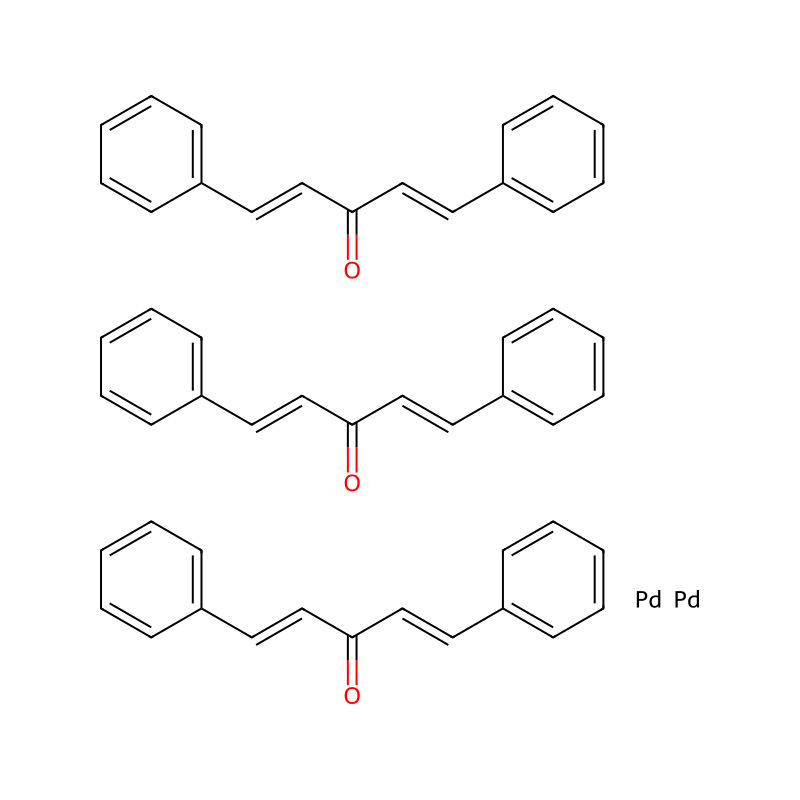
식별자 및 물리적 특성
| CAS No. | 51364-51-3 |
|---|
| 분자식 | C51H42O3Pd2 |
|---|
| 평균 분자량 | 915.7 g/mol |
|---|
| 단동위원소 질량 | 914.12036 g/mol |
|---|
| SMILES | O=C(/C=C/c1ccccc1)/C=C/c1ccccc1.O=C(/C=C/c1ccccc1)/C=C/c1ccccc1.O=C(/C=C/c1ccccc1)/C=C/c1ccccc1.[Pd].[Pd] |
|---|
| InChIKey | CYPYTURSJDMMMP-WVCUSYJESA-N |
|---|
| PubChem CID | 9811564 |
|---|
화학 및 물리적 성질
| 극성 표면적 | 51.2 |
|---|
| 수소 결합 공여자 수 | 0 |
|---|
| 수소 결합 수용자 수 | 3 |
|---|
| 회전 가능 결합 수 | 12 |
|---|
| 무거운 원자 수 | 56 |
|---|
| 형식 전하 | 0 |
|---|
| 복잡도 | 272 |
|---|
안전 및 규제
| 건강 영향 | Contact with palladium may cause palladium sensitivity and allergy. Animal studies have shown that palladium may damage the liver and kidney. (L798) |
|---|
| 독성 요약 | Due to their ability to form strong complexes with both inorganic and organic ligands, palladium ions can disturb cellular equilibria, replace other essential ions, and interact with functional groups of macromolecules, such as proteins or DNA. Palladium complexes binding to DNA and RNA leads to strand breakage. Palladium ions are able to inhibit most major cellular functions, including DNA and RNA synthesis. Palladium compounds have been shown to bind to and inhibit various enzymes, including creatine kinase and prolyl hydroxylase. (L798) |
|---|
| Signs and Symptoms | Skin contact with palladium may cause contact dermatitis, erythema, and oedema. (L798) |
|---|
| Carcinogen Classification | No indication of carcinogenicity to humans (not listed by IARC). |
|---|