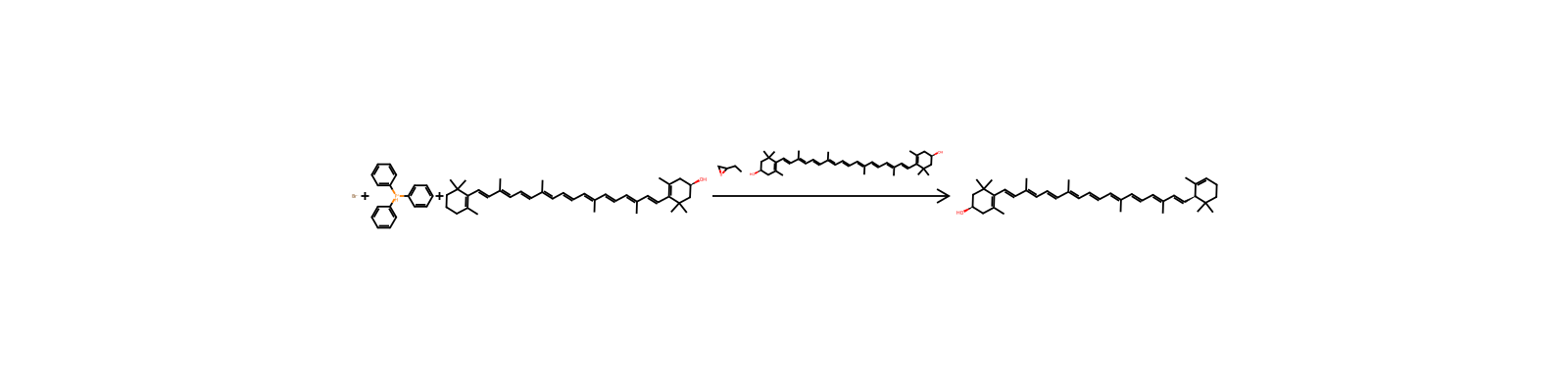
참여 물질
| 역할 | 이름 | HCID | 투입량 |
|---|
| 반응물 | Phosphine, triphenyl-, hydrobromide | HCID 517696 | — |
| 반응물 | Cryptoxanthin | HCID 5281235 | — |
| 용매 | 1,2-Epoxybutane | HCID 7834 | — |
| 용매 | Zeaxanthin | HCID 5280899 | — |
| 생성물 | Zeinoxanthin | HCID 5281234 | — |
반응 단계
The ketone 1 prepared from isophorone is reacted with a Grignard reagent prepared from but-3-yn-2-ol to give the diol 2, from which the dihydroxyketone 3 is formed by eliminating the ethylenedioxy protective group. The dihydroxyketone 3 can be reduced with lithium aluminum hydride to the triol 4, which can be reacted with acetic anhydride in pyridine to give the acetate 5. Dehydration of 5 with phosphoryl chloride in pyridine gives the enyne diacetate 7, which can be reduced with lithium aluminum hydride to the enynediol 6 and, when the reaction is carried out under more stringent conditions, to 3-hydroxy-β-ionol. Selective oxidation of 8 with manganese dioxide gives 3-hydroxy-β-ionone 9. Reaction of the latter with vinyl magnesium bromide gives the vinyl alcohol 10, which, when treated with triphenylphosphonium bromide, forms the Wittig reagent 11. When the latter is heated with the dialdehyde 12 in 1,2-epoxybutane, zeaxanthin 14 is obtained in good yield. Condensation of the Wittig salt 11 with (C25 -)-β-apo-12'-carotenal 16 in 1,2-epoxybutane gives β-cryptoxanthin 18, or condensation of 11 with racemic (C25 -)-α-apo-12'-carotenal gives zeinoxanthin 17. Equation 1 below illustrates the synthetic route described:
출처 및 근거
| DOI | 10.6084/m9.figshare.5104873.v1 |
|---|
| 특허 번호 | US04594456 |
|---|
| 출처 데이터셋 | uspto-grants-1986_06 |
|---|
| ORD ID | ord-fe45a8443881482fb3fe263a4bcee634 |
|---|
| 출처 메모 | uspto-grants-1986_06 |
|---|