1-Benzoylpiperazine → N-(benzoyl)-N'-[(4-fluoro-7-methoxy-6-azaindol-3-yl)-oxoacetyl]-piperazine
Reaction equation

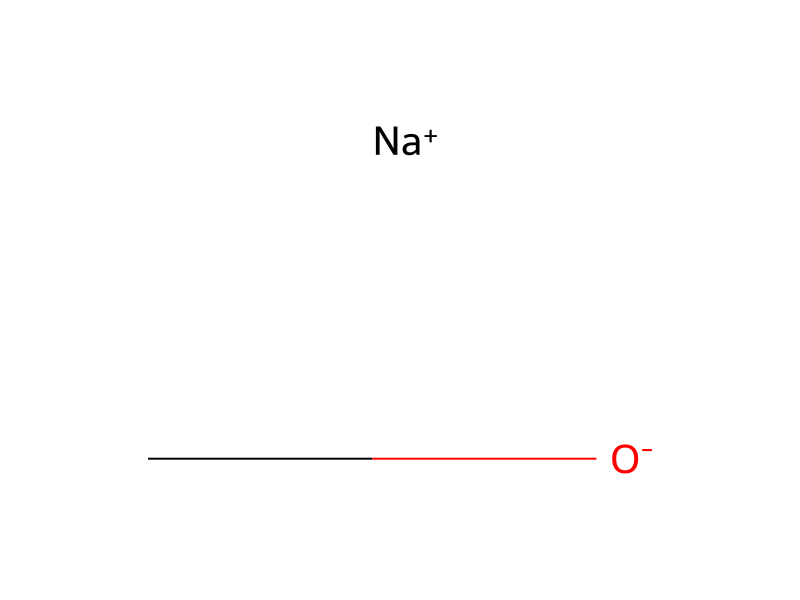
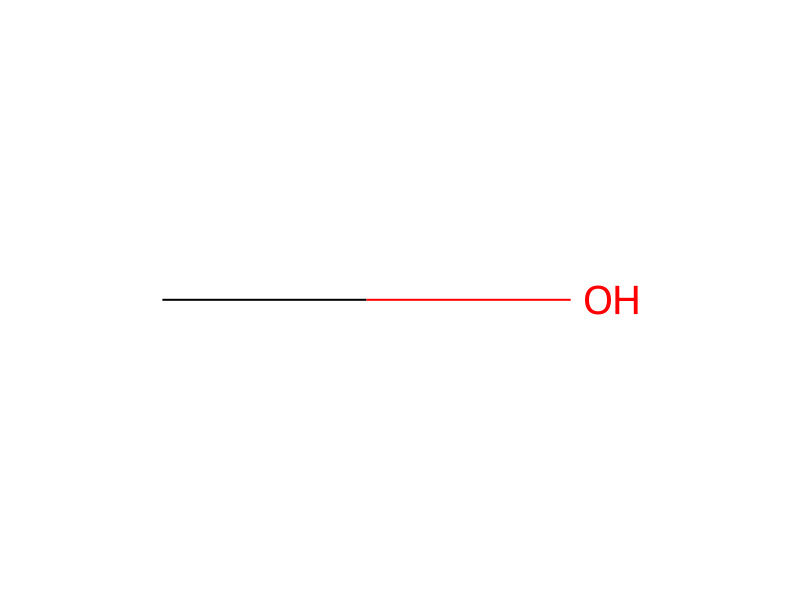
[C:1](N1CCNCC1)(=[O:8])C1C=CC=CC=1.[C:15]([N:23]1[CH2:28][CH2:27][N:26]([C:29](=[O:43])[C:30]([C:32]2[C:40]3[C:35](=[C:36](Cl)[N:37]=[CH:38][C:39]=3[F:41])[NH:34][CH:33]=2)=[O:31])[CH2:25][CH2:24]1)(=[O:22])[C:16]1[CH:21]=[CH:20][CH:19]=[CH:18][CH:17]=1.C[O-].[Na+].FC1C=NC(Cl)=C2C=1C=CN2>CO>[C:15]([N:23]1[CH2:28][CH2:27][N:26]([C:29](=[O:43])[C:30]([C:32]2[C:40]3[C:35](=[C:36]([O:8][CH3:1])[N:37]=[CH:38][C:39]=3[F:41])[NH:34][CH:33]=2)=[O:31])[CH2:25][CH2:24]1)(=[O:22])[C:16]1[CH:21]=[CH:20][CH:19]=[CH:18][CH:17]=1Participants
Reactant 4



Product 1

Reagents, catalysts & solvents 1
Procedure
It should be noted that 2-chloro-5-fluoro-3-nitro pyridine may be prepared by the method in example 5B of reference 59 Marfat et. al. The chemistry in Schemes 1 and 3 to provide the derivative which corresponds to general formula 5 and has a 6-aza ring and R2=F and R4=Cl. In particular, reaction of 2-chloro-5-fluoro-3-nitro pyridine with 3 equivalents of vinyl Magnesium bromide using the typical conditions described herein will provide 4-fluoro-7-chloro-6-azaindole in high yield. Addition of this compound to a solution of aluminum trichloride in dichlorometane stirring at ambident temperature followed 30 minutes later with chloromethyl or chloroethyl oxalate provides an ester. Hydrolysis with KOH as in the standard procedures herein provides an acid salt which reacts with piperazines 4 (for example 1-benzoyl piperazine) in the presence of DEPBT under the standard conditions described herein to provide the compound 5 described just above. The compound with the benzoyl piperazine is N-(benzoyl)-N′-[(4-fluoro-7-chloro-6-azaindol-3-yl)-oxoacetyl]-piperazine and is compound 5av. The 7-chloro moiety in 5av can be utilized by the methods of this invention to provide the desired derivatives where R4 is substituted according to the general claim. For example, exposure of 5av to sodium methoxide in refluxing methanol will provide the compound 5ay in which the 6-azaindole ring contains a 4-fluoro-and 7-methoxy substituent. Alternatively, the 4-fluoro-7-chloro-6-azaindole may be reacted with sodium methoxide and then carried through the sequence as above to provide N-(benzoyl)-N′-[(4-fluoro-7-methoxy-6-azaindol-3-yl)-oxoacetyl]-piperazine, 5ay. 4-fluoro-7-chloro-6-azaindole can also be reacted with CuCN/DMF as described in eq. 17 to provide a 7-cyano intermediate which can be hydrolyzed to an acid as described in eq.21 Scheme 9 using HCl in MeOH at RT for 12 h followed by reflux to complete the reaction. The acid can be smoothly converted to to a methly ester by adding diazomethane in ether to a stitting solution of the acid in diazometane at ambient temperature or lower. These are the standard conditions for using diazomethane which is conveniently generated as a solution in diethyl ether from Diazald® based on instructions which come with a kit from Aldrich Chemical Co. The methyl ester may be carried through the acylation using oxalyl chloride as shown in Scheme 4, followed by coupling with a piperazine (benzoyl piperazine for example) to generate the corresponding 4-fluoro-7-carbomethoxy-6-azaindole which upon addition to a solution of methylamine in water would provide 5az which is N-(benzoyl)-N′-[(4-fluoro-7-(N-methyl-carboxamido)-6-azaindol-3-yl)-oxoacetyl]-piperazine. The same sequences of chemistry described above for 4-fluoro-7-chloroindole may be carried out using 7-chloro-4aza-indole and (R)-3-methyl-N-benzoylpiperazine 4a to provide 5abc which is (R)-N-(benzoyl)-3-methyl-N′-[(7-methoxy-4-azaindol-3-yl)-oxoacetyl]-piperazine or 5abd which is (R)-N-(benzoyl)-3-methyl-N′[(7-(N-methyl-carboxamido)-4-azaindol-3-yl)-oxoacetyl]-piperazine. The starting 7-chloro-4-aza-indole is compound 1I and its prepartion is described as in example in the experimental section.
Workup
- customto provide the desired derivatives where R4
- customwill provide the compound
Sources & evidence
- ORD record
- ord-0d9800816ad24b528313428ce6e334e7
- Source dataset
- uspto-grants-2002_11
- Patent number
- US06476034B2
Reaction notes
Loading…