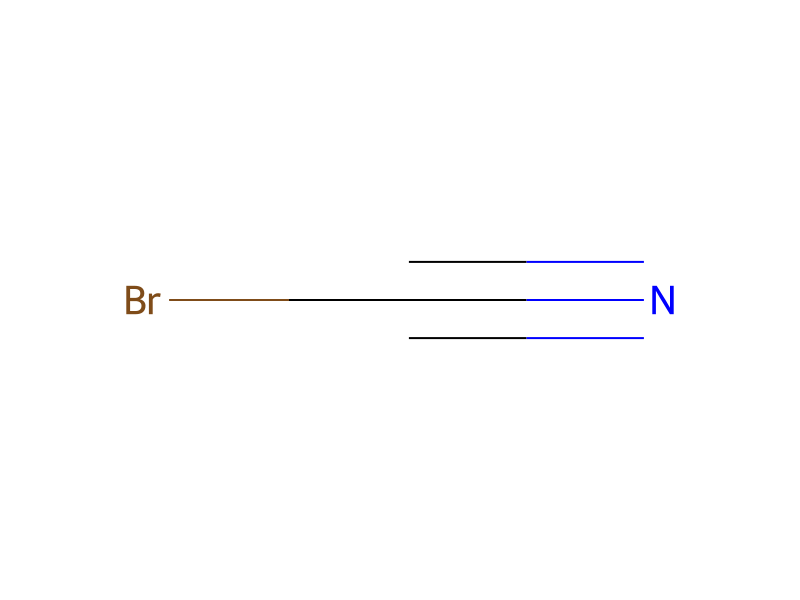
Cyanogen Bromide → HCID 178430968, compound
Reaction equation

[N+:1]([C:4]1C=CC=C([N+]([O-])=O)C=1C)([O-])=O.[NH2:14][C:15]1[C:20]([NH2:21])=[CH:19][CH:18]=[C:17]([N+:22]([O-:24])=[O:23])[C:16]=1[CH3:25].N#CBr>>[NH2:1][C:4]1[NH:14][C:15]2[C:16]([CH3:25])=[C:17]([N+:22]([O-:24])=[O:23])[CH:18]=[CH:19][C:20]=2[N:21]=1Participants


Procedure
This compound is prepared by a combination of Schemes 1 and 4. Commercially available 2,6-dinitrotoluene is converted to 2,3-diamino-6-nitrotoluene according to scheme 2. Reaction with cyanogen bromide affords 2-amino-4-methyl-5-nitrobenzimidazole. After protection of the amino group with a tert-butoxycarbonyl group, the compound is reduced by hydrogenation (palladium-on-carbon) and brominated (bromine, sodium acetate, acetic acid) to afford 5-amino-6-bromo-2-tert-butoxycarbonylamino-4-methylbenzimidazole. The formation of the 5-(2-imidazolinylamino) group is completed in the usual fashion and the tert-butoxycarbonyl group is cleaved by treatment with hydrobromic acid to afford 2-amino-6-bromo-5-(2-imidazolinylamino)-4-methylbenzimidazole.
Workup
- customThis compound is prepared by a combination of Schemes 1 and 4
Sources & evidence
- ORD record
- ord-0fbaa928578646d39372e1b6ef55c149
- Source dataset
- uspto-grants-2002_11
- Patent number
- US06486190B1
Reaction notes
Loading…