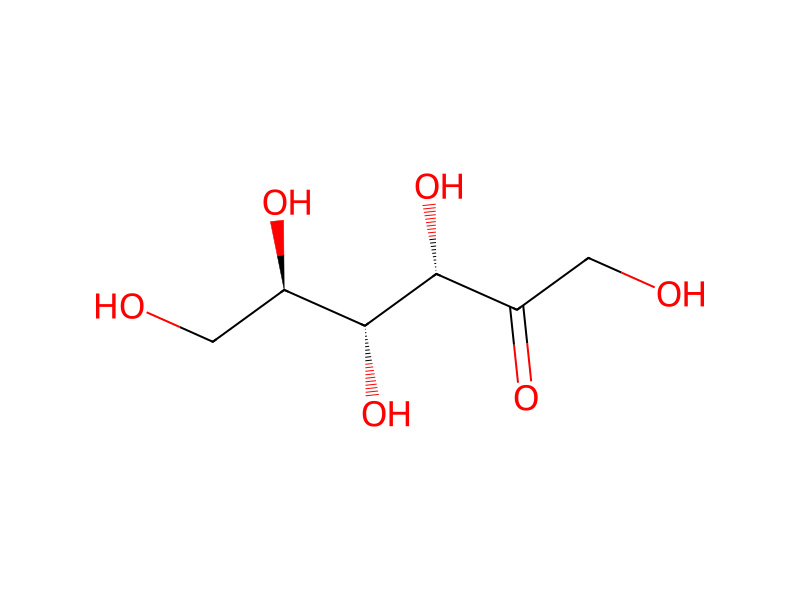
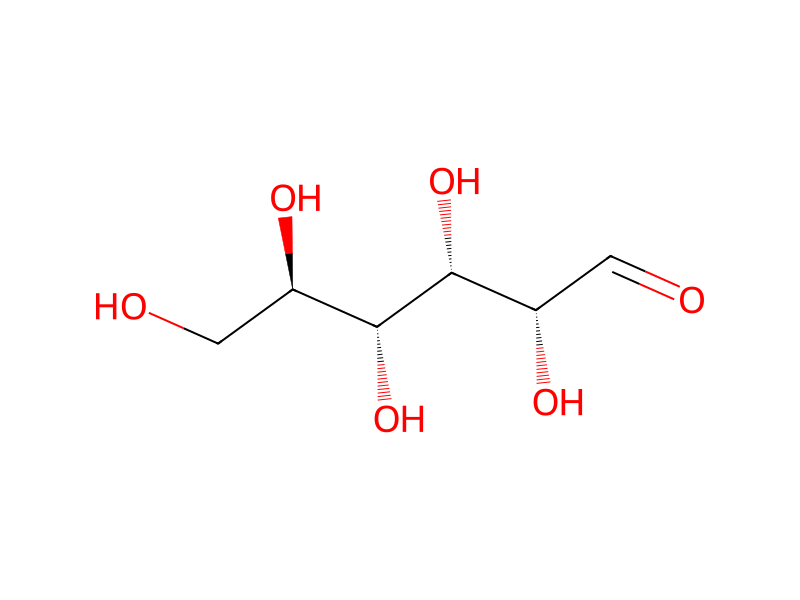
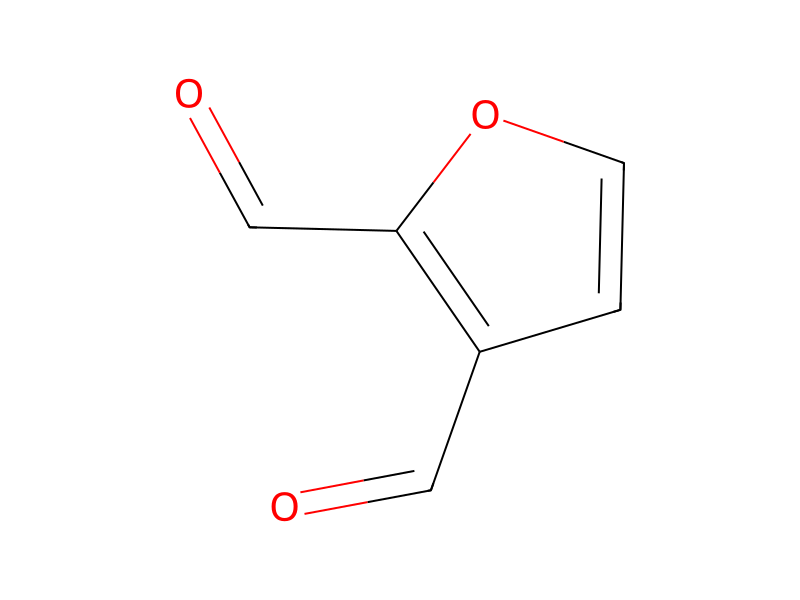
D-(-)-Fructose → Furan-2,3-dicarbaldehyde
Reaction equation

OCC([C@H:5]([C@@H:7]([C@@H:9]([CH2:11][OH:12])O)[OH:8])[OH:6])=O.O=[CH:14][C@@H:15]([C@H]([C@@H]([C@@H](CO)O)O)O)O>>[CH:11]([C:9]1[CH:15]=[CH:14][O:8][C:7]=1[CH:5]=[O:6])=[O:12]Participants
Procedure
Remarkably, catalyst activity was found to be closely related to the stereo property of the NHC ligands. 1-CrCl2 catalyzed the dehydration fructose and glucose with HMF yields of 65% and 66%, respectively (Table 1). Catalyst with the isopropyl-substituted NHC ligand, 2-CrCl2, showed similar efficiency as 1-CrCl2. In contrast, the HMF yields from sugars were significantly increased using chromium catalysts with the more bulky NHC ligands, such as 3-7. 6-CrCl2 system provided a HMF yield as high as 96% from fructose. It also gave a HMF yield of 81% from glucose, which was a record high efficiency for glucose feedstock. There was no difference in yield for the metal catalysts with saturated vs. unsaturated NHC ligands. The catalysts with the most bulky NHC ligand, 1,3-bis(2,6-diisopropylphenyl)imidazolylidene 6 and 1,3-bis(2,6-diisopropyl)phenylimidazolinylidene 7 provided the highest yields. To better understand the details of this reaction, bidentate ligand 8 was examined. Interestingly, catalyst 8-(Cr)2 gave a good HMF yield (81%) from glucose, while 8-(Cr)1 showed a poor HMF yield (14%). These results suggested that an over-crowded complex would have a lower activity in binding with substrates and initiating the reaction. Control reaction without catalyst showed a very low HMF yield (less than 40% and 1% from fructose and glucose, respectively). The reaction temperature was investigated between 80° C. and 100° C. for both fructose and glucose. Lower temperature led to a lower HMF yield: higher temperature gave rise to byproducts, mainly diformylfuran (DFF) (see FIG. 1).
Sources & evidence
- ORD record
- ord-91dfd1f194844d19ab91cb5a49fdb8e1
- Source dataset
- uspto-grants-2014_05
- Patent number
- US08729281B2
Reaction notes
Loading…