1,2-Dibromoethane → (3R)-4-(2-chloro-6-(1-(S-methylsulfonimidoyl)cyclopropyl)pyrimidin-4-yl)-3-methylmorpholine
Reaction equation

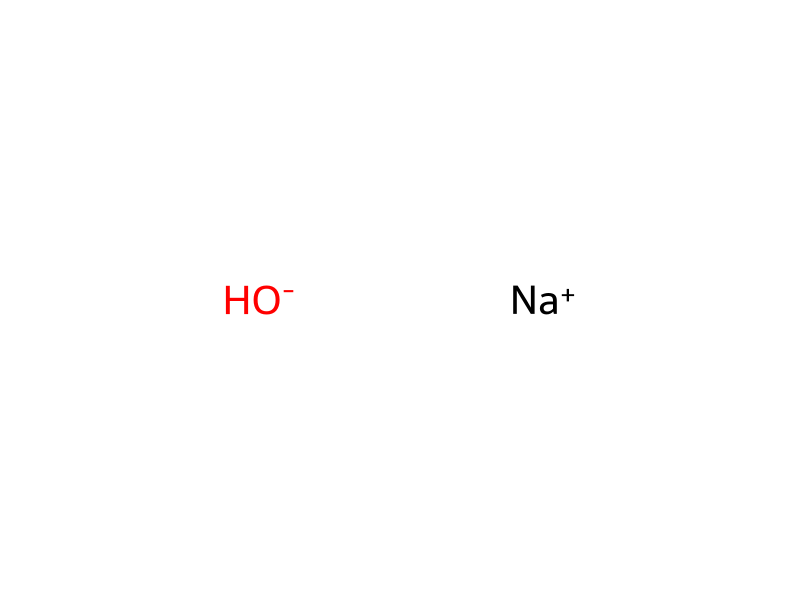
[OH-].[Na+].[Cl:3][C:4]1[N:9]=[C:8]([CH2:10][S:11]([CH3:20])(=[O:19])=[N:12]C(=O)C(F)(F)F)[CH:7]=[C:6]([N:21]2[CH2:26][CH2:25][O:24][CH2:23][C@H:22]2[CH3:27])[N:5]=1.Br[CH2:29][CH2:30]Br>[Br-].C([N+](CCCCCCCC)(CCCCCCCC)CCCCCCCC)CCCCCCC.CN1C2C(N=C(N)NC=2NCC1CNC1C=CC(C(NC(C(O)=O)CCC(O)=O)=O)=CC=1)=O>[Cl:3][C:4]1[N:5]=[C:6]([N:21]2[CH2:26][CH2:25][O:24][CH2:23][C@H:22]2[CH3:27])[CH:7]=[C:8]([C:10]2([S:11]([CH3:20])(=[NH:12])=[O:19])[CH2:30][CH2:29]2)[N:9]=1Participants
Reactant 3


Product 1

Reagents, catalysts & solvents 2


Conditions
- Temperature
- 20 °C
Procedure
Iodobenzene diacetate (6.54 g, 20.29 mmol) was added to (3R)-4-(2-chloro-6-(methylsulfinylmethyl)pyrimidin-4-yl)-3-methylmorpholine (5.88 g, 20.29 mmol), 2,2,2-trifluoroacetamide (4.59 g, 40.58 mmol), magnesium oxide (3.27 g, 81.16 mmol) and rhodium(II) acetate dimer (0.224 g, 0.51 mmol) in DCM (169 ml) under air. The resulting suspension was stirred at RT for 3 days. Further 2,2,2-trifluoroacetamide (1.15 g, 10.15 mmol), magnesium oxide (0.818 g, 20.29 mmol), rhodium(II) acetate dimer (0.056 g, 0.13 mmol) and iodobenzene diacetate (1.64 g, 5.07 mmol) were added and the suspension was stirred at RT for a further 24 hours. The reaction mixture was filtered and silica gel (3 g) was added to the filtrate and then the mixture was evaporated. The resulting powder was purified by flash chromatography on silica, eluting with a gradient of 20 to 50% EtOAc in isohexane. Fractions containing product were evaporated and the residue was triturated with isohexane/methyl tert-butylether to give a solid which was collected by filtration and dried under vacuum to afford N-[({2-chloro-6-[(3R)-3-methylmorpholin-4-yl]pyrimidin-4-yl}methyl)(methyl)oxido-λ6-sulfanylidene]-2,2,2-trifluoroacetamide (6.64 g, 82%); 1H NMR (400 MHz, CDCl3) 1.33 (3H, d), 3.28 (1H, dd), 3.43 (3H, d), 3.46-3.59 (1H, m), 3.62-3.71 (1H, m), 3.79 (1H, d), 3.90-4.50 (2H, br s), 4.21 (1H, s), 4.66 (1H, dd), 4.86 (1H, dd), 6.50 (1H, d); m/z: (ES+) MH 401.01, 402.93. b) Sodium hydroxide (Sigma-Aldrich 415413, d=1.515 g/ml, 50 ml of a 50% solution, 937.57 mmol) was added to N-[({2-chloro-6-[(3R)-3-methylmorpholin-4-yl]pyrimidin-4-yl}methyl)(methyl)oxido-λ6-sulfanylidene]-2,2,2-trifluoroacetamide (5.2 g, 12.97 mmol), 1,2-dibromoethane (4.47 ml, 51.90 mmol) and tetrabutylammonium hydrogensulfate (0.441 g, 1.30 mmol) in toluene (500 ml). The resulting mixture was stirred at RT for 24 hours. Further 1,2-dibromoethane (1.00 ml, 11.60 mmol) was added and the mixture was stirred at RT for a further 2 hours. The reaction mixture was diluted with EtOAc (500 ml), and washed sequentially with water (750 ml) and saturated brine (100 ml). The organic layer was dried over MgSO4, filtered and evaporated. The residue was dissolved in DCM (100 ml) and then purified by flash chromatography on silica, eluting with a gradient of 0 to 5% MeOH in DCM. Pure fractions were evaporated to dryness to afford (3R)-4-(2-chloro-6-(1-(S-methylsulfonimidoyl)cyclopropyl)pyrimidin-4-yl)-3-methylmorpholine (1.383 g, 32%); 1H NMR (400 MHz, CDCl3) 1.32 (3H, d), 1.39-1.48 (2H, m), 1.69-1.77 (2H, m), 3.12 (3H, s), 3.22-3.36 (1H, m), 3.54 (1H, td), 3.68 (1H, dd), 3.78 (1H, d), 3.90-4.10 (1H, br s), 4.00 (1H, dd), 4.33 (1H, br s), 6.79 (1H, d); m/z: (ES+) MH+, 331.08, 333.00. Alternatively, this step can be performed as follows: Sodium hydroxide (Sigma-Aldrich 415413, d=1.515 g/ml, 217 ml of a 50% solution, 4059.84 mmol) was added to N-[({2-chloro-6-[(3R)-3-methylmorpholin-4-yl]pyrimidin-4-yl}methyl)(methyl)oxido-λ6-sulfanylidene]-2,2,2-trifluoroacetamide (27.12 g, 67.66 mmol), 1,2-dibromoethane (23.32 ml, 270.66 mmol) and tetraoctylammonium bromide (3.70 g, 6.77 mmol) in methyl THF (1000 ml) at 20° C. under nitrogen. The resulting mixture was stirred at 20° C. for 24 hours. Further 1,2-dibromoethane (23.32 ml, 270.66 mmol) was added and the mixture was stirred at 20° C. for a further 24 hours. The reaction mixture was diluted with methyl THF (1000 ml) and the aqueous layer separated. The organic layer was diluted further with EtOAc (1000 ml) and washed with water (1500 ml). The organic layer was dried over MgSO4, filtered and then evaporated. The residue was purified by flash chromatography on silica, eluting with a gradient of 0 to 5% MeOH in DCM. Pure fractions were evaporated to afford (3R)-4-(2-chloro-6-(1-(S-methylsulfonimidoyl)cyclopropyl)pyrimidin-4-yl)-3-methylmorpholine (14.80 g, 66%); 1H NMR (400 MHz, DMSO-d6) 1.21 (3H, d), 1.39 (3H, m), 1.62-1.71 (1H, m), 3.01 (3H, s), 3.43 (1H, tt), 3.58 (1H, dd), 3.72 (1H, d), 3.82 (1H, d), 3.93 (1H, dd), 4.01 (1H, s), 4.38 (1H, s), 6.96 (1H, d); m/z: (ES+) MH+, 331.46 and 333.43. d) Dichlorobis(triphenylphosphine)palladium(II) (0.073 g, 0.10 mmol) was added in one portion to (3R)-4-(2-chloro-6-(1-(S-methylsulfonimidoyl)cyclopropyl)pyrimidin-4-yl)-3-methylmorpholine (1.383 g, 4.18 mmol), 2M aqueous sodium carbonate solution (2.508 ml, 5.02 mmol) and 4-(4,4,5,5-tetramethyl-1,3,2-dioxaborolan-2-yl)-1-tosyl-1H-pyrrolo[2,3-b]pyridine (1.665 g, 4.18 mmol) in DME:water 4:1 (100 ml) under nitrogen. The reaction mixture was stirred at 90° C. for 6 hours. The reaction mixture was concentrated and diluted with EtOAc (400 ml), and washed sequentially with water (300 ml) and saturated brine (75 ml). The organic layer was dried over MgSO4, filtered and evaporated onto silica gel (30 g). The resulting powder was purified by flash chromatography on silica, eluting with a gradient of 0 to 5% MeOH in DCM. Pure fractions were evaporated to dryness to afford (3R)-3-methyl-4-(6-(1-(S-methylsulfonimidoyl)cyclopropyl)-2-(1-tosyl-1H-pyrrolo[2,3-b]pyridin-4-yl)pyrimidin-4-yl)morpholine (2.174 g, 92%); 1H NMR (400 MHz, CDCl3) 1.37 (3H, d), 1.56 (2H, m), 1.83 (2H, q), 2.37 (4H, s), 3.16 (3H, s), 3.36 (1H, td), 3.60 (1H, td), 3.74 (1H, dd), 3.85 (1H, d), 4.01-4.19 (2H, m), 4.49 (1H, s), 6.95 (1H, d), 7.28 (2H, d, obscured by CDCL3 peak), 7.44 (1H, t), 7.82 (1H, d), 8.02-8.11 (3H, m), 8.52 (1H, d); m/z: (ES+) MH+, 567.11. Alternatively, example 2.01 and example 2.02, may be prepared as follows: Sodium hydroxide, 2M aqueous solution (9.95 ml, 19.90 mmol) was added to (3R)-3-methyl-4-(6-(1-(S-methylsulfonimidoyl)cyclopropyl)-2-(1-tosyl-1H-pyrrolo[2,3-b]pyridin-4-yl)pyrimidin-4-yl)morpholine (6.44 g, 11.37 mmol) in DME (100 ml)/water (25.00 ml). The resulting solution was stirred at 50° C. for 18 hours. Further NaOH, 2M aqueous solution (18 ml, 36.00 mmol) was added and the mixture was stirred at 50° C. for a further 3 days. The reaction mixture was acidified with 2M HCl (˜22 ml) to pH5. The reaction mixture was evaporated and the residue was dissolved in DCM (250 ml) and washed with water (200 ml). The organic layer was dried over MgSO4, filtered and then evaporated to approximately 50 ml in volume. The solution was purified by flash chromatography on silica, eluting with a gradient of 0 to 7% MeOH in DCM. Pure fractions were evaporated to afford 4-{4-[(3R)-3-methylmorpholin-4-yl]-6-[1-(S-methylsulfonimidoyl)cyclopropyl]pyrimidin-2-yl}-1H-pyrrolo[2,3-b]pyridine (2.440 g, 52%); 1H NMR (400 MHz, DMSO-d6) 1.27 (3H, d), 1.42 (1H, dd), 1.47-1.58 (2H, m), 1.68-1.80 (1H, m), 3.10 (3H, s), 3.24-3.31 (1H, m), 3.51 (1H, t), 3.66 (1H, dd), 3.80 (1H, d), 3.83-3.88 (1H, m), 4.00 (1H, dd), 4.20 (1H, s), 4.57 (1H, s), 6.99 (1H, d), 7.22 (1H, dd), 7.53-7.63 (1H, m), 7.94 (1H, d), 8.34 (1H, t), 11.80 (1H, s); m/z: (ES+) MH+, 413.47. In a separate experiment, NaOH, 2M aqueous solution (7.60 ml, 15.19 mmol) was added to (3R)-3-methyl-4-(6-(1-(S-methylsulfonimidoyl)cyclopropyl)-2-(1-tosyl-1H-pyrrolo[2,3-b]pyridin-4-yl)pyrimidin-4-yl)morpholine (4.92 g, 8.68 mmol) in DME (100 ml)/water (25.00 ml). The resulting solution was stirred at 50° C. for 18 hours. The reaction mixture was acidified with 2M HCl (˜5 mL) to pH5. The reaction mixture was evaporated and the residue was dissolved in DCM (250 ml) and washed with water (200 ml). The organic layer was dried over MgSO4, filtered and then evaporated to approximately 50 ml in volume. The resulting solution was purified by flash chromatography on silica, eluting with a gradient of 0 to 7% MeOH in DCM. Pure fractions were evaporated to dryness to afford 4-{4-[(3R)-3-methylmorpholin-4-yl]-6-[1-(S-methylsulfonimidoyl)cyclopropyl]pyrimidin-2-yl}-1H-pyrrolo[2,3-b]pyridine (2.160 g, 60%); 1H NMR (400 MHz, DMSO-d6) 1.28 (3H, d), 1.41-1.59 (3H, m), 1.76 (1H, dt), 3.10 (3H, d), 3.31 (1H, d), 3.52 (1H, t), 3.67 (1H, dd), 3.80 (2H, d), 4.01 (1H, dd), 4.21 (1H, d), 4.58 (1H, s), 7.00 (1H, d), 7.22 (1H, dd), 7.54-7.63 (1H, m), 7.95 (1H, d), 8.33 (1H, d), 11.75 (1H, s); m/z: (ES+) MH+, 413.19. The two samples of 4-{4-[(3R)-3-methylmorpholin-4-yl]-6-[1-(S-methylsulfonimidoyl)cyclopropyl]pyrimidin-2-yl}-1H-pyrrolo[2,3-b]pyridine were combined (4.56 g, 11.05 mmol) and purified by preparative chiral chromatography on a Merck 100 mm ChiralCel OJ column (1550 g), eluting isocratically with 50% isohexane in EtOH/MeOH (1:1) (modified with TEA) as eluent. The fractions containing the first eluting compound were combined and evaporated. The residue was dissolved in DCM (50 ml) and concentrated in vacuo onto silica (20 g). The resulting powder was purified by flash chromatography on silica, eluting with a gradient of 0 to 7% MeOH in DCM. Pure fractions were evaporated to afford the title compound 4-{4-[(3R)-3-methylmorpholin-4-yl]-6-[1-((R)—S-methylsulfonimidoyl)cyclopropyl]pyrimidin-2-yl}-1H-pyrrolo[2,3-b]pyridine (1.789 g, 39%); 1H NMR (400 MHz, DMSO-d6) 1.27 (3H, d), 1.43 (1H, dd), 1.46-1.58 (2H, m), 1.69-1.77 (1H, m), 3.10 (3H, s), 3.27 (1H, td), 3.51 (1H, td), 3.66 (1H, dd), 3.80 (1H, d), 3.85 (1H, s), 4.01 (1H, dd), 4.19 (1H, d), 4.59 (1H, s), 6.99 (1H, s), 7.22 (1H, dd), 7.54-7.63 (1H, m), 7.94 (1H, d), 8.33 (1H, d), 11.80 (1H, s); m/z: (ES+) MH+, 413.50. Chiral HPLC: (Kronlab prep system, 20 μm Chiralpak OJ (250 mm×4.6 mm) column eluting with Hexane/EtOH/MeOH/TEA 50/25/25/0.1) Rf, 9.684 99.4%. The fractions containing the second eluting compound were combined and evaporated. The residue was dissolved in DCM (50 ml) and concentrated in vacuo onto silica gel (20 g). The resulting powder was purified by flash<autotext key=“0CA02197” name=“[AP-silica/alumina]” type=“lookup” length=“6”/> chromatography on silica, eluting with a gradient of 0<autotext key=“0CA02198” name=“[AP-Num Purification]” type=“lookup” length=“1”/> to 7<autotext key=“0CA02199” name=“[AP-Num Purification]” type=“lookup” length=“1”/>% MeOH<autotext key=“0CA0219A” name=“[AP-Solvents]” type=“lookup” length=“4”/> in DCM<autotext key=“0CA0219B” name=“[AP-Solvents]” type=“lookup” length=“3”/>. Pure fractions were evaporated to afford the title compound 4-{4-[(3R)-3-Methylmorpholin-4-yl]-6-[1-((S)—S-methylsulfonimidoyl)cyclopropyl]pyrimidin-2-yl}-1H-pyrrolo[2,3-b]pyridine (2.85 g, 62%); 1H NMR (400 MHz, DMSO-d6) 1.27 (3H, d), 1.38-1.46 (1H, dd), 1.51 (2H, m), 1.72-1.81 (1H, m), 3.10 (3H, s), 3.26 (1H, td), 3.51 (1H, td), 3.66 (1H, dd), 3.80 (1H, d), 3.84 (1H, s), 3.94-4.04 (1H, dd), 4.21 (1H, d), 4.56 (1H, s), 6.99 (1H, s), 7.22 (1H, dd), 7.53-7.63 (1H, m), 7.94 (1H, d), 8.33 (1H, d), 11.80 (1H, s); m/z: (ES+) MH+, 413.53. Chiral HPLC: (Kronlab prep system, 20 μm Chiralpak OJ (250 mm×4.6 mm) column eluting with Hexane/EtOH/MeOH/TEA 50/25/25/0.1) Rf, 18.287 99.3%. Example 2.02 can also be prepared as follows: Dichlorobis(triphenylphosphine)palladium(II) (2.59 mg, 3.69 μmol) was added in one portion to (3R)-4-(2-chloro-6-(1-((R)—S-methylsulfonimidoyl)cyclopropyl)pyrimidin-4-yl)-3-methylmorpholine (63 mg, 0.15 mmol), 2M aqueous Na2CO3 solution (0.089 ml, 0.18 mmol) and 4-(4,4,5,5-tetramethyl-1,3,2-dioxaborolan-2-yl)-1-tosyl-1H-pyrrolo[2,3-b]pyridine (58.8 mg, 0.15 mmol) in DME:water 4:1 (5 ml) at RT. The reaction mixture was stirred at 90° C. for 4 hours. Sodium hydroxide, 2M aqueous solution (0.131 ml, 0.26 mmol) was added and the mixture was heated at 50° C. for 18 hours. The reaction mixture was acidified with 2M HCl to pH7. The reaction mixture was filtered and then purified by preparative HPLC using decreasingly polar mixtures of water (containing 1% NH3) and MeCN as eluents. Pure fractions were evaporated and the residue triturated with isohexane and Et2O to give a solid which was collected by filtration and dried under vacuum to afford the title compound (44.0 mg, 71%); 1H NMR (400 MHz, DMSO-d6) 1.29 (3H, d), 1.40-1.61 (3H, m), 1.70-1.81 (1H, m), 3.10 (3H, d), 3.53 (1H, dd), 3.68 (1H, dd), 3.77-3.87 (2H, m), 4.02 (1H, dd), 4.19 (1H, d), 4.58 (1H, s), 7.01 (1H, d), 7.23 (1H, dd), 7.55-7.61 (1H, m), 7.95 (1H, d), 8.34 (1H, d), 11.75 (1H, s).; m/z: (ES+) MH+, 413.19. Chiral HPLC: (HP1100 System 4, 5 μm Chiralcel OJ-H (250 mm×4.6 mm) column eluting with iso-Hexane/EtOH/MeOH/TEA 50/25/25/0.1) Rf, 9.023 88.0%, 15.796 12.0%.
Workup
- stirringthe mixture was stirred at 20° C. for a further 24 hours
- customthe aqueous layer separated
- additionThe organic layer was diluted further with EtOAc (1000 ml)
- washwashed with water (1500 ml)
- dry with materialThe organic layer was dried over MgSO4
- filtrationfiltered
- customevaporated
- customThe residue was purified by flash chromatography on silica
- washeluting with a gradient of 0 to 5% MeOH in DCM
- customPure fractions were evaporated
Sources & evidence
- ORD record
- ord-434fab46268a49999895a7d632442d1b
- Source dataset
- uspto-grants-2013_10
- Patent number
- US08552004B2
Reaction notes
Loading…