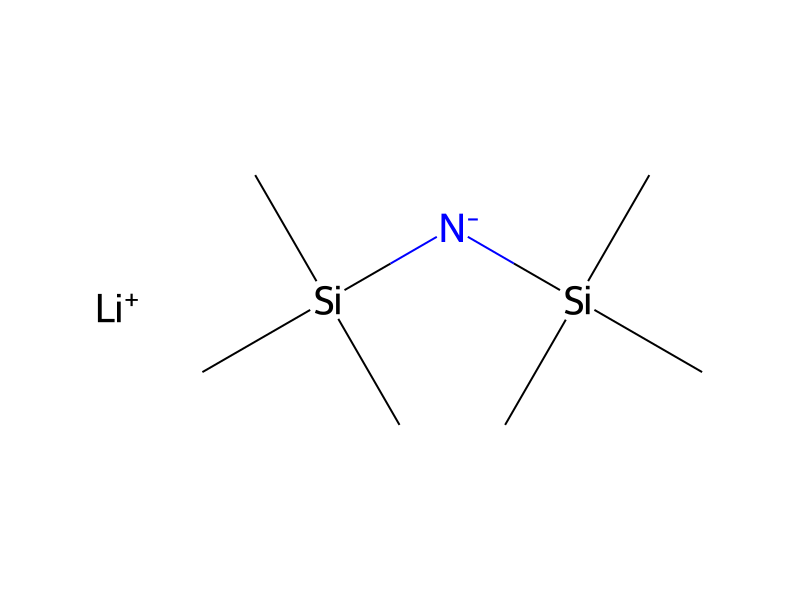
Lithium Hexamethyldisilazide → 8-Bromoquinolin-2-amine
Reaction equation

[Br:1][C:2]1[CH:3]=[CH:4][CH:5]=[C:6]2[C:11]=1[N:10]=[C:9](Cl)[CH:8]=[CH:7]2.[Li+].C[Si]([N-:18][Si](C)(C)C)(C)C>>[Br:1][C:2]1[CH:3]=[CH:4][CH:5]=[C:6]2[C:11]=1[N:10]=[C:9]([NH2:18])[CH:8]=[CH:7]2Participants


Procedure
Other cyclic amides of the present invention can be prepared such as the 3,4-dihydropyrrolo[1,2-a]pyrazin-1(2H)-ones 16 as described in Scheme 9. Substituted amines are coupled to the 8-bromo-2-chloroquinoline through treatment with base, such as LiHMDS, at a temperature of about RT, to afford the desired 8-bromoquinolin-2-amine 13. The bromo compound 13 is converted to the boronic acid 14 via treatment with a palladium catalyst, such as Pd(dppf)2Cl2, bis(pinacolato)diboron, and a base such as KOAc, at a temperature higher than RT, preferably above about 75° C., more preferably at about at 115° C. Coupling of the boronic acid 14 with the protected 7-bromo-3,4-dihydropyrrolo[1,2-a]pyrazin-1(2H)-one 11 such as in the presence of a palladium catalyst, such as Pd2(dba)3 or bis(di-tert-butyl(4-dimethylaminophenyl)phosphine)-dichloro-palladium(H), and dicyclohexyl(2′,4′,6′-triisopropyl-[1,1′-biphenyl]-2-yl)phosphine and a base such as K3PO4, at a temperature higher than RT, preferably above about 75° C., more preferably at about at 130° C., gave the protected 7-(quinolin-8-yl)-3,4-dihydropyrrolo[1,2-a]pyrazin-1(2H)-one 15. Deprotection, such as with acid, at a temperature higher than RT, preferably at about 50° C., affords the desired 7-(quinolin-8-yl)-3,4-dihydropyrrolo[1,2-a]pyrazin-1(2H)-one 16.
Sources & evidence
- ORD record
- ord-8ed0b01c2abe47019f9b63518cdb1f70
- Source dataset
- uspto-grants-2016_07
- Patent number
- US09394297B2
Reaction notes
Loading…