Diethanolamine → 3-[N,N-bis(2-hydroxyethyl)amino]methyl-1,8-dihydroxy-9,10-anthraquinone
Reaction equation

Br[CH2:2][C:3]1[CH:4]=[C:5]([OH:20])[C:6]2[C:7](=[O:19])[C:8]3[C:13]([C:14](=[O:17])[C:15]=2[CH:16]=1)=[CH:12][CH:11]=[CH:10][C:9]=3[OH:18].[OH:21][CH2:22][CH2:23][NH:24][CH2:25][CH2:26][OH:27]>CN(C)C=O>[OH:21][CH2:22][CH2:23][N:24]([CH2:2][C:3]1[CH:4]=[C:5]([OH:20])[C:6]2[C:7](=[O:19])[C:8]3[C:13]([C:14](=[O:17])[C:15]=2[CH:16]=1)=[CH:12][CH:11]=[CH:10][C:9]=3[OH:18])[CH2:25][CH2:26][OH:27]Participants
Reactant 2
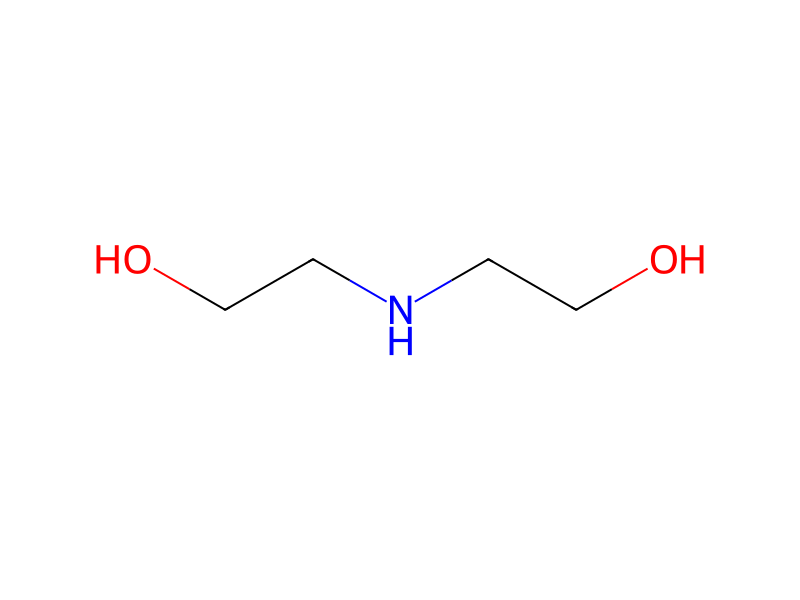

Product 1

Reagents, catalysts & solvents 1

Procedure
A mixture of 3-bromomethyl-1,8-dihydroxy-9,10-anthraquinone (456 mg) and bis(2-hydroxyethyl)amine (600 mg) in N,N-dimethylformamide (20 mL) is stirred for 2 hours, and then partitioned between chloroform (100 mL) and water (100 mL). The organic layer is separated, washed with water (50 mL×3), dried over sodium sulfate, and then concentrated to dryness. The residue is chromatographed on a silica gel column using chloroform-methanol (15:1 v/v) as the eluent. Upon concentration of the major fraction, 3-[N,N-bis(2-hydroxyethyl)amino]methyl-1,8-dihydroxy-9,10-anthraquinone is obtained as a solid: 1H NMR (CDCl3) δ: 2.77 (4H, t, NCH2CH2O), 3.78 (4H, t, NCH2CH2O), 3.78 (2H, s, CH2N=), 7.21-7.79 (5H, m, aromatic H), 11.95 (1H, s, OH), 12.00 (1H, s, OH).
Workup
- custompartitioned between chloroform (100 mL) and water (100 mL)
- customThe organic layer is separated
- washwashed with water (50 mL×3)
- dry with materialdried over sodium sulfate
- concentrationconcentrated to dryness
- customThe residue is chromatographed on a silica gel column
Sources & evidence
- ORD record
- ord-3a0dbc16981845a597c74a8c630f10fe
- Source dataset
- uspto-grants-1990_10
- Patent number
- US04966918
Reaction notes
Loading…