Chlorotrimethylsilane → 4-Bromo-N,N-bis(trimethylsilyl)aniline
Reaction equation

[Br:1][C:2]1[CH:8]=[CH:7][C:5]([NH2:6])=[CH:4][CH:3]=1.C([Li])CCC.Cl[Si:15]([CH3:18])([CH3:17])[CH3:16]>O1CCCC1>[CH3:16][Si:15]([CH3:18])([CH3:17])[N:6]([Si:15]([CH3:18])([CH3:17])[CH3:16])[C:5]1[CH:7]=[CH:8][C:2]([Br:1])=[CH:3][CH:4]=1Participants
Reactant 3

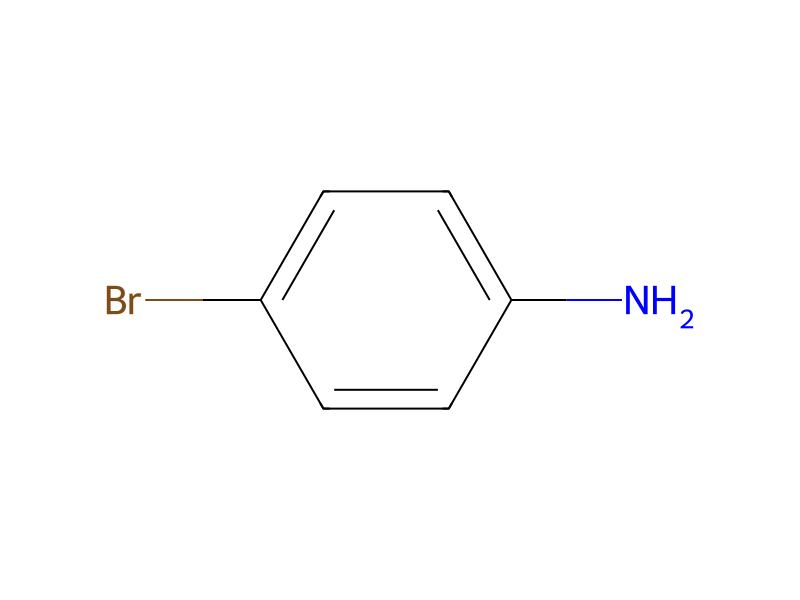

Product 1

Reagents, catalysts & solvents 1

Conditions
- Temperature
- 0 °C
Procedure
The general procedure described by J. R. Pratt et al, in the publication entitled "Organosilicon Compounds. XX. Synthesis of Aromatic Diamines via Trimethylsilyl-Protecting Aniline Intermediates," J. Org. Chem, Vol. 40, No. 8, 1975, pages 1090 to 1094, was followed with some modifications as described herein To a tetrahydrofuran (500 ml) solution of p-bromoaniline (106.0g, 0.62 mol) cooled to 0° C. there was added over a period of one hour n-butyllithium (825 ml, 1.3 mol). The reaction mixture turned brown but remained homogeneous The reaction mixture was refluxed for 2 hours to complete the metallation, cooled to ice temperature, and then chlorotrimethylsilane (180 ml, 1 4 mol) was added so as to not let the reaction temperature exceed 15° C.. The reaction mixture was allowed to warm to room temperature and was refluxed overnight Filtration was accomplished by the Schlenk technique, and a gas chromatogram (GC) was taken. The solvent was evaporated and the residue was distilled to give three fractions Fraction 1 - b.p. 25°-89° C./0.5 torr, 22.0g (this forerun was discarded); Fraction 2 - b.p. 90°-108° C./0 5 torr, 32g, 95% pure by
Workup
- temperaturewas refluxed for 2 hours
- temperaturecooled to ice temperature
- customexceed 15° C.
- temperatureto warm to room temperature
- temperaturewas refluxed overnight
- filtrationFiltration
- customThe solvent was evaporated
- distillationthe residue was distilled
- customto give three fractions Fraction 1 - b.p. 25°-89° C./0.5 torr, 22.0g (this forerun
Sources & evidence
- ORD record
- ord-31656538063449eaa7e6162eaf9b5b5c
- Source dataset
- uspto-grants-1992_01
- Patent number
- US05081201
Reaction notes
Loading…