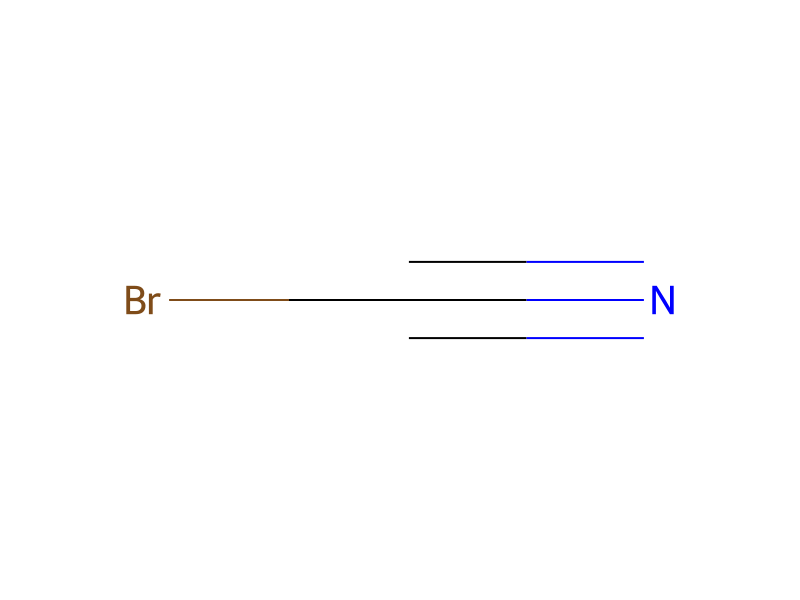
Cyanogen Bromide → HCID 86626298, compound
Reaction equation

[Cl:1][C:2]1[C:11]([NH2:12])=[C:10]([NH:13][C@H:14]([C:16]2[CH:21]=[CH:20][CH:19]=[CH:18][CH:17]=2)[CH3:15])[C:9]2[C:4](=[CH:5][CH:6]=[CH:7][CH:8]=2)[N:3]=1.[N:22]#[C:23][Br:24]>C(O)C>[BrH:24].[Cl:1][C:2]1[C:11]2[N:12]=[C:23]([NH2:22])[N:13]([C@H:14]([C:16]3[CH:21]=[CH:20][CH:19]=[CH:18][CH:17]=3)[CH3:15])[C:10]=2[C:9]2[CH:8]=[CH:7][CH:6]=[CH:5][C:4]=2[N:3]=1Participants
Reactant 2

Product 1

Reagents, catalysts & solvents 1

Conditions
- Temperature
- 80 °C
Procedure
A solution of 2-chloro-N4-[(1S)-1-phenylethyl]quinoline-3,4-diamine (13.0 g, 43.7 mmol) in ethanol (100 mL) was heated to 80° C. for 30 minutes. Cyanogen bromide (4.6 g, 44 mmol) was added, and the dark solution was heated at 80° C. for one hour. An analysis by LC/MS indicated the presence of starting material. Additional cyanogen bromide (4.6 g, 44 mmol) was added, and the reaction was stirred overnight at 80° C. The reaction was still incomplete, and additional cyanogen bromide (4.6 g, 44 mmol) was added. The reaction was heated overnight at 100° C. after a fourth equivalent of cyanogen bromide (4.6 g, 44 mmol) was added. The solvent was removed under reduced pressure, and aqueous sodium hydroxide (200 mL of 2 N) was slowly added to the resulting oil. The mixture was stirred for two hours at room temperature, and a precipitate formed, which was isolated by filtration. The solid was then purified by automated flash chromatography (silica cartridge, eluting with aqueous ammonium hydroxide:methanol:dichloromethane in a gradient from 0:0:100 to 0.3:4.7:95) to provide 9.4 g of 4-chloro-1-[(1S)-1-phenylethyl]-1H-imidazo[4,5-c]quinolin-2-amine hydrobromide as a brown solid. A portion of the product was purified again by automated flash chromatography (silica cartridge, eluting with aqueous ammonium hydroxide:methanol:dichloromethane in a gradient from 0:0:100 to 0.2:3.8:96) to provide a sample of the product as gray needles, mp 170-172° C.
Workup
- additionwas added
- customThe solvent was removed under reduced pressure, and aqueous sodium hydroxide (200 mL of 2 N)
- additionwas slowly added to the resulting oil
- stirringThe mixture was stirred for two hours at room temperature
- customa precipitate formed
- customwhich was isolated by filtration
- customThe solid was then purified by automated flash chromatography (silica cartridge
- washeluting with aqueous ammonium hydroxide
Sources & evidence
- ORD record
- ord-0c4f1804af674d7683ee76d2cf932f33
- Source dataset
- uspto-grants-2012_03
- Patent number
- US08143270B2
Reaction notes
Loading…