Acetate → 4-(Perfluoro3-iodopropyl)phenyl acetate
Reaktionsgleichung

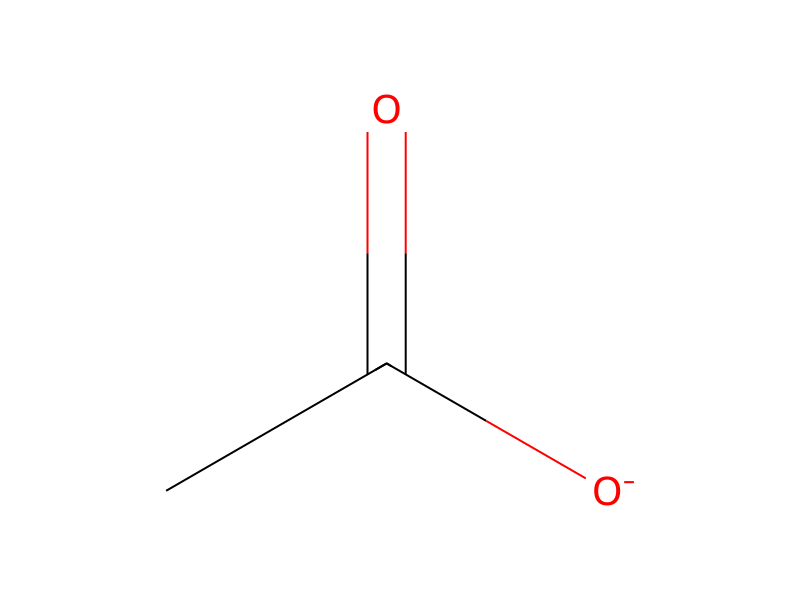
[C:1]([O:4][C:5]1[CH:10]=[CH:9][C:8](I)=[CH:7][CH:6]=1)(=[O:3])[CH3:2].[I:12][C:13]([F:22])([F:21])[C:14]([F:20])([F:19])[C:15]([F:18])([F:17])I.IC(I)(C(F)(F)F)C(F)(F)F.C([O-])(=O)C>CS(C)=O.[Cu]>[C:1]([O:4][C:5]1[CH:10]=[CH:9][C:8]([C:15]([F:18])([F:17])[C:14]([F:20])([F:19])[C:13]([F:22])([F:21])[I:12])=[CH:7][CH:6]=1)(=[O:3])[CH3:2]Komponenten
Edukt 4


Produkt 1

Reagenzien, Katalysatoren, Lösungsmittel 2
Versuchsvorschrift
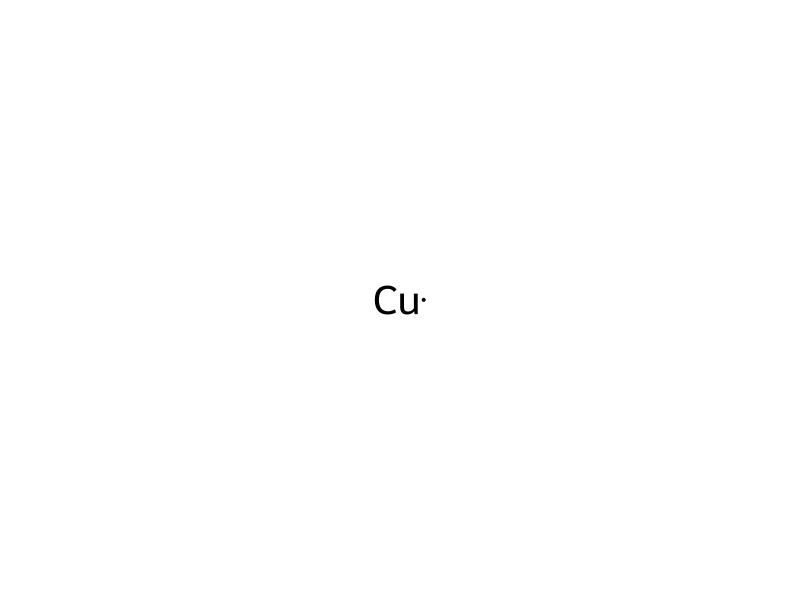
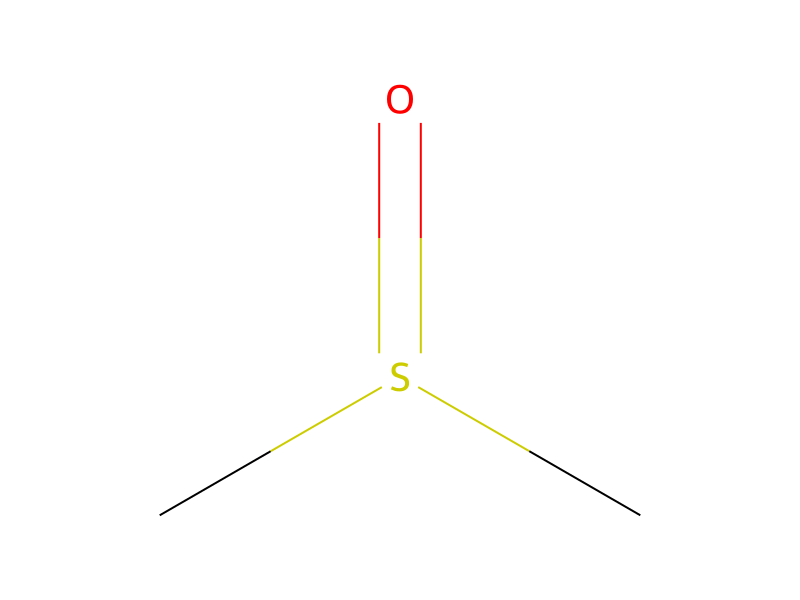
The first stage of the process (equation A) involves reacting p-iodophenyl acetate (II) with 1,3-diiodohexafluoropropane (III). The reaction is conducted in anhydrous dimethyl sulfoxide (DMSO) in the presence of copper powder. Equimolar amounts of the reactants can be used, but it is usually preferred to employ an excess of the diiodohexafluoropropane e.g., 1 to 1.5 moles per mole of the acetate. For every mole of acetate, at least 2, e.g., about 2 to 10, gram atoms of copper are utilized. The reaction is carried out in an inert atmosphere at a temperature ranging from about 110° to 130° C. Examples of gases suitable for providing an inert atmosphere include nitrogen, helium and argon. The reaction period usually ranges from about 2 to 5 hours. At the end of the reaction period, the reaction product is recovered from the reaction mixture. In a preferred procedure, the reaction mixture is allowed to cool after which saturated aqueous ammonium chloride and methylene chloride are added. The excess copper and cuprous salts are then filtered off, and the organic layer is separated. After extracting the aqueous layer with additional methylene chloride, the organic extracts are combined, washed with water, dried over anhydrous magnesium sulfate, and finally reduced in volume to a light yellow oil. The oil is refluxed in acetic anhydride for about 30 minutes to one hour followed by removal of excess acetic anhydride and acetic acid by vacuum distillation. Distillation of the residual oil yields crude 4-(perfluoro-3-iodopropyl)phenyl acetate (IV) which is then purified by recrystallization from hexane.
Aufarbeitung
- customranging from about 110° to 130° C
- customThe reaction period
- customAt the end of the reaction period
- customthe reaction product is recovered from the reaction mixture
- temperatureto cool after which saturated aqueous ammonium chloride and methylene chloride
- additionare added
- filtrationThe excess copper and cuprous salts are then filtered off
- customthe organic layer is separated
- extractionAfter extracting the aqueous layer with additional methylene chloride
- washwashed with water
- dry with materialdried over anhydrous magnesium sulfate
- temperatureThe oil is refluxed in acetic anhydride for about 30 minutes to one hour
- customfollowed by removal of excess acetic anhydride and acetic acid by vacuum distillation
- distillationDistillation of the residual oil
Quellen und Nachweise
- ORD-Eintrag
- ord-04f1a89d813344b8b2a62d73f0ee7c0f
- Quelldatensatz
- uspto-grants-1978_10
- Patentnummer
- US04120900
Notizen zur Reaktion
Wird geladen…