1,2,3-Trimethoxybenzene → 3,4,5-Trimethoxybenzoic Acid
Reaction equation

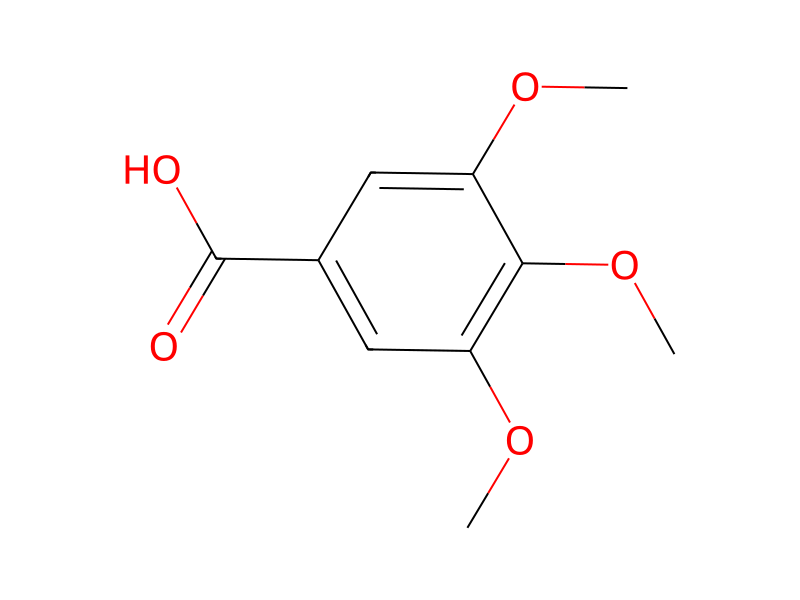
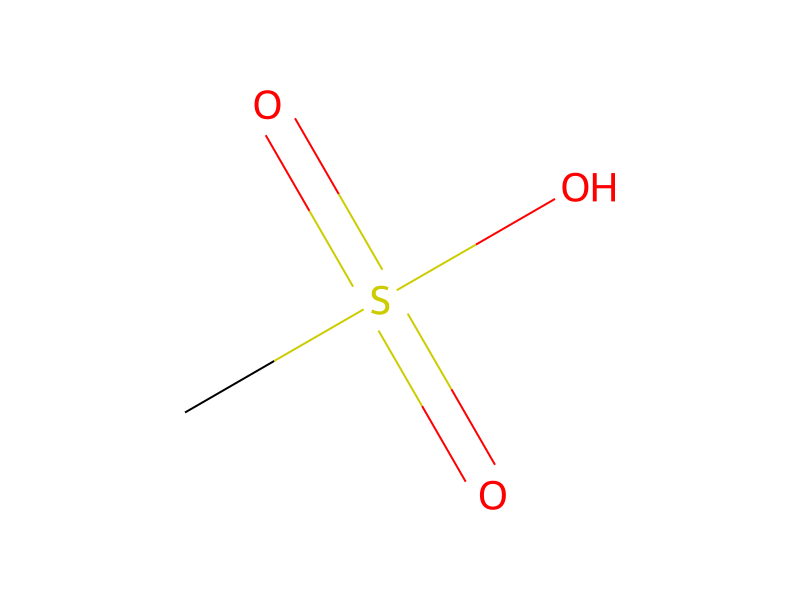
COC1C=CC=C(OC)C=1OC.[OH:13][C:14]1[C:22]([O:23][CH3:24])=[C:21]([O:25][CH3:26])[C:20]([O:27][CH3:28])=[CH:19][C:15]=1[C:16]([OH:18])=[O:17].O=P12OP3(OP(OP(O3)(O1)=O)(=O)O2)=O>CS(O)(=O)=O>[OH:13][C:14]1[C:22]([O:23][CH3:24])=[C:21]([O:25][CH3:26])[C:20]([O:27][CH3:28])=[CH:19][C:15]=1[C:16]([OH:18])=[O:17].[CH3:28][O:27][C:20]1[CH:19]=[C:15]([CH:14]=[C:22]([O:23][CH3:24])[C:21]=1[O:25][CH3:26])[C:16]([OH:18])=[O:17]Participants


Procedure
A mixture of 1,2,3-Trimethoxybenzene (1.48 g) and 2-hydroxy-3,4,5-trimethoxybenzoic acid (2.00 g) is stirred in 40 ml of ≈9% solution of P2O5 in methanesulfonic acid at room temperature in a stoppered flask for 4 hours. The 2-hydroxy-3,4,5-trimethoxybenzoic acid was obtained by the method of Mayer and Fikentscher (Mayer and Fikentscher (1956) Chem. Ber. 89:511) from 3,4,5-trimethoxybenzoic acid by bromination and then copper-catalyzed replacement of bromine (by OH) of 2-bromo-3,4,5-trimethoxybenzoic acid. The resultant orange mixture is poured onto crushed ice (500 ml) producing an unfilterable gummy precipitate. This crude product is then subjected to base-catalyzed ring closure by heating in a beaker in 100 ml of 40% ethanol and 10 ml of 10N NaOH just below boiling point. As the mixture reaches 80° C., a white flocculent product appears. The temperature is maintained just below the boiling point and the volume is kept constant by addition of water. After 5 hours, the supernatant is bright yellow and a mass of the precipitate has formed. Heating is continued for 4 more hours. Cooling, filtering (by suction) and washing with water afforded 1.37 g of analytically pure 2,3,4,5,6-pentainethoxyxanthone (yield approximately 45% relative to benzoic acid). This base-catalyzed ring closure is illustrated below:
Sources & evidence
- ORD record
- ord-32806fadaa3644c89c44e44cc79d3cbb
- Source dataset
- uspto-grants-2003_09
- Patent number
- US06613797B2
Reaction notes
Loading…