Phosphorus oxide (P4O10) → HCID 12083119, 화합물
반응식

OC1C(OC)=C(OC)C(OC)=CC=1C(O)=O.COC1C=CC(OC)=C(OC)C=1OC.O=P12OP3(OP(OP(O3)(O1)=O)(=O)O2)=O.O[C:46]1[C:67]([O:68][CH3:69])=[C:66]([O:70][CH3:71])[C:65]([O:72][CH3:73])=[CH:64][C:47]=1[C:48]([C:50]1[CH:55]=[C:54]([O:56][CH3:57])[C:53]([O:58][CH3:59])=[C:52]([O:60][CH3:61])[C:51]=1[O:62]C)=[O:49]>CS(O)(=O)=O>[CH3:57][O:56][C:54]1[C:53]([O:58][CH3:59])=[C:52]([O:60][CH3:61])[C:51]2[O:62][C:64]3[C:47](=[CH:46][C:67]([O:68][CH3:69])=[C:66]([O:70][CH3:71])[C:65]=3[O:72][CH3:73])[C:48](=[O:49])[C:50]=2[CH:55]=1참가 물질


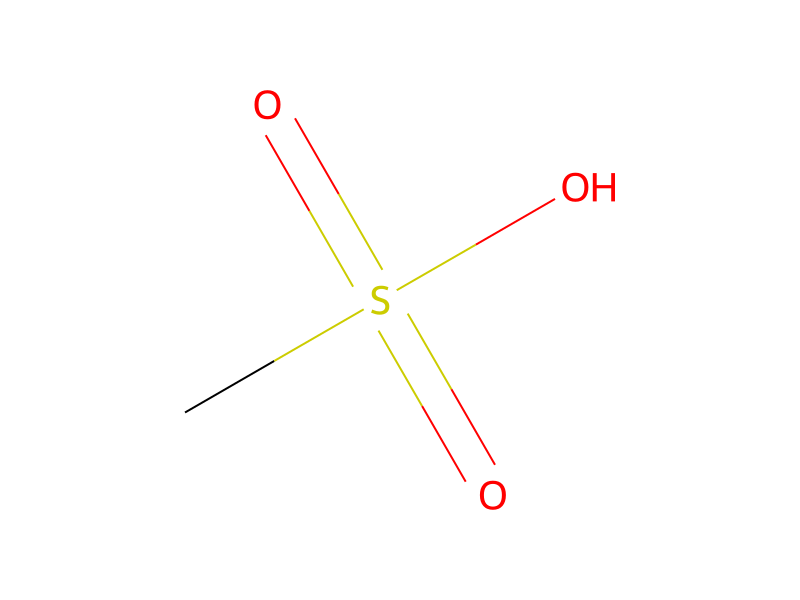
실험 절차
2-hydroxy-3,4,5-trimethoxybenzoic acid (1.14 g, 0.005 mol) and 1,2,3,4-tetramethoxybenzene (0.99 g, 0.005 mol) and 25 ml of a 9% solution of P2O5 in methanesulfonic acid were shaken in a 50 ml cylindrical glass tube with a Teflon-lined screw-cap at room temperature for 54 hours. The dark orange mixture was then poured onto crushed ice (150 ml). After melting, the product was extracted with methylene chloride (3×40 ml). After removal of the solvent, the residue was chromatographed on silica gel (30 g) with CH2Cl2. Of the three fractions obtained (the eluent was monitored by thin-layer chromatography), the middle one was uniform and left pure 2-hydroxy-3,4,5,2′,3′,4′, 5′-heptamethoxybenzophenone (0.51 g, 25%) as a yellow oil upon evaporation of the solvent. This was dissolved in 100 ml 75% alcohol whereafter 5 ml of 10N NaOH were added and the mixture was heated to boiling in a beaker for three hours; the volume was kept at 100 ml by occasional addition of water. The mixture was then transferred to a 250 ml round bottom flask and refluxed for another 17 hours. After cooling, suction filtration yielded 0.36 g of 2,3,4,5,6,7-hexamethoxyxanthone as a white product (small needles, matted, 77%). In a deprotection procedure, similar to the one described above for pentamethoxyxanthone, 0.42 g of the hexamethoxyxanthone produced 0.296 g of hexahydroxyxanthone (91%) as a pale yellow powder. It was found advantageous to circumvent the need for centrifugation by stirring the methylene chloride-water mixture (from the quenching of the BBr3-solution) in a wide-mouthed container for several hours, leading to the evaporation of the methylene chloride; the mixture is then easily filterable.
후처리
- customlined screw-cap at room temperature for 54 hours
- additionThe dark orange mixture was then poured
- extractionthe product was extracted with methylene chloride (3×40 ml)
- customAfter removal of the solvent
- customthe residue was chromatographed on silica gel (30 g) with CH2Cl2
- customOf the three fractions obtained (the eluent
- customupon evaporation of the solvent
- dissolutionThis was dissolved in 100 ml 75% alcohol whereafter 5 ml of 10N NaOH
- additionwere added
- temperaturethe mixture was heated
- additionthe volume was kept at 100 ml by occasional addition of water
- customThe mixture was then transferred to a 250 ml round bottom flask
- temperaturerefluxed for another 17 hours
- temperatureAfter cooling
- filtrationsuction filtration
출처 및 근거
- ORD 기록
- ord-34c7deea87214466aaaec601ff7c26b9
- 출처 데이터셋
- uspto-grants-2003_09
- 특허 번호
- US06613797B2
반응 노트
불러오는 중…