4-Methylmorpholine → N-({4-[(2R,3R)-3-{[(2R)-2-(4-fluorophenyl)-2-hydroxyethyl]thio}-1-(4-{3-[(methylsulfonyl)amino]prop-1-yn-1-yl}phenyl)-4-oxoazetidin-2-yl]phenoxy}acetyl)glycyl-D-valine
Reaction equation

[Si]([O:8][C@H:9]([C:42]1[CH:47]=[CH:46][C:45]([F:48])=[CH:44][CH:43]=1)[CH2:10][S:11][C@H:12]1[C:15](=[O:16])[N:14]([C:17]2[CH:22]=[CH:21][C:20]([C:23]#[C:24][CH2:25][NH:26][S:27]([CH3:30])(=[O:29])=[O:28])=[CH:19][CH:18]=2)[C@@H:13]1[C:31]1[CH:41]=[CH:40][C:34]([O:35][CH2:36][C:37](O)=[O:38])=[CH:33][CH:32]=1)(C(C)(C)C)(C)C.CN1CCOCC1.CN(C(ON1N=NC2C=CC=CC1=2)=[N+](C)C)C.[B-](F)(F)(F)F.Cl.[NH2:79][CH2:80][C:81]([NH:83][C@@H:84]([C:88]([OH:90])=[O:89])[CH:85]([CH3:87])[CH3:86])=[O:82].[Si](O[Si](C(C)(C)C)(C)C)(C(C)(C)C)(C)C>CN(C=O)C>[F:48][C:45]1[CH:46]=[CH:47][C:42]([C@@H:9]([OH:8])[CH2:10][S:11][C@H:12]2[C:15](=[O:16])[N:14]([C:17]3[CH:22]=[CH:21][C:20]([C:23]#[C:24][CH2:25][NH:26][S:27]([CH3:30])(=[O:29])=[O:28])=[CH:19][CH:18]=3)[C@@H:13]2[C:31]2[CH:41]=[CH:40][C:34]([O:35][CH2:36][C:37]([NH:79][CH2:80][C:81]([NH:83][C@@H:84]([C:88]([OH:90])=[O:89])[CH:85]([CH3:86])[CH3:87])=[O:82])=[O:38])=[CH:33][CH:32]=2)=[CH:43][CH:44]=1Participants
Reactant 5
 HCID 79724-Methylmorpholine
 HCID 590018TBDMS ether
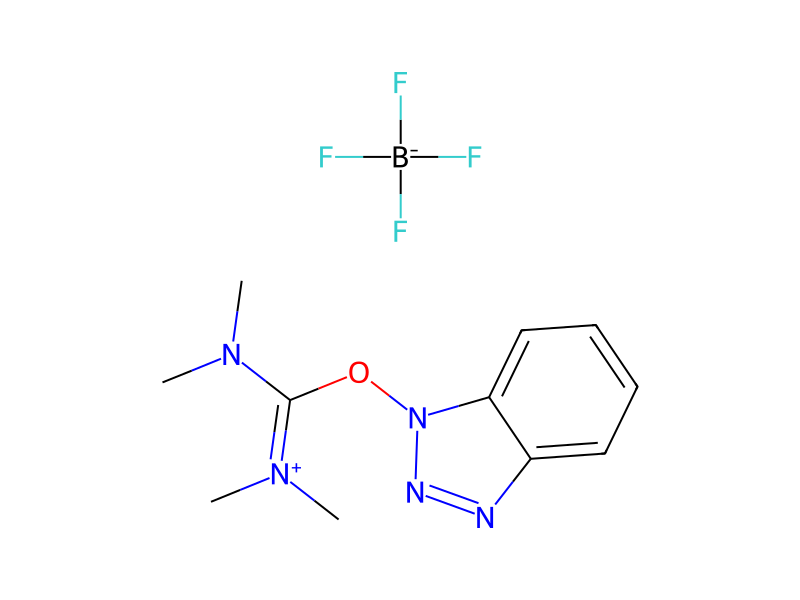 HCID 2733207O-(Benzotriazol-1-yl)-N,N,N',N'-tetramethyluronium tetrafluoroborate
 HCID 68774413{4-[(2R,3R)-3-{[(2R)-2-{[tert-butyl(dimethyl)silyl]oxy}-2-(4-fluorophenyl)ethyl]thio}-(4-{3-[(methylsulfonyl)amino]prop-1-yn-1-yl}phenyl)-4-oxoazetidin-2-yl]phenoxy}acetic acid
 HCID 86628617Glycyl-D-valine hydrochloride
Product 1

Reagents, catalysts & solvents 1

Procedure
To a stirred solution of {4-[(2R,3R)-3-{[(2R)-2-{[tert-butyl(dimethyl)silyl]oxy}-2-(4-fluorophenyl)ethyl]thio}-1-(4-{3-[(methylsulfonyl)amino]prop-1-yn-1-yl}phenyl)-4-oxoazetidin-2-yl]phenoxy}acetic acid (19.4 mg, 0.027 mmol), and N-methylmorpholine (9 μl, 0.082 mmol) in DMF (1 ml, dry) was added. TBTU (12 mg, 0.037 mmol) and the reaction mixture was stirred at 30° C. for 1 hour. Glycyl-D-valine hydrochloride (8.0 mg, 0.038 mmol) was added and the reaction mixture was stirred for 1 hour. LC-MS showed the formation of the TBDMS-ether of the title compound, M/z: 868.68 (M−1). The reaction mixture was diluted with water and EtOAc. The solution was acidified with KHSO4 (2M) to pH ca 3. The phases were separated and the organic phase was concentrated. The residue was dissolved in acetic acid (1 ml). Water (100 μl) and LiCl (51.4 mg, 1.21 mmol) were added and the reaction mixture was stirred over the weekend. The acetic acid was co-evaporated with toluene. The residue was purified with preparative HPLC on a C8 column, UV 235/285 nm. A gradient from 20 to 80% MeCN in 0.1M NH4OAc buffer was used as eluent. The pure fractions were collected and most of the MeCN was removed under reduced pressure. The residue was diluted with water and DCM. It was acidified with KHSO4 (2M) to pH 3. The phases were separated and the organic phase was passed through a phase separator. The organic phase was concentrated and the residue was dissolved in MeCN and water. After lyophilisation, the title compound was obtained. H-NMR (500 MHz, DMSO-d6): 0.84 (d, 3H), 0.86 (d, 3H), 1.99-2.06 (m, 1H), 2.92 (d, 2H), 2.97 (s, 3H), 3.79-3.88 (m, 2H), 4.01 (d, 2H), 4.12-4.17 (m, 1H), 4.29 (d, 1H), 4.53 (s, 2H), 4.71 (t, 1H), 5.10 (d, 1H), 5.65 (bs, 1H), 6.99 (d, 2H), 7.08-7.13 (m, 2H), 7.20 (d, 2H), 7.30-7.40 (m, 6H), 7.58 (t, 1H), 8.02 (d, 1H), 8.24 (t, 1H), 12.65 (b, 1H). M/z: 753.52 (M−1).
Sources & evidence
- ORD record
- ord-80afba7bfcb8414294754d9c7df17f46
- Source dataset
- uspto-grants-2010_11
- Patent number
- US07842684B2
Reaction notes
Loading…