Citrate → Nadh
Reaction equation

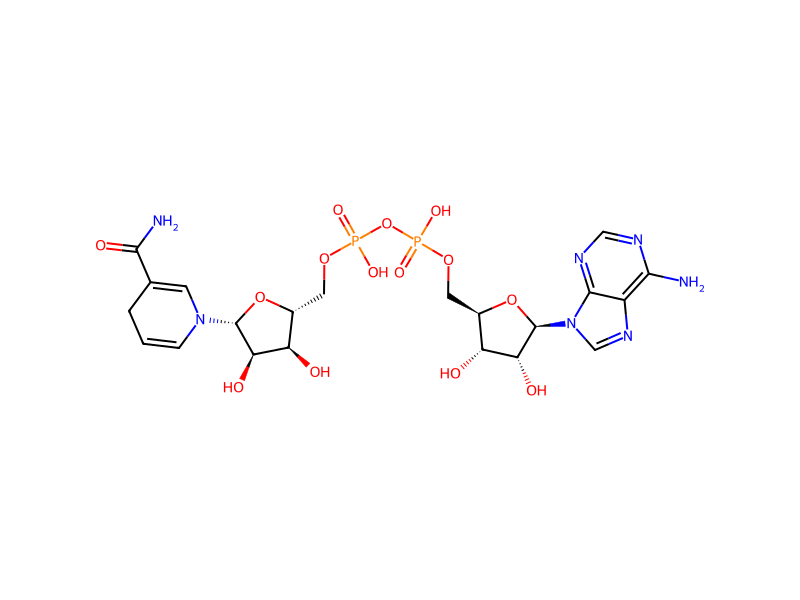
C(SCCNC(=O)CCNC(=O)[C@H](O)C(C)(C)[CH2:15][O:16][P:17]([OH:46])(=[O:45])[O:18][P:19]([OH:44])(=[O:43])[O:20][CH2:21][C@H:22]1[O:26][C@@H:25]([N:27]2[C:36]3[N:35]=[CH:34][N:33]=[C:31]([NH2:32])[C:30]=3[N:29]=[CH:28]2)[C@H:24]([OH:37])[C@@H:23]1[O:38]P(O)(O)=O)(=O)C.C(SCCNC(=O)CCNC(=O)[C@H](O)C(C)(C)COP(O)(=O)OP(O)(=O)OC[C@H:76]1[O:80][C@@H:79]([N:81]2[C:90]3N=C[N:87]=[C:85](N)[C:84]=3N=[CH:82]2)[C@H:78]([OH:91])[C@@H:77]1[O:92]P(O)(O)=O)(=O)CC(O)=O.[C:106]([O-])(=O)[CH:107](CC([O-])=O)O.C1N=C(N)C2N=CN([C@@H]3[O:128][C@H](COP(OP(OC[C@H]4O[C@@H](N5C=C(C(N)=O)CC=C5)[C@H](O)[C@@H]4O)(O)=O)(O)=O)[C@@H](O)[C@H]3O)C=2N=1.C(CC([O-])=O)(C(O)=O)=O.C1N=C(N)C2N=CN([C@@H]3O[C@H](COP(OP(OC[C@H]4O[C@@H](N5C=C(C(N)=O)CC=C5)[C@H](O)[C@@H]4O)(O)=O)(O)=O)[C@@H](O)[C@H]3O)C=2N=1.C(CC([O-])=O)(C(O)=O)=O.C([O-])(=O)CC(CC([O-])=O)(C([O-])=O)O>>[CH:34]1[N:33]=[C:31]([NH2:32])[C:30]2[N:29]=[CH:28][N:27]([C@@H:25]3[O:26][C@H:22]([CH2:21][O:20][P:19]([O:18][P:17]([O:16][CH2:15][C@H:76]4[O:80][C@@H:79]([N:81]5[CH:90]=[C:84]([C:85]([NH2:87])=[O:128])[CH2:107][CH:106]=[CH:82]5)[C@H:78]([OH:91])[C@@H:77]4[OH:92])([OH:46])=[O:45])([OH:44])=[O:43])[C@@H:23]([OH:38])[C@H:24]3[OH:37])[C:36]=2[N:35]=1Participants


Procedure
In Vitro MCD Inhibitory Assay: The conversion of acetyl-CoA from malonyl-CoA was assayed using a modified protocol as previously described by Kim, Y. S. and Kolattukudy, P. E. in 1978 (Arch. Biochem. Biophys 190:585 (1978)). As shown in eq. 1-3, the establishment of the kinetic equilibrium between malate/NAD and oxaloacetate/NADH was catalyzed by malic dehydrogenase (eq. 2). The enzymatic reaction product of MCD, acetyl-CoA, shifted the equilibrium by condensing with oxaloacetate in the presence of citrate synthase (eq. 3), which resulted in a continuous generation of NADH from NAD. The accumulation of NADH can be continuously followed by monitoring the increase of fluorescence emission at 460 nm on a fluorescence plate reader. The fluorescence plate reader was calibrated using the authentic acetyl-CoA from Sigma. For a typical 96-well plate assay, the increase in the fluorescence emission (λex=360 nm, λem=460 nm, for NADH) in each well was used to calculate the initial velocity of hMCD. Each 50 μL assay contained 10 mM phosphate buffered saline (Sigma), pH 7.4, 0.05% Tween-20, 25 mM K2HPO4—KH2PO4 (Sigma), 2 mM Malate (Sigma), 2 mM NAD (Boehringer Mannheim), 0.786 units of MD (Roche Chemicals), 0.028 unit of CS (Roche Chemicals), 5-10 nM hMCD, and varying amounts of MCA substrate. Assays were initiated by the addition of MCA, and the rates were corrected for the background rate determined in the absence of hMCD. Isolated Working Rat Heart Assay Protocol Isolated working hearts from male Sprague-Dawley rats (300-350 g) are subjected to a 60-minute aerobic perfusion period. The working hearts are perfused with 95% O2, 5% CO2 with a modified Krebs-Henseleit solution containing 5 mM glucose; 100 μU/mL insulin; 3% fatty acid-free BSA; 2.5 mM free Ca2+, and 0.4 to 1.2 mmol/L palmitate (Kantor et al., Circulation Research 86:580-588(2000)). The test compound is added 5 minutes before the perfusion period. DMSO (0.05%) is used as control. Measurement of Glucose Oxidation Rates Samples were taken at 10-minute intervals for measurements of experimental parameters. Glucose oxidation rates are determined by the quantitative collection of 14CO2 produced by hearts perfused with buffer containing [U14]-Glucose (R. Barr and G. Lopaschuk, in “Measurement of cardiovascular function”, McNeill, J. H. ed., Chapter 2, CRC press, New York (1997)). After the perfusion, the 14CO2 from the perfusae is subsequently released by injecting 1 mL of perfusate into sealed test tube containing 1 mL of 9N H2SO4. The tube was sealed with a rubber stopper attached to a scintillation vial containing a piece of filter papers saturated with 300 μl of hyamine hydroxide. The scintillation vials with filter papers were then removed and Ecolite Scintillation Fluid added. Samples were counted by standard procedures as described above. Average rates of glucose oxidation for each phase of perfusion are expressed as μmol/min/g dry wt as described above. Measurement of Fatty Acid Oxidation Rates: Rates of fatty acid oxidation are determined using the same method as described above for glucose oxidation rate measurement using [14C]palmitate or by the quantitative collection of 3H2O produced by hearts perfused with buffer containing [5-3H]palmitate (R. Barr and G. Lopaschuk, in “Measurement of cardiovascular function”, McNeill, J. H. ed., Chapter 2, CRC press, New York (1997)). 3H2O was separated from [5-3H]palmitate by treating 0.5 mL buffer samples with 1.88 mL of a mixture of chloroform/methanol (1:2 v:v) and then adding 0.625 mL of chloroform and 0.625 mL of a 2 M KCl/HCl solution. The sample is centrifuged for 10 min and aqueous phase was removed and treated with a mixture of 1 mL of chloroform, 1 mL of methanol and 0.9 mL KCl/HCl with a ration of 1:1:0.9. The aqueous layer was then counted for total 3H2O determination. This process resulted in greater than 99.7% extraction and separation of 3H2O from the pamiltate. Average rates of fatty acid oxidation for each phase of perfusion are expressed as nmol/min/g dry wt after taking consideration the dilution factor.
Sources & evidence
- ORD record
- ord-1417d977a85e4ef79ad5ee63358dc3a8
- Source dataset
- uspto-grants-2007_10
- Patent number
- US07285562B2
Reaction notes
Loading…