2-Aminopyridine → 4-(2-pyridyl)aminomethylnaphthalene-1-carboxylic Acid
Reaction equation

Br[CH2:2][C:3]1[C:12]2[C:7](=[CH:8][CH:9]=[CH:10][CH:11]=2)[C:6]([C:13]([O:15]C)=[O:14])=[CH:5][CH:4]=1.C(=O)([O-])[O-].[K+].[K+].[NH2:23][C:24]1[CH:29]=[CH:28][CH:27]=[CH:26][N:25]=1>CN(C=O)C>[N:25]1[CH:26]=[CH:27][CH:28]=[CH:29][C:24]=1[NH:23][CH2:2][C:3]1[C:12]2[C:7](=[CH:8][CH:9]=[CH:10][CH:11]=2)[C:6]([C:13]([OH:15])=[O:14])=[CH:5][CH:4]=1Participants
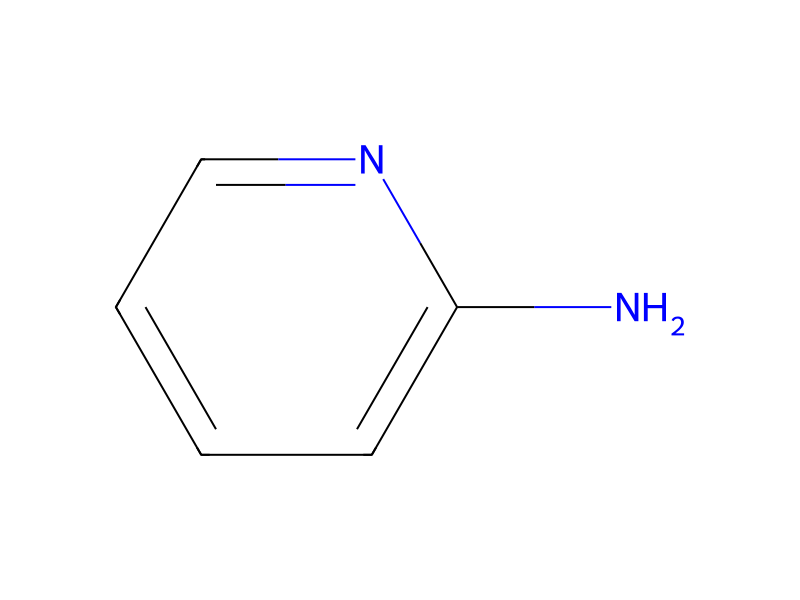




Procedure
The compound obtained in Example 17-2 (1.6728 g) was dissolved in DMF (33 ml). After the addition of potassium carbonate (1.66 g) and 2-aminopyridine (0.68 g), the mixture was stirred for 15 hours at room temperature. After the reaction, the solvent was removed by distillation and the residue was dissolved in chloroform. The organic layer was washed with 1 mol/l aqueous solution of hydrochloric acid and saturated brine, and dried over anhydrous sodium sulfate. Then, the solvent was removed by distillation. The residue was dissolved in DMF (44 ml). Triethylamine. (1.58 ml) and di-t-butyldicarbonate (2.60 ml) were added and the mixture was stirred for 6 hours at room temperature. After the reaction, the solvent was removed by distillation. The residue was dissolved in ethyl acetate. The solution was washed with 0.5 mol/l aqueous solution of hydrochloric acid and saturated brine, and dried over anhydrous sodium sulfate. The solvent was removed by distillation. The residue was dissolved in methanol (6 ml), and 1 mol/l aqueous solution of sodium hydroxide (6 ml) was added. After the reaction for one day, the reaction solution was concentrated. The residue was dissolved again in methanol and neutralized with ion-exchange resin CG50. The resin was removed by filtration. The filtrate was concentrated. The residue was purified by silica gel column chromatography (15 g, chloroform/methanol=5/1) to obtain the title compound (159 mg) as a colorless viscous liquid.
Workup
- customAfter the reaction
- customthe solvent was removed by distillation
- dissolutionthe residue was dissolved in chloroform
- washThe organic layer was washed with 1 mol/l aqueous solution of hydrochloric acid and saturated brine
- dry with materialdried over anhydrous sodium sulfate
- customThen, the solvent was removed by distillation
- dissolutionThe residue was dissolved in DMF (44 ml)
- addition(1.58 ml) and di-t-butyldicarbonate (2.60 ml) were added
- stirringthe mixture was stirred for 6 hours at room temperature
- customAfter the reaction
- customthe solvent was removed by distillation
- dissolutionThe residue was dissolved in ethyl acetate
- washThe solution was washed with 0.5 mol/l aqueous solution of hydrochloric acid and saturated brine
- dry with materialdried over anhydrous sodium sulfate
- customThe solvent was removed by distillation
- dissolutionThe residue was dissolved in methanol (6 ml)
- addition1 mol/l aqueous solution of sodium hydroxide (6 ml) was added
- customAfter the reaction for one day
- concentrationthe reaction solution was concentrated
- dissolutionThe residue was dissolved again in methanol and neutralized with ion-exchange resin CG50
- customThe resin was removed by filtration
- concentrationThe filtrate was concentrated
- customThe residue was purified by silica gel column chromatography (15 g, chloroform/methanol=5/1)
Sources & evidence
- ORD record
- ord-ebd70d5959dd40d49b1ca0a2b29a7ea9
- Source dataset
- uspto-grants-2006_08
- Patent number
- US07098215B2
Reaction notes
Loading…