Triphenylphosphine → (-)-(1R,3R)-(3-azido-cyclopentyloxy)-tert-butyl-dimethyl-silane
Reaction equation

[C:1]([Si:5]([CH3:14])([CH3:13])[O:6][C@@H:7]1[CH2:11][CH2:10][C@H:9](O)[CH2:8]1)([CH3:4])([CH3:3])[CH3:2].C1(P(C2C=CC=CC=2)C2C=CC=CC=2)C=CC=CC=1.N(C(OCC)=O)=NC(OCC)=O.C1(P([N:60]=[N+:61]=[N-:62])(C2C=CC=CC=2)=O)C=CC=CC=1>O1CCCC1>[N:60]([C@@H:9]1[CH2:10][CH2:11][C@@H:7]([O:6][Si:5]([C:1]([CH3:4])([CH3:3])[CH3:2])([CH3:14])[CH3:13])[CH2:8]1)=[N+:61]=[N-:62]Participants
Reactant 4



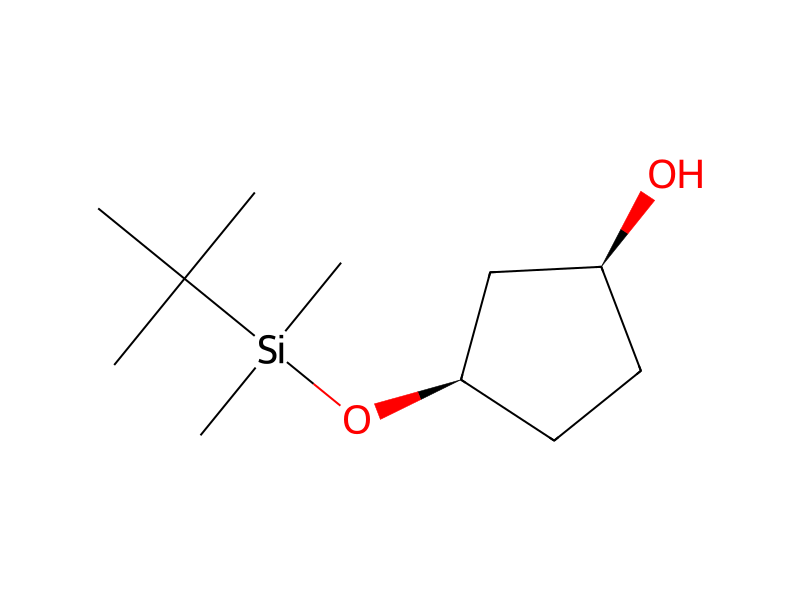
Product 1

Reagents, catalysts & solvents 1

Conditions
- Temperature
- 0 °C
Procedure
To a mixture of (−)-(1S,3R)-3-(tert-butyl-dimethyl-silanyloxy)-cyclopentanol (670 mg, 3.09 mmol) (from Example 27b supra) and triphenyl phosphine (1.06 g, 4.02 mmol) (Aldrich) in anhydrous tetrahydrofuran (60 mL) cooled at 0° C. was added dropwise diethyl azodicarboxylate (640 μL, 0.70 g, 4.02 mmol) (Aldrich). After 2 to 3 minutes, followed a dropwise addition of diphenylphosphoryl azide (860 μL, 1.1 g, 4.02 mmol) (Aldrich). The mixture was allowed to slowly warm up to room temperature and after overnight stirring was partitioned between ethyl acetate and water. The organic layer was collected, dried over sodium sulfate filtered and concentrated to a residue that was purified by chromatography with a silica gel column using a 0–20% diethyl ether in hexanes gradient to give (−)-(1R,3R)-(3-azido-cyclopentyloxy)-tert-butyl-dimethyl-silane as a colorless liquid. (Yield 540 mg, 72%).
Workup
- temperatureto slowly warm up to room temperature and after overnight
- customwas partitioned between ethyl acetate and water
- customThe organic layer was collected
- dry with materialdried over sodium sulfate
- filtrationfiltered
- concentrationconcentrated to a residue that
- customwas purified by chromatography with a silica gel column
Sources & evidence
- ORD record
- ord-ad38a2ca41974da6a72d41295365d01e
- Source dataset
- uspto-grants-2006_10
- Patent number
- US07115740B2
Reaction notes
Loading…