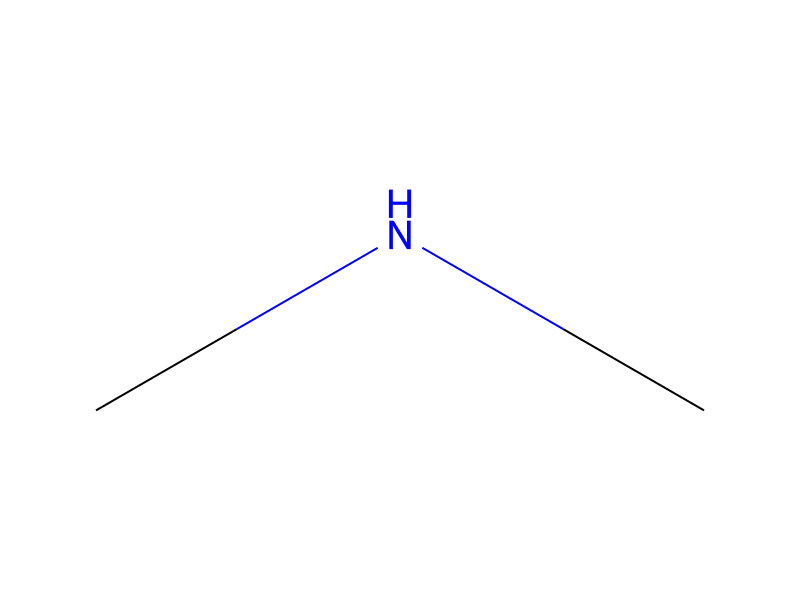
Dimethylamine → (2E)-4-(Dimethylamino)-2-butenoic acid
Reaction equation

C[Si]([O:5][C:6](=[O:11])/[CH:7]=[CH:8]/[CH2:9]Br)(C)C.[CH3:12][NH:13][CH3:14]>O1CCCC1>[CH3:12][N:13]([CH3:14])[CH2:9]/[CH:8]=[CH:7]/[C:6]([OH:5])=[O:11]Participants
Reactant 2

Product 1

Reagents, catalysts & solvents 1

Procedure
The preparation of 4-(dimethylamino)-2-butenoyl chloride (hydrochloride) (I) is described in Scheme II wherein but-2-enoic acid 7 is reacted with chlorotrimethylsilane in pyridine to afford trimethylsilylcrotonate 8 which is brominated with a brominating agent preferably N-bromosuccinimide under free radical conditions in the presence of light and peroxide in methylene chloride, acetonitrile, 1,2-dichloroethane, carbon tetrachloride or ethyl acetate to give trimethylsilyl-4-bromocrotonate 9. Reaction of trimethylsilyl-4-bromocrotonate 9 with dimethylamine in tetrahydrofuran at about 0–5° C. affords 4-dimethylaminocrotonic acid 10 isolated as the hydrochloride salt. Alternatively, 4-dimethylaminocrotonic acid 10 can be prepared by reaction of methyl or ethyl 4-bromocrotonate 11 with dimethylamine at 0 to 10° C. in tetrahydrofuran to give methyl or ethyl 4-dimethylaminocrotonate 12 which is hydrolyzed with aqueous base which includes sodium hydroxide in methanol as a cosolvent at about 40–45° C. to give 4-dimethylaminocrotonic acid 10 which is isolated to 4-dimethylaminocrotonic acid (hydrochloride) 10 with a solution of hydrogen chloride in isopropyl alcohol, and then chlorinated with a chlorinating agent preferably, but not limited to, oxalyl chloride in methylene chloride, tetrahydrofuran (THF) or acetonitrile in the presence of a catalytic amount of N,N-dimethylformamide to afford 4-(dimethylamino)-2-butenoyl chloride hydrochloride 2.
Sources & evidence
- ORD record
- ord-db1c1f0754f64effae80dfd71f775866
- Source dataset
- uspto-grants-2006_10
- Patent number
- US07126025B2
Reaction notes
Loading…