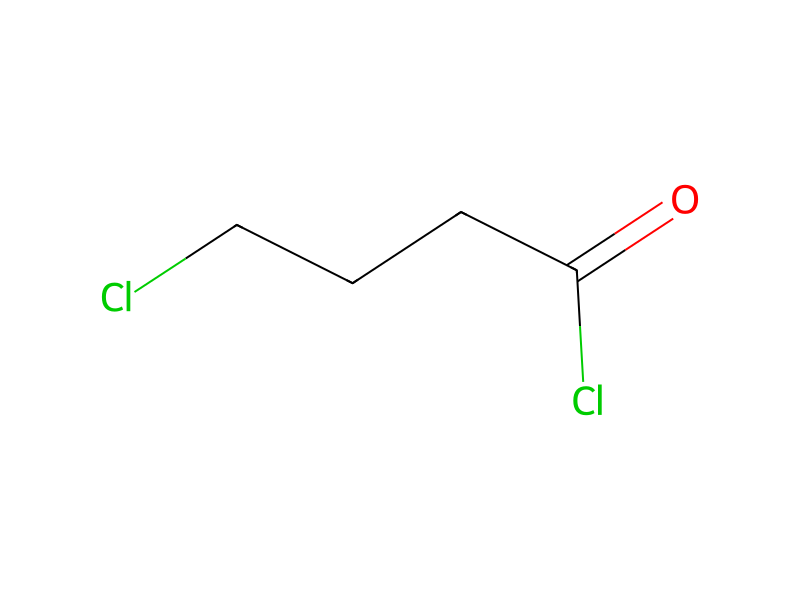
4-Chlorobutyryl chloride → 5-(4-Chlorobutyramido)-4-cyano-1-(2,3,4-trichlorophenyl)pyrazole
Reaction equation

[NH2:1][C:2]1[N:6]([C:7]2[CH:12]=[CH:11][C:10]([Cl:13])=[C:9]([Cl:14])[C:8]=2[Cl:15])[N:5]=[CH:4][C:3]=1[C:16]#[N:17].[Cl:18][CH2:19][CH2:20][CH2:21][C:22](Cl)=[O:23]>C(#N)C>[Cl:18][CH2:19][CH2:20][CH2:21][C:22]([NH:1][C:2]1[N:6]([C:7]2[CH:12]=[CH:11][C:10]([Cl:13])=[C:9]([Cl:14])[C:8]=2[Cl:15])[N:5]=[CH:4][C:3]=1[C:16]#[N:17])=[O:23]Participants



Procedure
A mixture of 5-amino-4-cyano-1-(2,3,4-trichlorophenyl)pyrazole (12.47 g) and 4-chlorobutyryl chloride (12.3 g) in dry acetonitrile (200 ml) was stirred and gently warmed to effect dissolution. The solution was cooled to room temperature and stirred, after 48 hours a further quantity of 4-chlorobutyryl chloride (6.15 g) was added and stirring continued for 24 hours. The solution was evaporated under reduced pressure to give an oil which was chromatographed using dichloromethane-ethyl acetate (19:1) as eluent. Evaporation of the eluate containing the fastest moving component gave 5-(4-chlorobutyramido)-4-cyano-1-(2,3,4-trichlorophenyl)pyrazole (5 g), m.p. 173°-174° C., after crystallisation from toluene, in the form of pale yellow crystals.
Workup
- temperaturegently warmed
- dissolutiondissolution
- additionwas added
- stirringstirring
- customThe solution was evaporated under reduced pressure
- customto give an oil which
- customwas chromatographed
- customEvaporation of the eluate
- additioncontaining the
Sources & evidence
- ORD record
- ord-44b8871891de43fa95b4101124ef8844
- Source dataset
- uspto-grants-1986_12
- Patent number
- US04629495
Reaction notes
Loading…