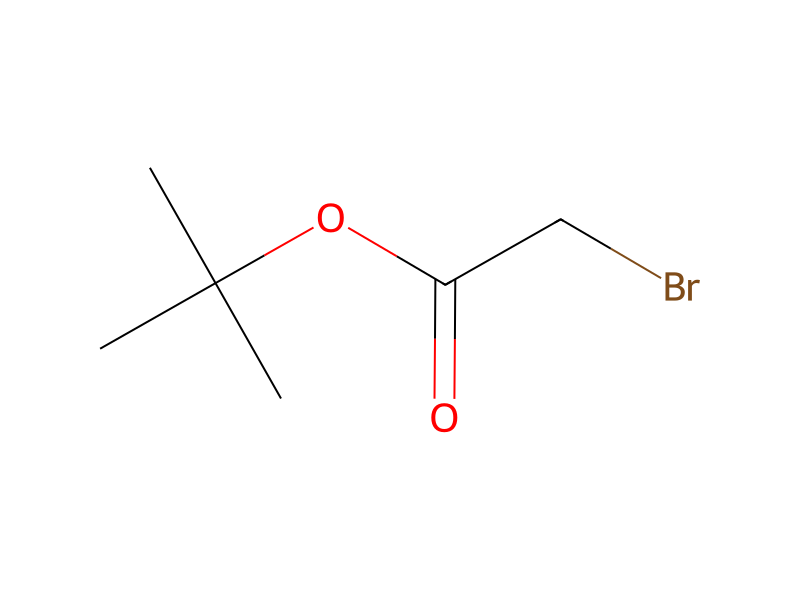
tert-Butyl bromoacetate → tert-Butyl 3-nitro-2-oxo-1(2H)-pyridineacetate
Reaction equation

[OH:1][C:2]1[C:7]([N+:8]([O-:10])=[O:9])=[CH:6][CH:5]=[CH:4][N:3]=1.C[Si]([N-][Si](C)(C)C)(C)C.[Li+].Br[CH2:22][C:23]([O:25][C:26]([CH3:29])([CH3:28])[CH3:27])=[O:24]>O1CCCC1>[N+:8]([C:7]1[C:2](=[O:1])[N:3]([CH2:22][C:23]([O:25][C:26]([CH3:29])([CH3:28])[CH3:27])=[O:24])[CH:4]=[CH:5][CH:6]=1)([O-:10])=[O:9]Participants




Conditions
- Temperature
- 25 °C
Procedure
2-Hydroxy-3-nitro-pyridine (75 g, 0.535 mole) and 1400 mL of anhydrous tetrahydrofuran were stirred at 0° C. using a mechanical stirrer. Lithium bis(trimethylsilyl)amide (1.0 M solution in tetrahydrofuran, 683.5 mL) was slowly added over 30 minutes. The deep brown reaction mixture was stirred for 30 additional minutes and then t-butyl bromoacetate (109.6 g, 0.561 mole) was slowly added over 30 minutes. The reaction mixture was warmed to 25° C. overnight. The organic solvents were removed under vacuum and the residue was dissolved in 2 liters of ethyl acetate and 500 mL of water. The organic phase was dried with magnesium sulfate, filtered and evaporated under vacuum. The residue was chromatographed on silica gel using a methylene chloride:ethanol gradient, 100:0 to 98:2, to yield 102.1 g (75 %) of the title compound as a yellow-orange solid.
Workup
- customThe organic solvents were removed under vacuum
- dissolutionthe residue was dissolved in 2 liters of ethyl acetate
- dry with materialThe organic phase was dried with magnesium sulfate
- filtrationfiltered
- customevaporated under vacuum
- customThe residue was chromatographed on silica gel using a methylene chloride
Sources & evidence
- ORD record
- ord-17402dab1af047289b5a04c7a8f08623
- Source dataset
- uspto-grants-2002_01
- Patent number
- US06342504B1
Reaction notes
Loading…