Hydrochloric Acid → benzhydryl (6R,7R)-7-[[(2Z)-2-(2-amino-5-chloro-1,3-thiazol-4-yl)-2-cyclopent-2-en-1-yloxyiminoacetyl]amino]-8-oxo-3-(1H-pyrazol-4-ylmethylsulfanyl)-5-thia-1-azabicyclo[4.2.0]oct-2-ene-2-carboxylate
Reaction equation

[Cl:1][C:2]1[S:6][C:5]([NH:7]C=O)=[N:4][C:3]=1/[C:10](=[N:65]/[O:66][CH:67]1[CH2:71][CH2:70][CH:69]=[CH:68]1)/[C:11]([NH:13][C@@H:14]1[C:63](=[O:64])[N:16]2[C:17]([C:47]([O:49][CH:50]([C:57]3[CH:62]=[CH:61][CH:60]=[CH:59][CH:58]=3)[C:51]3[CH:56]=[CH:55][CH:54]=[CH:53][CH:52]=3)=[O:48])=[C:18]([S:21][CH2:22][C:23]3[CH:24]=[N:25][N:26](C(C4C=CC=CC=4)(C4C=CC=CC=4)C4C=CC=CC=4)[CH:27]=3)[CH2:19][S:20][C@H:15]12)=[O:12].CO.Cl>O1CCCC1>[NH2:7][C:5]1[S:6][C:2]([Cl:1])=[C:3](/[C:10](=[N:65]/[O:66][CH:67]2[CH2:71][CH2:70][CH:69]=[CH:68]2)/[C:11]([NH:13][C@@H:14]2[C:63](=[O:64])[N:16]3[C:17]([C:47]([O:49][CH:50]([C:57]4[CH:58]=[CH:59][CH:60]=[CH:61][CH:62]=4)[C:51]4[CH:56]=[CH:55][CH:54]=[CH:53][CH:52]=4)=[O:48])=[C:18]([S:21][CH2:22][C:23]4[CH:27]=[N:26][NH:25][CH:24]=4)[CH2:19][S:20][C@H:15]23)=[O:12])[N:4]=1Participants
Reactant 3



Product 1
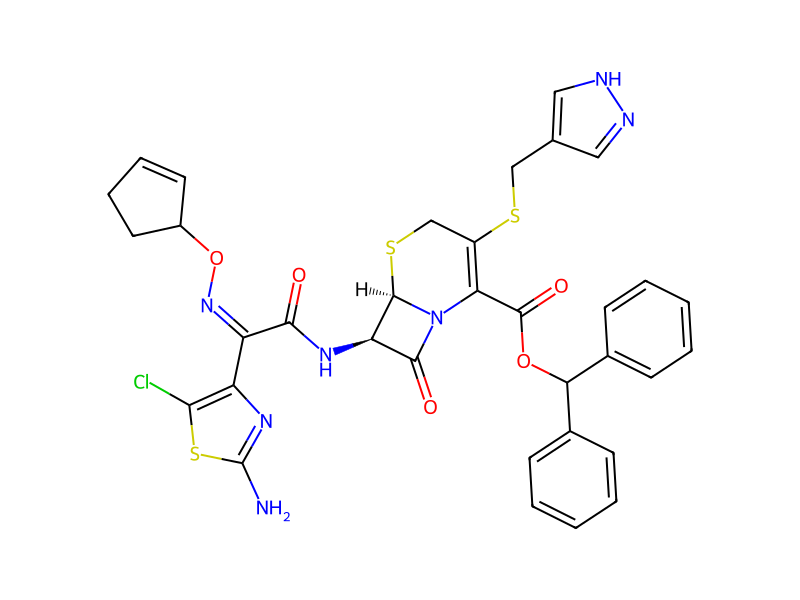
Reagents, catalysts & solvents 1

Procedure
To a stirred mixture of solution of diphenylmethyl 7β-[2-(5-chloro-2-formylaminothiazol-4-yl)-2-(Z)-(2-cyclopenten-1-yloxyimino)acetamido]-3-[(1-tritylpyrazol-4-yl)methylthio]-3-cephem-4-carboxylate (3.82 g) in the mixture of methanol (40 ml) and tetrahydrofurane (12 ml) was added dropwise conc. hydrochloric acid (i.56 ml) at room temperature. After the mixture was stirred for 3 hours, the solvent was evaporated in vacuo. The residue was diluted with the mixture of water and ethyl acetate while the pH was adjusted between 8.0 and 8.5 with saturated sodium hydrogen carbonate. The organic layer was collected, washed with water and brine and dried over magnesium sulfate. After evaporation of the solvent, the residue was purified on silica gel (eluent: dichloromethane--acetone) to afford diphenylmethyl 7β-[2-(2-amino-5-chlorothiazol-4-yl)-2-(Z)-(2-cyclopenten-1-yloxyimino)acetamido]-3-[(pyrazol-4-yl)methylthio]-3-cephem-4-carboxylate (1.77 g).
Workup
- customthe solvent was evaporated in vacuo
- additionThe residue was diluted with the mixture of water and ethyl acetate while the pH
- customThe organic layer was collected
- washwashed with water and brine
- dry with materialdried over magnesium sulfate
- customAfter evaporation of the solvent
- customthe residue was purified on silica gel (eluent: dichloromethane--acetone)
Sources & evidence
- ORD record
- ord-4638c33a48304158967e897c327a7d88
- Source dataset
- uspto-grants-2000_12
- Patent number
- US06159961
Reaction notes
Loading…