Fluorotrimethylsilane → 1,4,7-Tris(trimethylsilyl)-1,4,7-triazacyclododecane
Reaction equation

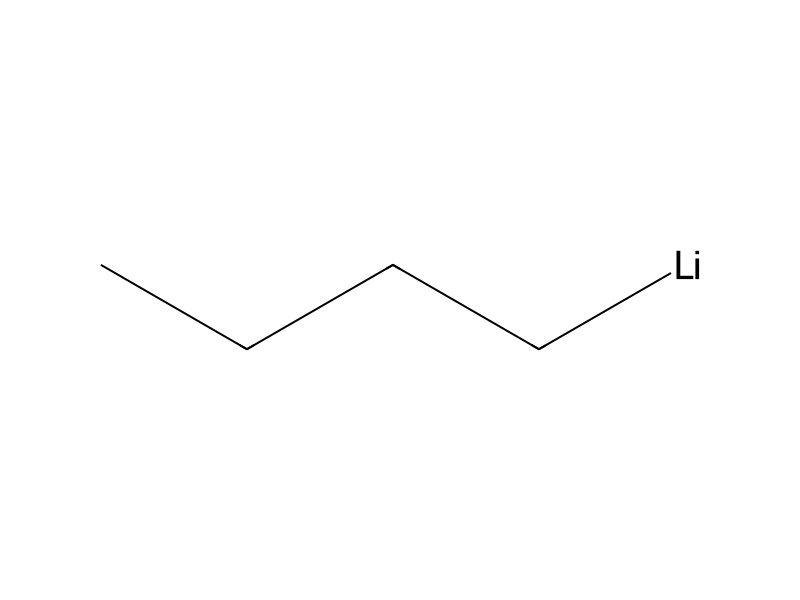
Cl.Cl.Cl.[NH:4]1[CH2:15][CH2:14][CH2:13][CH2:12][CH2:11][NH:10][CH2:9][CH2:8][NH:7][CH2:6][CH2:5]1.C([Li])CCC.F[Si:22]([CH3:25])([CH3:24])[CH3:23]>ClC1C=CC=CC=1>[CH3:23][Si:22]([CH3:25])([CH3:24])[N:4]1[CH2:15][CH2:14][CH2:13][CH2:12][CH2:11][N:10]([Si:22]([CH3:25])([CH3:24])[CH3:23])[CH2:9][CH2:8][N:7]([Si:22]([CH3:25])([CH3:24])[CH3:23])[CH2:6][CH2:5]1Participants




Procedure
1,4,7-Tris(trimethylsilyl)-1,4,7-triazacyclododecane was prepared from 1,4,7-triazacyclododecane trishydrochloride with six equivalents of n-butyllithium essentially by the procedure of Example 1 (A). In a 50 ml flask a solution of 0.675 g of the tris silyl compound (distilled bulb-to-bulb at 95°-125°/0.1 mm) in 2.5 ml of chlorobenzene was frozen, evacuated, and pressured with 40 ml of phosphorus oxyfluoride gas. The flask was sealed and the mixture heated overnight at 100°. Then the mixture was refluxed under a nitrogen atmosphere for 4 hours. A sample indicated (by nmr) that two-thirds of the silyl groups had reacted. Refluxing was continued for 5.8 hours under a nitrogen pressure of 960- 1040 mm of mercury. A sample at this time showed almost complete displacement of the silyl groups as fluorotrimethylsilane. The mixture remaining (about 80-85% of the original) was concentrated under vacuum and distilled bulb-to-bulb under vacuum (0.1 mm). The fraction collected at 80°-100° oven temperature consisted of solidified condensate in the mouth of the receiver, mp 78°-86.5°. This sample (~30 mg) was used for ir and mass spectroscopy which identify this material as 13-oxo-1,4,7-triaza-13-phosphatricyclo[5.5.1.04,13 ]-tridecane. It was recrystallized in part from cyclohexane giving needles, mp 86°-87.5°.
Workup
- customevacuated
- customThe flask was sealed
- temperaturethe mixture heated overnight at 100°
- temperatureThen the mixture was refluxed under a nitrogen atmosphere for 4 hours
- customhad reacted
- temperatureRefluxing
- concentrationwas concentrated under vacuum
- distillationdistilled bulb-to-bulb under vacuum (0.1 mm)
- customThe fraction collected at 80°-100° oven temperature
- customIt was recrystallized in part from cyclohexane giving needles, mp 86°-87.5°
Sources & evidence
- ORD record
- ord-852154e6c6864917a419c5131b7ae959
- Source dataset
- uspto-grants-1976_10
- Patent number
- US03987128
Reaction notes
Loading…