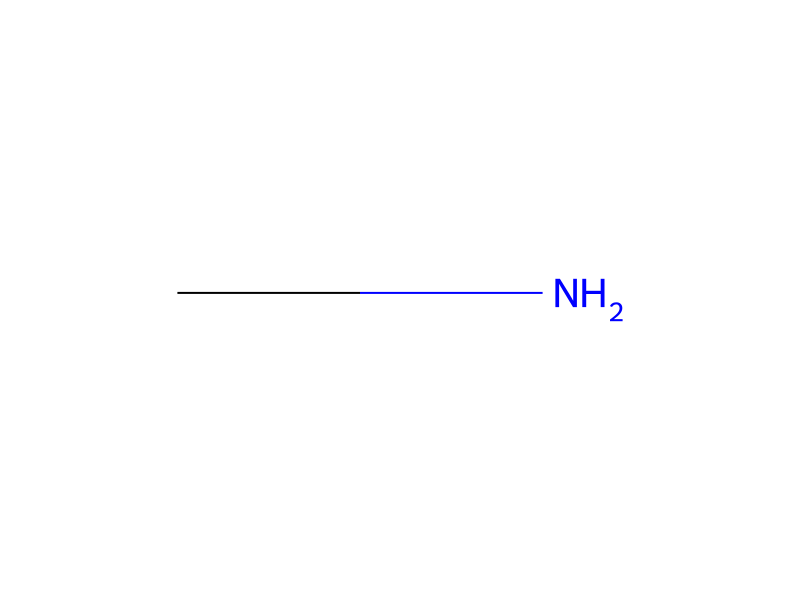
Methylamine → N-(4-(3,4-Dichlorophenyl)-3,4-dihydro-1(2H)-naphthalenylidene)methanamine
Reaction equation

ClC1C=C(C=CC=1Cl)C(C1C=CC=CC=1)=O.[Cl:17][C:18]1[CH:19]=[C:20]([CH:25]2[C:34]3[C:29](=[CH:30][CH:31]=[CH:32][CH:33]=3)[C:28](=O)[CH2:27][CH2:26]2)[CH:21]=[CH:22][C:23]=1[Cl:24].[CH3:36][NH2:37]>[Ti](Cl)(Cl)(Cl)Cl>[Cl:17][C:18]1[CH:19]=[C:20]([CH:25]2[C:34]3[C:29](=[CH:30][CH:31]=[CH:32][CH:33]=3)[C:28](=[N:37][CH3:36])[CH2:27][CH2:26]2)[CH:21]=[CH:22][C:23]=1[Cl:24]Participants


Procedure
There is described in U.S. Pat. Nos. 4,536,518 and 4,556,676 to W. M. Welch, Jr. et al., as well as in the paper of W. M. Welch, Jr. et al., appearing in the Journal of Medicinal Chemistry, Vol. 27, No. 11, p. 1508 (1984), a multi-step method for synthesizing pure racemic cis-(1S) (4S)-N-methyl-4-(3,4-dichlorophenyl)-1,2,3,4-tetrahydro -1-naphthaleneamine, starting from the readily available 3,4-dichlorobenzophenone and proceeding via the known racemic or (±)-4-(3,4-dichlorophenyl)-4-butanoic acid and then to (±) -4-(3,4-dichlorophenyl)-3,4-dihydro-1(2H)-naphthalenone (see also U.S. Pat. Nos. 4,777,288 and 4,839,104 to G. J. Quallich et al. for improved methods leading to these intermediates), with the latter ketone then being condensed with methylamine in the presence of titanium tetrachloride to yield N-[4-(3,4-dichlorophenyl)-3,4-dihydro-1(2H)-naphthalenylidene]methanamine. In the last step of the overall synthesis, the aforementioned imine is then readily reduced by means of catalytic hydrogenation or by the use of a metal hydride complex to yield N-methyl-4-(3,4-dichlorophenyl)-1,2,3,4-tetrahydro-1-naphthaleneamine, which is actually a mixture of the cis- and trans-isomers in the form of a racemate. The aforesaid isomeric mixture is then separated into its component parts by conventional means, e.g., by fractional crystallization of the hydrochloride salts or by column chromatography on silica gel of the corresponding free base. Resolution of the separated cis-racemate free base compound while in solution with an optically-active selective precipitant acid, such as D-(-)-mandelic acid, in a classical manner then ultimately affords the desired cis-(1S)(4S)-enantiomer (sertraline).
Sources & evidence
- ORD record
- ord-d8f8c1c6200e40948cd3d3357a1e5786
- Source dataset
- uspto-grants-1995_11
- Patent number
- US05466880
Reaction notes
Loading…