2-Pyrazinecarboxylic acid → 5-(2-Cyano-phenoxy)-2-pyrazin-2-yl-6-(6-methanesulfonyl-pyridin-3-yloxy)-1H-benzimidazole
Reaction equation

[N:1]1[CH:6]=[CH:5][N:4]=[CH:3][C:2]=1[C:7](O)=O.OC1C2N=NNC=2C=CC=1.[H-].CN(C)CCCN=C=NCC.[C:32]([C:34]1[CH:59]=[CH:58][CH:57]=[CH:56][C:35]=1[O:36][C:37]1[CH:38]=[C:39]([NH2:55])[C:40]([NH2:54])=[CH:41][C:42]=1[O:43][C:44]1[CH:45]=[N:46][C:47]([S:50]([CH3:53])(=[O:52])=[O:51])=[CH:48][CH:49]=1)#[N:33]>C(OCC)(=O)C.CN(C)C=O>[C:32]([C:34]1[CH:59]=[CH:58][CH:57]=[CH:56][C:35]=1[O:36][C:37]1[C:42]([O:43][C:44]2[CH:45]=[N:46][C:47]([S:50]([CH3:53])(=[O:51])=[O:52])=[CH:48][CH:49]=2)=[CH:41][C:40]2[NH:54][C:7]([C:2]3[CH:3]=[N:4][CH:5]=[CH:6][N:1]=3)=[N:55][C:39]=2[CH:38]=1)#[N:33]Participants
Reactant 4


Product 1

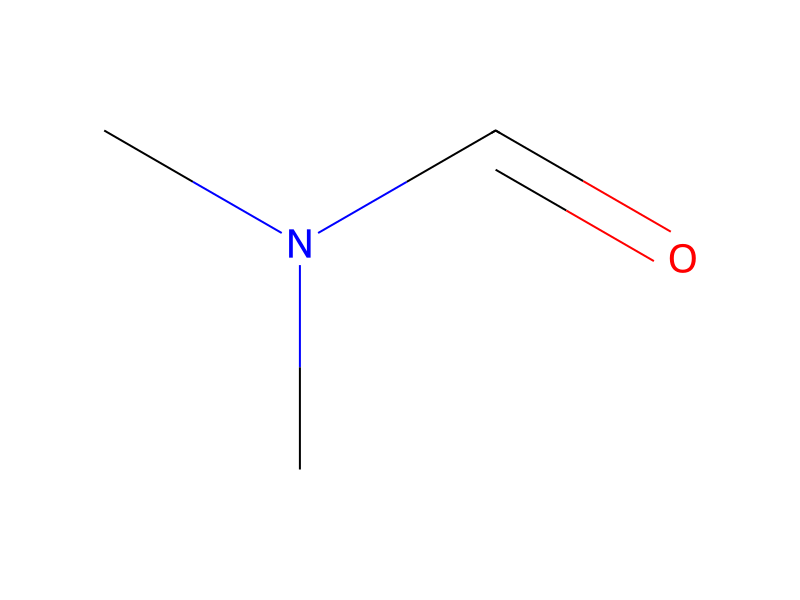
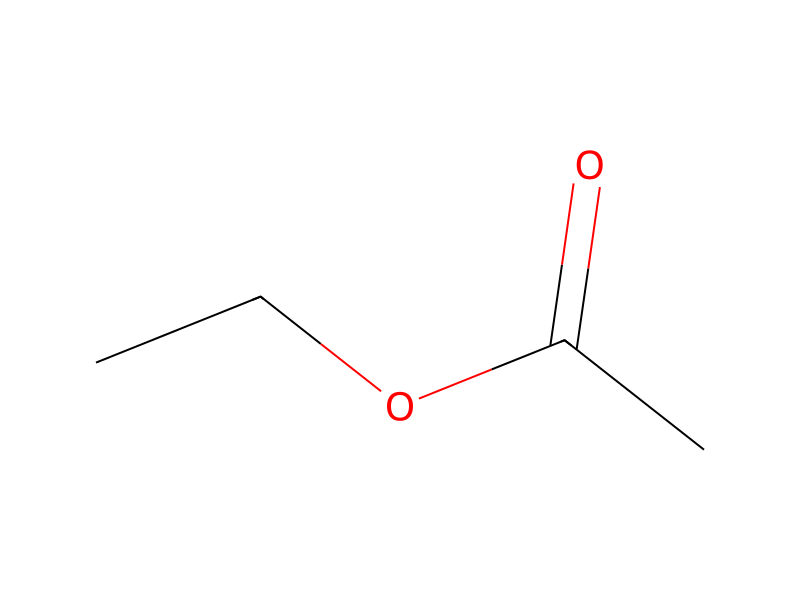
Reagents, catalysts & solvents 2
Procedure
21 mg of pyrazine-2-carboxylic acid, 52 mg of hydroxybenzotriazole and 52 mg of 1-(3-dimethylaminopropyl)-3-ethylcarbodiimide monohydride were added to a dimethylformamide (2 ml) solution of 72 mg of 4-(2-cyano-phenoxy)-5-(6-methanesulfonyl-pyridin-3-yloxy)-benzene-1,2-diamine obtained in Example 196 (step 5), and the reaction liquid was stirred at room temperature for 1 hour. The reaction liquid was diluted with ethyl acetate, washed with aqueous saturated sodium bicarbonate, water and saturated saline in order, and dried with anhydrous sodium sulfate. The solvent was evaporated away under reduced pressure, and the resulting residue was dissolved in 1 ml of N-methylpyrrolidinone, and 20 mg of ytterbium trifluoromethanesulfonate was added to it, and the reaction liquid was stirred at 160° C. for 2 h ours. The reaction liquid was diluted with ethyl acetate, washed with aqueous saturated sodium bicarbonate and saturated saline in order, and dried with anhydrous sodium sulfate. The solvent was evaporated away under reduced pressure, and the resulting residue was purified through silica gel column chromatography (developing solvent: chloroform/methanol=30/1) and through partitioning thin-layer chromatography (Kieselgel™ 60F254, Art 5744 (by Merck), chloroform/methanol=10/1) to obtain the entitled compound as a brown solid.
Workup
- customthe reaction liquid
- customThe reaction liquid
- washwashed with aqueous saturated sodium bicarbonate, water and saturated saline in order
- dry with materialdried with anhydrous sodium sulfate
- customThe solvent was evaporated away under reduced pressure
- dissolutionthe resulting residue was dissolved in 1 ml of N-methylpyrrolidinone
- addition20 mg of ytterbium trifluoromethanesulfonate was added to it
- customthe reaction liquid
- stirringwas stirred at 160° C. for 2 h ours
- customThe reaction liquid
- washwashed with aqueous saturated sodium bicarbonate and saturated saline in order
- dry with materialdried with anhydrous sodium sulfate
- customThe solvent was evaporated away under reduced pressure
- customthe resulting residue was purified through silica gel column chromatography (developing solvent: chloroform/methanol=30/1)
- customthrough partitioning thin-layer chromatography (Kieselgel™ 60F254, Art 5744 (by Merck), chloroform/methanol=10/1)
Sources & evidence
- ORD record
- ord-b0457459d64b4664b6ce4025aaac386e
- Source dataset
- uspto-grants-2010_06
- Patent number
- US07728025B2
Reaction notes
Loading…