6-Aminohexanoic Acid → Cyclohexanone Oxime
Reaction equation

[C:1]1(=[O:8])[NH:7][CH2:6][CH2:5][CH2:4][CH2:3][CH2:2]1.[NH2:9][CH2:10][CH2:11][CH2:12][CH2:13][CH2:14][C:15](O)=O>>[C:1]1(=[O:8])[NH:7][CH2:6][CH2:5][CH2:4][CH2:3][CH2:2]1.[C:10]1(=[N:9][OH:8])[CH2:15][CH2:14][CH2:13][CH2:12][CH2:11]1Participants


Procedure
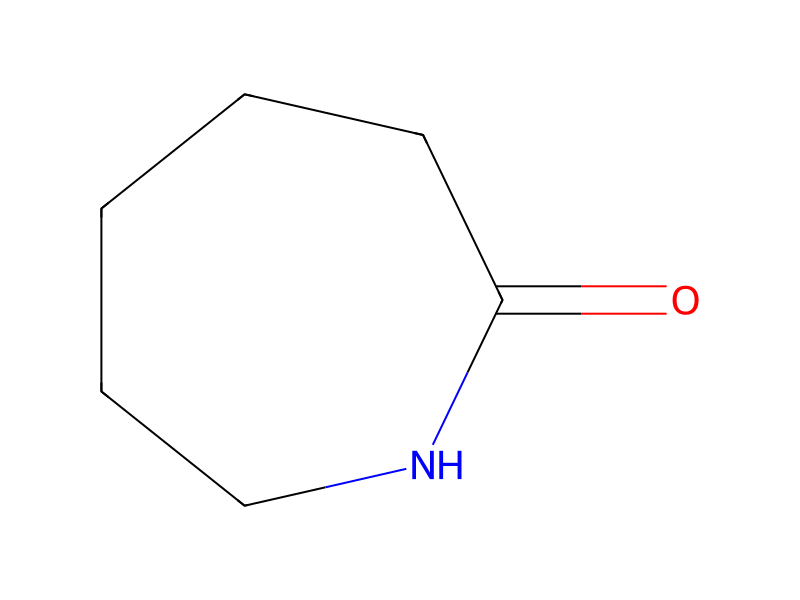
ε-Caprolactam is a precursor for the preparation of Nylon-6. Nylon-6 was first made in 1899 by heating 6-aminohexanoic acid. Commercially feasible synthesis from ε-caprolactam (CL) was discovered by Paul Schlack at I. G. Farbenindustrie in 1938. Currently, approximately 95 wt % of the world's ε-caprolactam is produced from cyclohexanone oxime via the Beckmann rearrangement. The starting material for cyclohexanone can be cyclohexane, phenol, or benzene. Then, through a series of reductions and/or oxidations, cyclohexanone is formed. The latter is then reacted with a hydroxylamine salt, usually the sulfate, to form the oxime and ammonium sulfate. The oxime is rearranged in concentrated sulfuiric acid, and the resulting lactam sulfate salt is neutralized with ammonia to form ε-caprolactam and more ammonium sulfate. Subsequently, pure ε-caprolactam is obtained by a number of separation and purification steps. Currently, this process is extremely capital intensive and generates large quantities of waste.
Sources & evidence
- ORD record
- ord-f636124140a941a087578111c7155e79
- Source dataset
- uspto-grants-2008_06
- Patent number
- US07390897B2
Reaction notes
Loading…