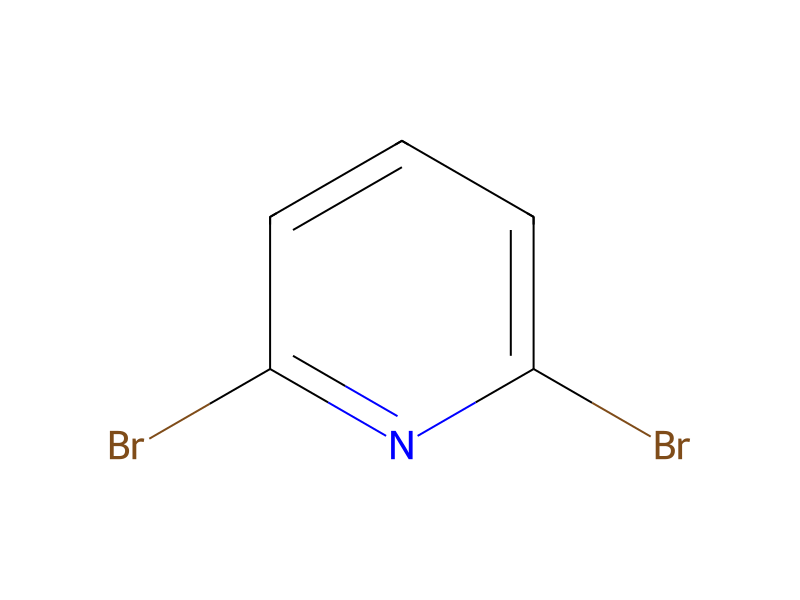
2,6-Dibromopyridine → 2-Bromo-6-(4-bromo-2,6-difluorobenzyl)pyridine
Reaction equation

[Br:1][C:2]1[CH:3]=[C:4]([F:11])[C:5]([CH2:9]Br)=[C:6]([F:8])[CH:7]=1.[Br:12][C:13]1[CH:18]=[CH:17][CH:16]=[C:15](Br)[N:14]=1>C1COCC1.[Zn].C1COCC1.C1C=CC([P]([Pd]([P](C2C=CC=CC=2)(C2C=CC=CC=2)C2C=CC=CC=2)([P](C2C=CC=CC=2)(C2C=CC=CC=2)C2C=CC=CC=2)[P](C2C=CC=CC=2)(C2C=CC=CC=2)C2C=CC=CC=2)(C2C=CC=CC=2)C2C=CC=CC=2)=CC=1>[Br:12][C:13]1[CH:18]=[CH:17][CH:16]=[C:15]([CH2:9][C:5]2[C:4]([F:11])=[CH:3][C:2]([Br:1])=[CH:7][C:6]=2[F:8])[N:14]=1Participants
Reactant 2

Product 1

Reagents, catalysts & solvents 3



Procedure
To a solution of 5-bromo-2-(bromomethyl)-1,3-difluorobenzene (from Step B above, 18.5 g, 65.17 mmol) in THF (400 mL) was added 100 mL of Zn/THF solution (5 g Zn/100 mL, 76.46 mmol) at 0° C. The mixture was warmed to room temperature and stirred for 30 minutes. To this reaction was added 2,6-dibromo pyridine (15.44 g, 65.17 mmol) and tetrakis(triphenylphosphine)palladium (7.51 g, 6.51 mmol), and heated to 90° C. for 1 hr. The reaction was monitor by LCMS. After cooling to room temperature, the reaction was quenched with aqueous NH4Cl, and diluted with EtOAc. The organic layer was washed with water (3×), brine (3×), dried over MgSO4, and condensed in vacuo to yield a yellow oil. The crude residue was purified via silica gel chromatography to give the title compound (16 g).
Workup
- temperatureheated to 90° C. for 1 hr
- temperatureAfter cooling to room temperature
- customthe reaction was quenched with aqueous NH4Cl
- additiondiluted with EtOAc
- washThe organic layer was washed with water (3×), brine (3×)
- dry with materialdried over MgSO4, and condensed in vacuo
- customto yield a yellow oil
- customThe crude residue was purified via silica gel chromatography
Sources & evidence
- ORD record
- ord-287e55e370ad45f8816117eab73ab0fc
- Source dataset
- uspto-grants-2011_02
- Patent number
- US07879875B2
Reaction notes
Loading…