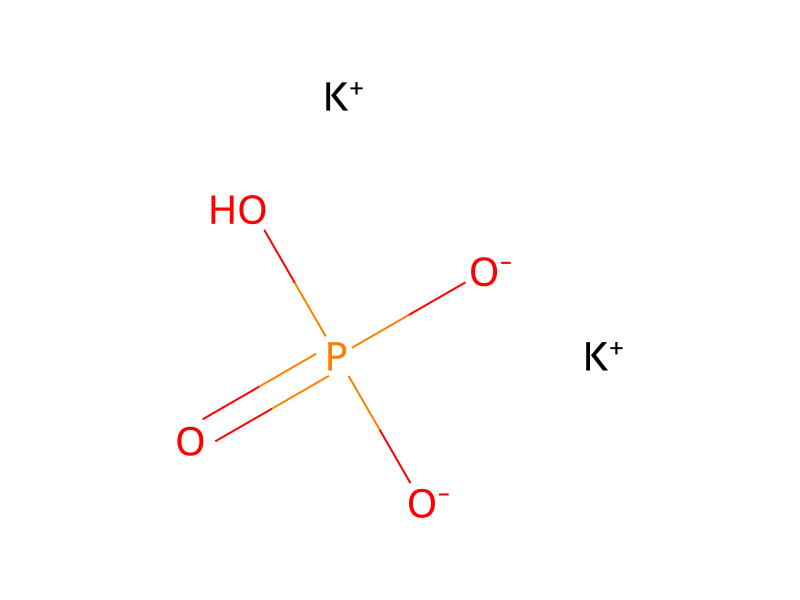
Potassium Phosphate, Dibasic → 5-(4-Methoxy-phenyl)-benzofuran-7-carbaldehyde
Reaction equation

[CH3:1][O:2][C:3]1[CH:8]=[CH:7][C:6]([C:9]2[CH:10]=[C:11]([CH3:18])[C:12]3[O:16][CH:15]=[CH:14][C:13]=3[CH:17]=2)=[CH:5][CH:4]=1.C1C(=O)N(Br)C(=[O:22])C1.OP([O-])([O-])=O.[K+].[K+]>C(Cl)(Cl)(Cl)Cl.CC(N=NC(C#N)(C)C)(C#N)C>[CH3:1][O:2][C:3]1[CH:8]=[CH:7][C:6]([C:9]2[CH:10]=[C:11]([CH:18]=[O:22])[C:12]3[O:16][CH:15]=[CH:14][C:13]=3[CH:17]=2)=[CH:5][CH:4]=1Participants
Reactant 3


Product 1

Reagents, catalysts & solvents 2


Procedure
To a solution of 5-(4-methoxyphenyl)-7-methyl-benzofuran (1.60 g, 2.83 g 1:1 ratio with 4-methoxy-biphenyl 6.72 mmol) in carbon tetrachloride (190 ml) was added NBS (1.32 g, 7.40 mmol) and AIBN (50 mg). The solution was brought to reflux for 2 h, cooled to room temperature, and the solids were filtered off. The solution was then concentrated and anhydrous CH3CN (80 ml) was added. Then potassium benzeneselenite (2.14 g, 9.41 mmol), and K2HPO4 (1.17 g, 6.72 mmol) were added and then reaction was heated to reflux for 1 h after which it was allowed to cool to room temperature. The solution was then passed through a silica plug and concentrated under high vacuum. Chromatography (100% CH2Cl2) afforded 850 mg (50%) product as a white solid: mp 94–95° C.; 1H NMR (300 MHz, DMSO-d6): δ 3.82 (3H, s), 7.08 (2H, d, J=8.8 Hz), 7.14 (1H, d, J=2.2 Hz), 7.71 (2H, d, J=8.8 Hz), 8.10 (1H, d, J=1.9 Hz), 8.21 (1H, d, J=2.2 Hz), 8.25 (1H, d, J=1.9 Hz), 10.37 (1H, s); MS (ESI) m/z 253 ([M+H]+).
Workup
- temperatureto reflux for 2 h
- filtrationthe solids were filtered off
- concentrationThe solution was then concentrated
- additionanhydrous CH3CN (80 ml) was added
- customreaction
- temperaturewas heated
- temperatureto reflux for 1 h after which it
- temperatureto cool to room temperature
- concentrationconcentrated under high vacuum
Sources & evidence
- ORD record
- ord-af8f9388d9d640ec8835d587aa4c0212
- Source dataset
- uspto-grants-2007_01
- Patent number
- US07157491B2
Reaction notes
Loading…